Securing adult-gerontology primary care rotations across Texas
Texas is a restricted-practice state and, at its scale, really several primary care regions rather than one. Houston, Dallas and Fort Worth, San Antonio, and Austin hold most of the clinic density, with El Paso, the Rio Grande Valley, and a vast rural interior filling in the rest. Your AGPCNP hours here sit in adult and internal medicine clinics, community health centers, and the long-term-care and home-based settings that a fast-aging population leans on, and we help you secure them when your program hands you the search.
Tell us your school and city. It is free to ask, with no obligation.
Texas trains across metros, the border, and a rural interior
Texas holds most of its adult primary care in the big metros. Houston, the Dallas and Fort Worth area, San Antonio, and Austin carry the densest supply of internal medicine and family medicine practices, adult chronic-disease clinics, and multispecialty groups with adult panels. El Paso anchors the far west, and the Rio Grande Valley carries a large, fast-growing, and underserved population along the border. The rest of the state is a wide rural interior where primary care is thin.
For an AGPCNP student, your region usually decides where your ambulatory hours begin. The settings that host adult-gerontology primary care rotations in Texas include:
- Adult and internal medicine primary care in the metro clinic groups
- Community health centers serving the border, the metros, and rural counties, the great majority of which are federally designated shortage areas
- Geriatrics and long-term care in nursing facilities, assisted living, PACE programs for older adults, and home-based primary care
- Specialty primary care in endocrinology, cardiology, and nephrology used for chronic-disease continuity
An aging population, and where the geriatric hours are
Texas is young overall, but its older population is large and growing fast, and it does not sit only in the cities. Retirement counties in the Hill Country, stretches of the coast, and the edges of the metros concentrate older adults, while the Rio Grande Valley carries heavy chronic-disease burden across all ages. That demand loads the geriatric and long-term-care end of the AGPCNP arc.
The settings that carry it are nursing facilities, assisted living residences, PACE programs that keep frail elders in the community, and home-based primary care practices. Genuine frail-elder hours usually come from one of these, not from a general adult clinic, so building that into your plan is what makes a Texas rotation credible across the full range.
Restricted practice and the prescriptive authority agreement
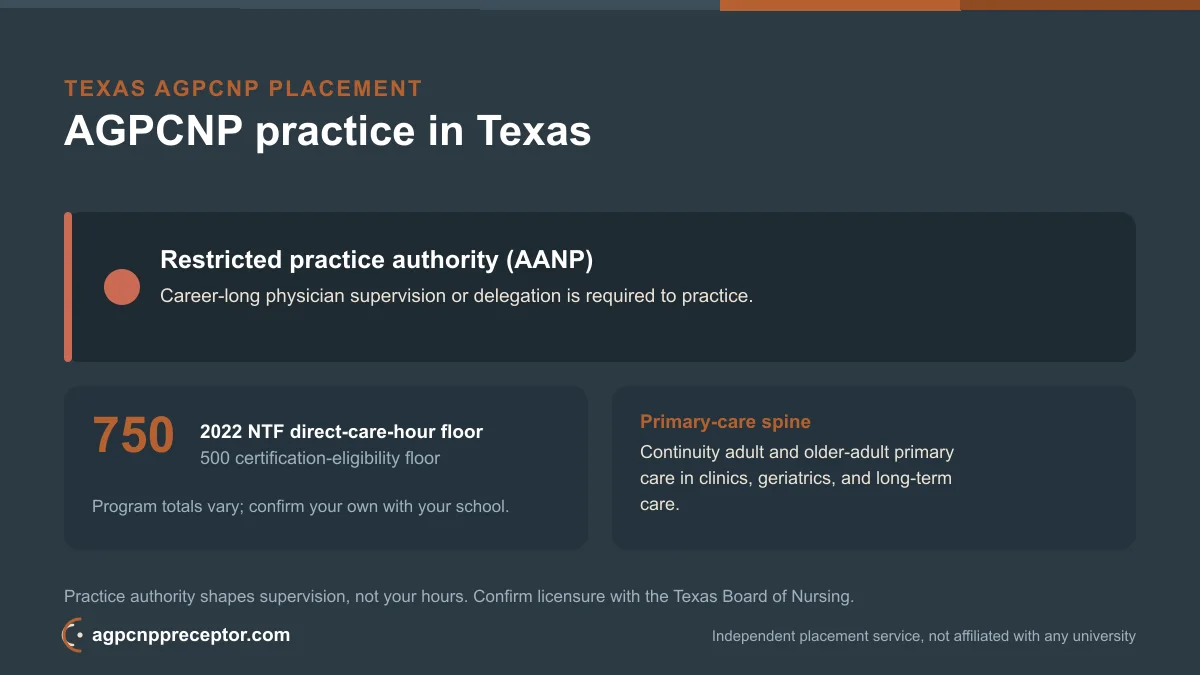
Texas is a restricted-practice state. A nurse practitioner prescribes under a prescriptive authority agreement with a delegating physician, with defined chart review, periodic meetings, and, in most settings, a geographic limit on how far the practice can sit from the physician. The Texas Board of Nursing publishes the current terms, so confirm them there before relying on any summary.
For your rotation, this shapes the supervision arrangement, not the qualifications you need in a teacher. Your preceptor can be a board-certified adult-gerontology or family primary care nurse practitioner working within that agreement, or a physician in internal medicine, family medicine, or geriatrics, licensed in Texas and practicing where you rotate.
Distance, shortage areas, and student travel
The great majority of Texas counties are federally designated primary care shortage areas, and much of the state sits hours from a large clinic hub. That concentrates preceptor supply in the metros and the border cities, and it means students from rural counties, the Panhandle, or west Texas often relocate for a block to reach a clinic or long-term-care site with capacity.
It cuts both ways. The continuity, chronic-disease, and geriatric hours you need are genuinely available in the metros and border regions, but reaching them takes planning. Building travel and housing into your schedule early keeps a rotation from slipping.
The AGPCNP hours hardest to secure here
Even in a state this large, the scarce piece is predictable. Because so much adult care sits in general primary care, dedicated geriatrics and long-term-care time with a preceptor who will sign for it is the hardest block to arrange. A family or internal medicine office can usually cover continuity and chronic-disease hours; a committed geriatrics, nursing-home, or PACE preceptor is the harder find.
That capacity competes with residents and other students in the academic metros, so locking it early is what keeps your clinical hours on schedule.
How we place AGPCNP students in Texas
We source and vet adult-gerontology primary care preceptors, then carry the affiliation-agreement paperwork that stalls most students. Tell us your metro or region, your program, and the mix of continuity, chronic-disease, and geriatric hours you still need, and we build a plan around the nearest clinic engine and any regional center or long-term-care site within reach. Review the pricing, then start with the match form on this page. We match first, so you know the site and preceptor are real before anything is due.
Good to know
Is AGPCNP placement harder because Texas is restricted?
Less than students fear. The prescriptive authority agreement mostly affects how the practice is organized and documented, not your daily learning. A board-certified adult-gerontology or family primary care NP can still precept you within that agreement, as can a physician in adult or geriatric primary care. Credentialing and clinic capacity are the real hurdles, and those are the work we handle.
Which Texas regions have the most primary care capacity?
Houston, the Dallas and Fort Worth area, San Antonio, and Austin hold the densest adult and internal medicine supply and the chronic-disease clinics used for continuity, with El Paso and the Rio Grande Valley anchoring the border. Most rural counties are designated shortage areas, so students there often travel to a hub.
Where do the geriatric hours come from in Texas?
Usually from nursing facilities, assisted living, PACE programs, or home-based primary care rather than a general clinic. Retirement counties in the Hill Country and along the coast, plus the aging edges of the metros, concentrate that demand. Dedicated geriatrics is the block we prioritize early, since it is the scarcest.
Can a physician be my AGPCNP preceptor in Texas?
Yes. A Texas-licensed physician in internal medicine, family medicine, or geriatrics can precept, as can a board-certified adult-gerontology or family primary care nurse practitioner. Your program sets the final requirements, so we verify eligibility against your school's rules before you commit.
How many clinical hours will I need?
The 2022 NTF Standards recommend at least 750 direct patient care hours, while AANP and ANCC certification eligibility requires at least 500 supervised hours. Many programs publish totals from roughly 500 to 750 or more, and some sit below 750, so confirm your own program's number. Simulation does not count.
Secure both ends of the arc, not just one
Tell us your school, your city, and the hours you still need across the continuum. We will come back with a plan that reaches from continuity primary care to genuine frail-elder exposure, and a realistic path to placed.