Long-Term Care Rotation Placement for AGPCNP Students
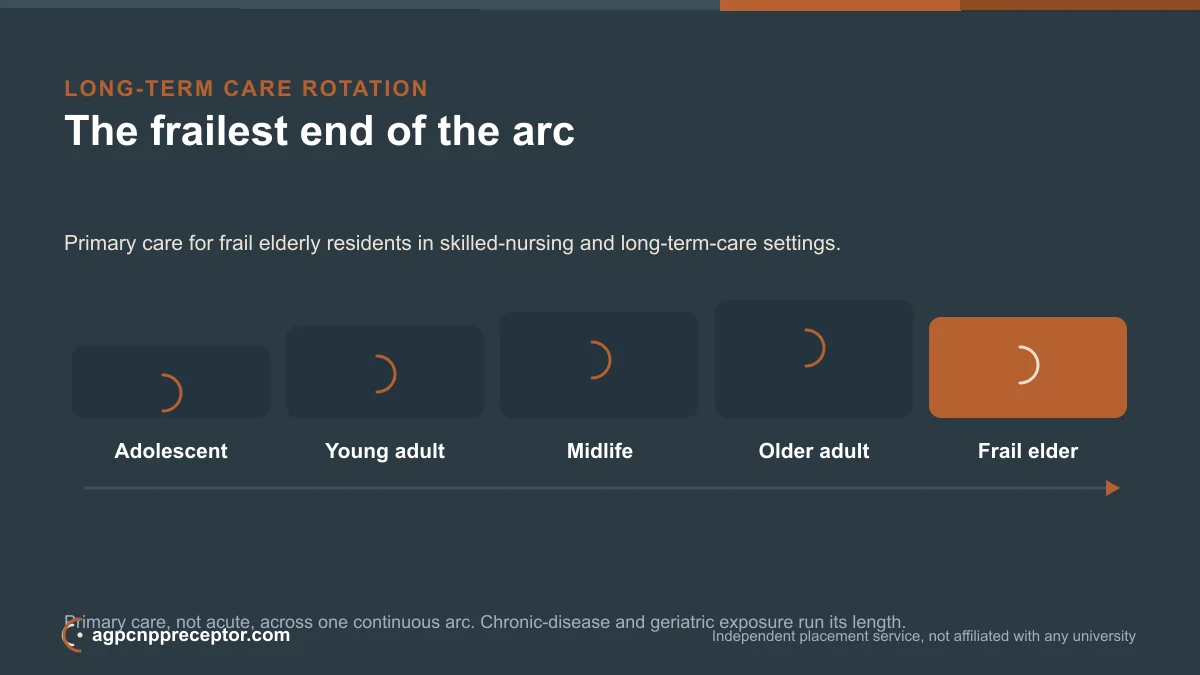
The long-term care rotation sits at the frailest end of the Adult-Gerontology Primary Care NP arc, and it is often the single hardest placement to arrange alone. This is primary care for frail elderly residents in skilled-nursing facilities and long-term-care settings, a population with dense comorbidity, functional decline, and care that has to be coordinated across a whole facility. Few of these settings are set up to precept students, which is exactly why we make them a focus. We are an independent placement service that works separately from any university. This page explains what a long-term-care rotation asks of an AGPCNP student and how we secure a qualified preceptor and an approved frail-elder site so this rotation does not hold up your program.
Tell us your school and city. It is free to ask, with no obligation.
What does a long-term care rotation involve for an AGPCNP?
Long-term care is primary care delivered where frail elderly residents live: skilled-nursing facilities, long-term-care and rehabilitation settings, and similar residential environments. The clinical work is continuity primary care under real complexity, managing multiple chronic conditions at once, reconciling and deprescribing medications, assessing cognition and function, addressing falls and frailty, and coordinating goals of care with families and the facility team.
For an AGPCNP, this rotation delivers the frail-elder exposure the credential is named for, at the far end of the same arc that begins with young-adult continuity care. It is the population that separates adult-gerontology from a purely adult scope, and most programs want authentic hours here, not a token visit or two.
The exact number of long-term-care or geriatric hours your program wants is set by your school, not by a single national figure. What is consistent is that this frail-elder exposure is expected, and that the setting and preceptor have to be approved before you start logging hours.
How do long-term care hours fit the national standard?
Your total clinical hours are anchored to a national standard. The 2022 NTF Standards for Quality NP Education, published by AACN, set a minimum of 750 direct patient care clinical hours per NP track, replacing the older 500-hour standard that now serves only as the AANP and ANCC certification-eligibility floor. Because the 750-hour standard is still phasing in across schools, total AGPCNP clinical hours typically run from roughly 500 to 750 or more.
The long-term-care rotation is one slice of that total, part of the gerontology exposure required across the arc. Programs allocate hours differently between general adult primary care, geriatric clinic time, and frail-elder settings, so there is no universal long-term-care hour count. Simulation does not count toward direct patient care hours. Confirm your program's exact allocation with your school, and we place to it.
Our clinical hours page lays out the full hour standard and the table behind it.
Who can precept a long-term care rotation?
The preceptor for a frail-elder rotation generally has to be a provider delivering primary care in the long-term-care or skilled-nursing setting whom your program will accept. Subject to your school's rules, that usually means:
- An Adult-Gerontology Primary Care NP (A-GNP or AGPCNP-BC) covering a facility panel
- A Family Nurse Practitioner practicing substantial long-term-care primary care
- A physician (MD or DO) in geriatrics or internal medicine who serves the facility
Because many facilities have not precepted before, part of our job is confirming not only that the preceptor is eligible but that the site can support a student at all. We verify eligibility against your program's requirements and prepare the site for approval before you commit. See our preceptor requirements guide for the full picture.
How do we secure your long-term care placement?
This is the scarcest end of the arc, so we start it first and search wide. You tell us your school, your city, and the frail-elder hours you still need, and we source a skilled-nursing or long-term-care setting and a qualified preceptor near you, well ahead of your rotation dates.
- Real frail-elder panels. We target settings where residents receive ongoing primary care, so the exposure is authentic.
- Site readiness. We confirm the facility can actually host a student, not just that a provider is eligible.
- Eligibility verified. We check each preceptor against your program's rules before you commit.
- Approval-ready and early. Long-term-care placements take the longest to arrange, so we begin the search ahead of everything else.
Final approval of any site or preceptor rests with your university, not with us, and we do not act for any school. We do not guarantee hours, grades, certification, or outcomes, and nothing here is a tuition refund. See how it works, or start on the find a preceptor page. This rotation pairs with the broader geriatrics rotation at the elder end of your arc.
Good to know
Do AGPCNP students have to complete long-term care hours?
Most AGPCNP programs require authentic frail-elder or geriatric exposure as part of the gerontology end of the arc, and long-term-care and skilled-nursing settings are a common way to meet it. The exact hours are set by your school. Confirm your program's requirement, and we place to it.
How many long-term care hours does an AGPCNP need?
There is no single national long-term-care hour count. Total AGPCNP direct patient care hours run from roughly 500 to 750 or more, anchored to the 2022 NTF minimum of 750 hours per NP track and the older 500-hour certification-eligibility floor. Your program decides how those hours split between adult primary care, geriatric clinic time, and frail-elder settings. Confirm the split with your school.
Why are long-term care placements the hardest to secure?
Skilled-nursing and long-term-care facilities are fewer, and many have never precepted students, so both the preceptor and the site have to be prepared. That scarcity is why we start this search first and search widely, and why the frail-elder end is a focus of our sourcing.
Are you affiliated with my university?
No. We are an independent placement service that works separately from any university or certification body. We help AGPCNP students at any school secure a qualified long-term-care preceptor and an approved site; final approval always rests with the university.
Secure both ends of the arc, not just one
Tell us your school, your city, and the hours you still need across the continuum. We will come back with a plan that reaches from continuity primary care to genuine frail-elder exposure, and a realistic path to placed.