Adult Primary Care Rotation Placement for AGPCNP Students
The adult primary care rotation is the continuity backbone of an Adult-Gerontology Primary Care Nurse Practitioner program. It is where you build the longitudinal, non-emergent skills the credential is named for, in a family-medicine or internal-medicine clinic that carries a steady adult panel from young adults through midlife. It also tends to be the largest single block of hours you owe, so if it slips, your whole timeline slips. We are an independent placement service that works separately from any university. This page explains what an AGPCNP adult primary care rotation actually asks of you, how it fits the national clinical-hour standard, and how we secure a qualified preceptor and an approved continuity site so this rotation runs on schedule.
Tell us your school and city. It is free to ask, with no obligation.
What does an AGPCNP adult primary care rotation involve?
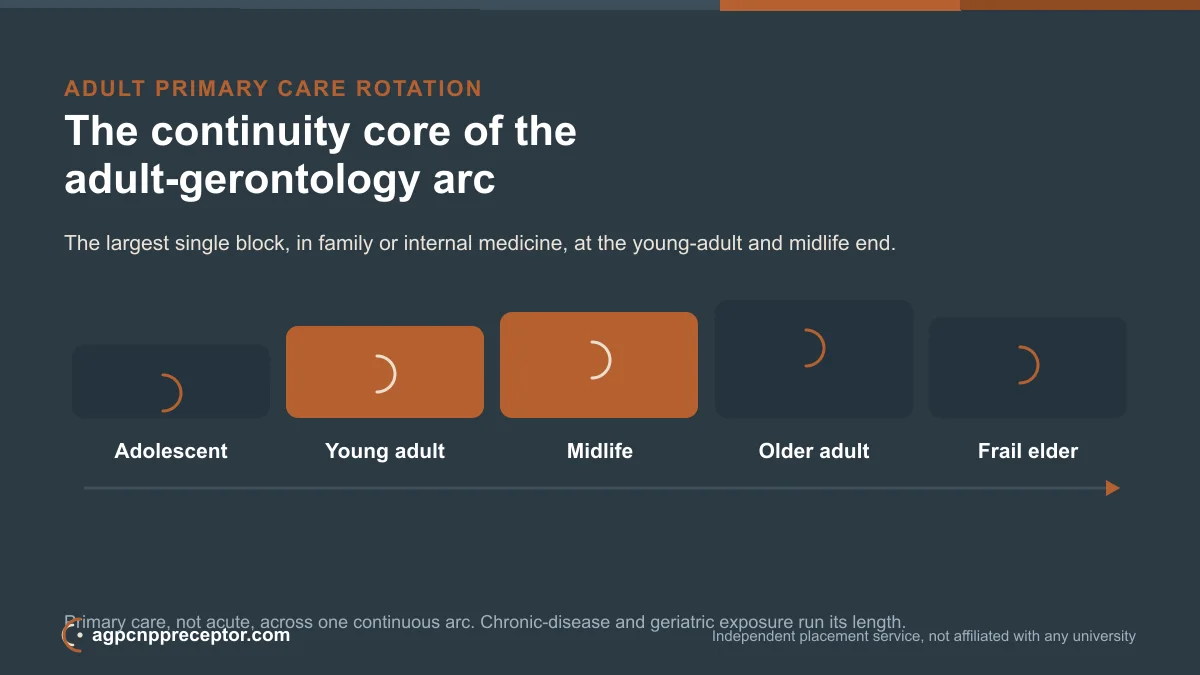
Adult primary care is the continuity end of the adult-gerontology arc. In practice that means an ambulatory clinic where the same patients return over time, so you carry a panel, follow chronic conditions, order and interpret routine diagnostics, adjust medications, and practice health promotion and prevention rather than episodic urgent care. Family medicine and internal medicine outpatient clinics are the two settings that most reliably provide this volume.
Because AGPCNP is longitudinal by design, this rotation is not about a single visit type. You are expected to see the working-age adult across reasons for visit, from a routine physical to a new complaint to a stable chronic-disease follow-up. The point of the continuity block is repetition: enough patient encounters, spread across enough visit types, that you develop independent primary-care judgment.
This rotation typically supplies a large share of an AGPCNP student's total direct patient care hours, but there is no single national number that is right for every school. Your program sets the exact allocation, and we place to it.
How many hours does the adult primary care block usually take?
Clinical hours are governed by a national standard, not a guess. The 2022 NTF Standards for Quality NP Education, published by AACN, set a minimum of 750 direct patient care clinical hours per NP track. That figure replaced the older 500-hour standard, which now survives only as the AANP and ANCC certification-eligibility floor. Because the 750-hour standard is still phasing in across schools, total AGPCNP clinical hours typically run from roughly 500 to 750 or more, depending on the university and the enrollment year.
| Benchmark | Hours | Source |
|---|---|---|
| 2022 national minimum | 750 direct patient care hours per NP track | NTF Standards for Quality NP Education (AACN) |
| Certification-eligibility floor | 500 faculty-supervised clinical hours | AANP and ANCC |
| Typical AGPCNP total | roughly 500 to 750 or more | Varies by university; confirm yours |
Within that total, the adult primary care rotation is usually the single largest continuity block, with the balance going to geriatrics, chronic-disease management, and other required exposures. Simulation does not count toward direct patient care hours. Confirm the exact split for your program with your school, because your graduation is governed by the requirements you enrolled under.
Who can precept an adult primary care rotation?
The preceptor for a continuity adult primary care block generally has to be a licensed provider practicing adult primary care whom your program will accept. In practice that usually means one of the following, subject to your school's rules:
- An Adult-Gerontology Primary Care NP (A-GNP or AGPCNP-BC) practicing in an ambulatory clinic
- A Family Nurse Practitioner, whose scope covers the adult population
- A physician (MD or DO) in family medicine or internal medicine primary care
Beyond credential, the practical requirement is patient volume and continuity: a preceptor and site that can keep you busy with the kind of adult panel your program wants you to see. We verify each preceptor's eligibility against your school's requirements and confirm the site can supply the volume before you commit, so a rotation is not disqualified after the fact. Our preceptor requirements guide covers eligibility in full.
How do we secure your adult primary care placement?
Most AGPCNP programs are online and do not assign placements, so the continuity search lands on you. That is the piece we take off your plate. You tell us your school, your city, and the hours you still need, and we source a family-medicine or internal-medicine continuity clinic and a qualified preceptor near you, early enough that the placement is settled before the rotation begins.
- Location and volume first. We search your area for ambulatory primary-care clinics that carry the adult panel and patient volume your program expects.
- Eligibility verified. We confirm each preceptor against your school's rules before you commit.
- Affiliation-agreement ready. We shepherd the paperwork your program and the site need before you start logging hours.
- On your timeline. We aim to have the placement in hand before the rotation, not during it.
Final approval of any site or preceptor rests with your university, not with us, and we do not act for any school. We do not guarantee hours, grades, certification, or program outcomes, and nothing here is a tuition refund. See how it works, or start on the find a preceptor page. When you also need the elder end of the arc, our geriatrics rotation guide explains that half.
Good to know
How many hours is the AGPCNP adult primary care rotation?
There is no single national number for the adult primary care block on its own. Total AGPCNP direct patient care hours run from roughly 500 to 750 or more, anchored to the 2022 NTF minimum of 750 hours per NP track and the older 500-hour AANP and ANCC certification-eligibility floor. The continuity adult primary care rotation is usually the largest single block within that total. Confirm your program's exact allocation with your school.
What kind of clinic counts for an AGPCNP adult primary care rotation?
A family-medicine or internal-medicine outpatient clinic that carries a continuity adult panel is the typical setting, because it supplies the longitudinal, non-emergent volume the credential is built on. Urgent care and inpatient settings generally do not substitute for the continuity requirement. Your program approves the site, and we source clinics that fit that intent.
Who can precept my adult primary care rotation?
Generally an Adult-Gerontology Primary Care NP, a Family Nurse Practitioner, or a physician (MD or DO) in family medicine or internal medicine, subject to your program's rules. We verify each preceptor's eligibility against your school's requirements before you commit.
Are you affiliated with my university?
No. We are an independent placement service that works separately from any university or certification body. We help AGPCNP students at any school find and secure a qualified preceptor and an approved site; final approval always rests with the university.
Secure both ends of the arc, not just one
Tell us your school, your city, and the hours you still need across the continuum. We will come back with a plan that reaches from continuity primary care to genuine frail-elder exposure, and a realistic path to placed.