How Many Clinical Hours Does an AGPCNP Program Require?
Clinical hours are the number every Adult-Gerontology Primary Care NP student wants pinned down, and the honest answer is a range anchored to a national standard, not a single figure. The 2022 NTF Standards for Quality NP Education, published by AACN, set a minimum of 750 direct patient care clinical hours per NP track, replacing an older 500-hour standard that now survives only as the AANP and ANCC certification-eligibility floor. Because the 750-hour standard is still phasing in, total AGPCNP clinical hours typically run from roughly 500 to 750 or more, depending on your school and your enrollment year. We are an independent placement service that works separately from any university or certification body. This page lays out exactly what the standard says, why you see two different numbers, and how the hours distribute across the adult-gerontology arc.
Tell us your school and city. It is free to ask, with no obligation.
What is the national AGPCNP clinical-hour standard?
There are two numbers in circulation, and the difference between them is the source of most of the confusion.
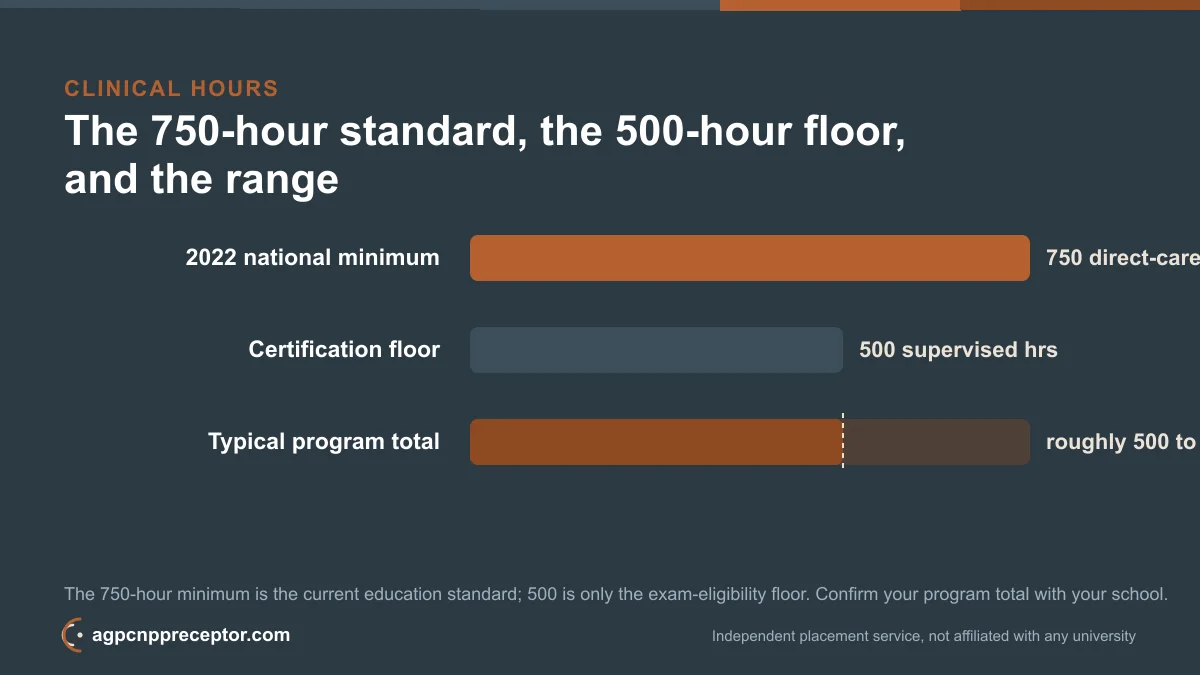
| Benchmark | Hours | Source |
|---|---|---|
| 2022 national minimum | 750 direct patient care hours per NP track | NTF Standards for Quality NP Education (AACN) |
| Certification-eligibility floor | 500 faculty-supervised clinical hours | AANP and ANCC |
| Typical program range | roughly 500 to 750 or more total | Varies by university; confirm yours |
The 750-hour figure is the current national education standard: the 2022 NTF Standards for Quality NP Education set a minimum of 750 direct patient care clinical hours per NP track. The older 500-hour figure is not the education standard; it is the certification-eligibility floor used by the AANP Certification Board and the ANCC, the minimum supervised hours needed to sit the exam. A program can meet the 500-hour certification floor and still fall short of the 750-hour education standard, which is why you see both numbers.
Because the 750-hour standard is still phasing in across accredited programs, the practical reality today is a range. Confirm the exact figure for your program with your school, because your graduation is governed by the requirements you enrolled under.
Why do I see both 500 and 750 hours?
The short version: 500 is the number you need to be allowed to certify, and 750 is the number the national education standard now expects your program to require. They come from different bodies for different purposes.
The 500-hour figure has long been the certification-eligibility minimum: to sit the A-GNP exam through the AANP Certification Board, or the AGPCNP-BC exam through the ANCC, a program must include at least 500 faculty-supervised direct-care clinical hours. That floor has not gone away.
The 750-hour figure is newer and higher. The 2022 NTF Standards raised the education expectation to a minimum of 750 direct patient care hours per NP track, and accreditors are moving programs toward it over time. So a modern AGPCNP program is being pushed to require 750, while the certification bodies still only insist on 500. The result you should plan around is a range from roughly 500 to 750 or more, with your school's specific requirement as the number that governs you.
How do AGPCNP hours distribute across the arc?
Total hours are one question; how they spread across the adult-gerontology span is another. AGPCNP is longitudinal, non-emergent primary care from late adolescence, roughly age 13, through the frail elderly, so your hours have to reach both ends of that arc, not pile up in one clinic.
In practice that usually means a large continuity block in adult primary care, a required block of geriatric or gerontology exposure, chronic-disease management woven through both, and often authentic frail-elder or long-term-care time. Programs set the exact split, and it varies, so there is no universal breakdown. What is consistent is that you need genuine exposure across the population span, which is why lining up a single continuity clinic is rarely enough on its own.
- Adult primary care continuity, the largest block, in family or internal medicine
- Geriatrics and gerontology, older-adult primary care
- Chronic-disease management, woven through the continuity blocks
- Frail-elder or long-term-care exposure, the scarcest to arrange
One more detail that matters for the count: simulation does not count toward direct patient care hours, and precepted telehealth may, subject to your program. Confirm both with your school.
How do we place your hours to your program's target?
The number only helps if you can actually accumulate it. Because most AGPCNP programs are online and do not assign placements, the search for preceptors and sites across the whole arc lands on you. That is what we take on.
- We place to your program's number. We confirm your school's exact hour requirement first, then source to it.
- We cover the whole arc. Continuity adult primary care and genuine geriatric or long-term-care exposure, not just the easy end.
- We verify eligibility. Each preceptor checked against your program's rules, then the affiliation agreement.
- We start early. The scarce geriatric and long-term-care hours get the longest runway.
Final approval of any site or preceptor rests with your university, not with us, and we do not act for any school. We do not guarantee hours, grades, certification, or outcomes, and nothing here is a tuition refund. See how it works, or start on the find a preceptor page.
Good to know
How many clinical hours does an AGPCNP program require?
The 2022 NTF Standards for Quality NP Education, published by AACN, set a minimum of 750 direct patient care clinical hours per NP track, up from the older 500-hour standard that still serves as the AANP and ANCC certification-eligibility floor. Because the standard is still phasing in, total AGPCNP clinical hours typically run from roughly 500 to 750 or more. Confirm your program's exact requirement with your school.
Why is the AGPCNP hour requirement sometimes listed as 500?
The 500-hour figure is the certification-eligibility floor set by the AANP Certification Board and the ANCC, the minimum supervised hours needed to sit the exam. It is not the education standard. The 2022 NTF Standards raised the education expectation to a minimum of 750 direct patient care hours per NP track. A program can meet 500 and still be moving toward 750, which is why both numbers appear.
Do simulation hours count toward AGPCNP clinical hours?
No. Simulation does not count toward the direct patient care clinical hours the standard requires. Precepted telehealth may count, subject to your program. Confirm both with your school, since programs apply these rules differently.
Are you affiliated with a university or certification body?
No. We are an independent placement service that works separately from any university or certification body. We help AGPCNP students at any school find and secure the preceptors and sites they need to reach their program's hour requirement; final approval always rests with the university.
Secure both ends of the arc, not just one
Tell us your school, your city, and the hours you still need across the continuum. We will come back with a plan that reaches from continuity primary care to genuine frail-elder exposure, and a realistic path to placed.