Geriatrics Rotation Placement for AGPCNP Students
The geriatrics rotation is the half of an Adult-Gerontology Primary Care NP program that students most often struggle to arrange, and it is the half we focus on securing. AGPCNP is one credential stretched across the whole adult lifespan, and the gerontology end demands authentic older-adult primary care, complex chronic-disease continuity, and often frail-elder or long-term-care exposure. Few of the same clinics that supply your continuity adult hours also carry a genuine geriatric panel, so students end up running a second, harder search. We are an independent placement service that works separately from any university. This page explains what the geriatrics rotation genuinely requires and how we source a qualified geriatrics preceptor and an approved site so this rotation does not become the reason your program stalls.
Tell us your school and city. It is free to ask, with no obligation.
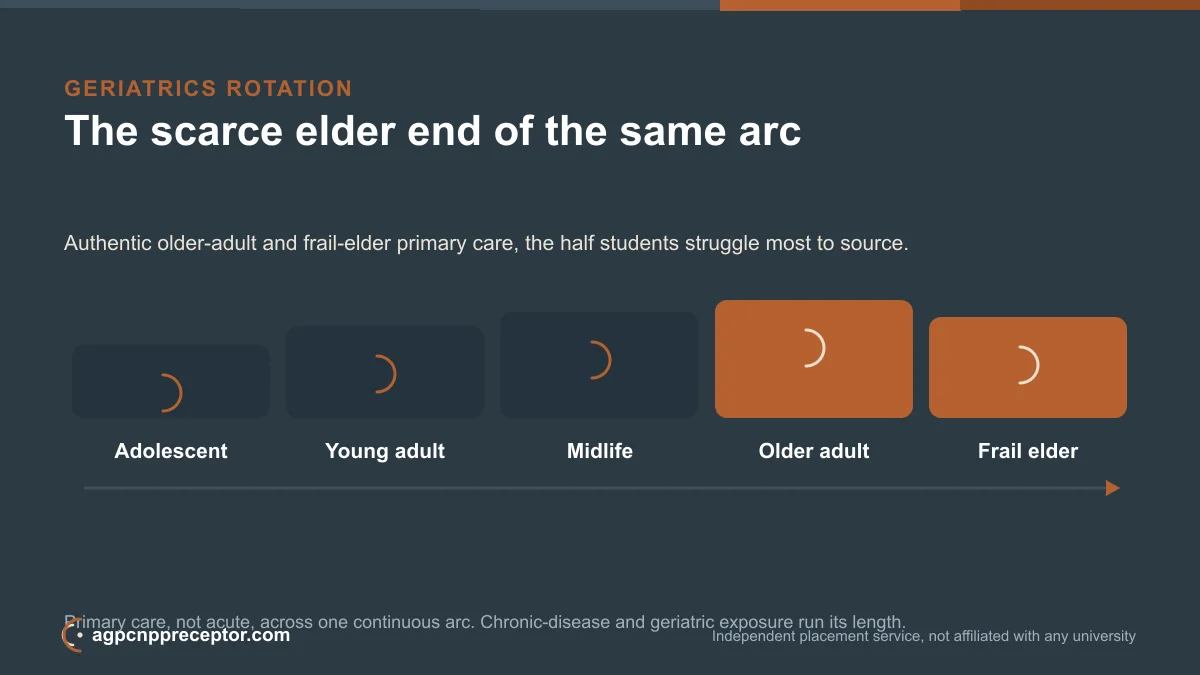
What does an AGPCNP geriatrics rotation require?
The gerontology end of the AGPCNP arc is primary care for older adults, not acute or episodic care. In practice that means longitudinal management of the older-adult panel: multiple chronic conditions at once, polypharmacy and deprescribing, cognitive and functional assessment, falls and frailty, and care coordination across settings. It is the same continuity mindset as the adult primary care block, applied to a population with more complexity and more comorbidity.
Settings that supply authentic geriatric primary-care hours include gerontology and geriatric-medicine clinics, primary-care practices with a heavy older-adult panel, and, at the frailest end, skilled-nursing facilities and long-term-care settings where residents receive ongoing primary care. Our long-term care rotation guide covers that frail-elder end in detail.
The exact hours your program wants in geriatrics, versus general adult primary care, are set by your school, not by a single national figure. What is consistent is that the gerontology exposure is required, and that authentic older-adult continuity, not a handful of incidental elderly patients in a general clinic, is what most programs are looking for.
Why is a geriatrics preceptor so hard to find?
Two things make this the scarce end of the arc. First, there are simply fewer providers who practice primary care with a concentrated older-adult or frail-elder panel than there are general family-medicine clinicians. Second, the settings that do carry that panel, such as skilled-nursing facilities and geriatric clinics, are not always set up to take students and may not have precepted before.
The result is that students who can line up a continuity adult clinic on their own often stall on the geriatric block. A busy family-medicine clinic rarely carries a frail-elder panel, and a skilled-nursing facility rarely offers continuity outpatient volume, so you are sourcing two very different environments from two different preceptors on two different affiliation agreements. That two-ended search is exactly what we take on, and the geriatric end is where our sourcing effort concentrates.
Who can precept a geriatrics rotation?
A geriatrics preceptor generally has to be a licensed provider practicing primary care with older adults whom your program will accept. Subject to your school's rules, that usually means:
- An Adult-Gerontology Primary Care NP (A-GNP or AGPCNP-BC) with an older-adult panel
- A Family Nurse Practitioner practicing substantial geriatric primary care
- A physician (MD or DO) in geriatrics, internal medicine, or family medicine with an older-adult focus
The practical test, beyond credential, is whether the preceptor and site can actually give you continuity older-adult volume rather than occasional elderly encounters. We verify eligibility against your program's requirements and confirm the panel before you commit, so the hours count. See our preceptor requirements guide for the full eligibility picture.
How do we secure your geriatrics placement?
Because this is the scarce end, we start early and search wide. You tell us your school, your city, and the geriatric hours you still need, and we source a gerontology clinic, an older-adult primary-care practice, or a long-term-care setting and a qualified preceptor near you, ahead of your rotation dates.
- Panel first. We target settings that carry a genuine older-adult or frail-elder panel, not just incidental elderly patients.
- Eligibility verified. We confirm each geriatrics preceptor against your school's rules before you commit.
- Approval-ready. We shepherd the affiliation agreement the site and your program need before you start.
- Early, because it is scarce. Geriatric and long-term-care placements take the longest to secure, so we begin the search first.
Final approval of any site or preceptor rests with your university, not with us, and we do not act for any school. We do not guarantee hours, grades, certification, or outcomes, and nothing here is a tuition refund. See how it works, or start on the find a preceptor page. Pair this with your adult primary care rotation for the full arc.
Good to know
Does an AGPCNP program require a geriatrics rotation?
Yes. Adult-Gerontology Primary Care NP is one credential across the whole adult lifespan, so gerontology exposure is required. Most programs want authentic older-adult primary-care continuity, and often frail-elder or long-term-care hours, not just a few incidental elderly patients in a general clinic. Your school sets the exact hours, and we place to it.
Why is a geriatrics preceptor harder to find than an adult primary care one?
There are fewer providers who practice primary care with a concentrated older-adult or frail-elder panel, and the settings that do, such as skilled-nursing facilities and geriatric clinics, are not always set up to precept students. That scarcity is why the geriatric end of the arc is where our sourcing effort concentrates.
Can a skilled-nursing facility count for my geriatrics hours?
It can, when residents receive ongoing primary care there and the setting and preceptor are approved by your program. Frail-elder and long-term-care settings are covered in our long-term care rotation guide. Whether a specific site qualifies is a program decision, and we prepare the site for your school's approval rather than assuming it will pass.
Are you affiliated with my university?
No. We are an independent placement service that works separately from any university or certification body. We help AGPCNP students at any school secure a qualified geriatrics preceptor and an approved site; final approval always rests with the university.
Secure both ends of the arc, not just one
Tell us your school, your city, and the hours you still need across the continuum. We will come back with a plan that reaches from continuity primary care to genuine frail-elder exposure, and a realistic path to placed.