Who Can Serve as an AGPCNP Preceptor?
Before you commit to a rotation, the first question to answer is whether the preceptor will actually be accepted by your program. For Adult-Gerontology Primary Care NP students, the eligible pool is broader than many assume, but the final call always belongs to your school, and a preceptor who looks qualified on paper can still be disqualified on a technicality. We are an independent placement service that works separately from any university. This page lays out who can generally serve as an AGPCNP preceptor, what eligibility usually turns on, and how we verify each preceptor against your program's rules before you rely on them.
Tell us your school and city. It is free to ask, with no obligation.
Who can serve as an AGPCNP preceptor?
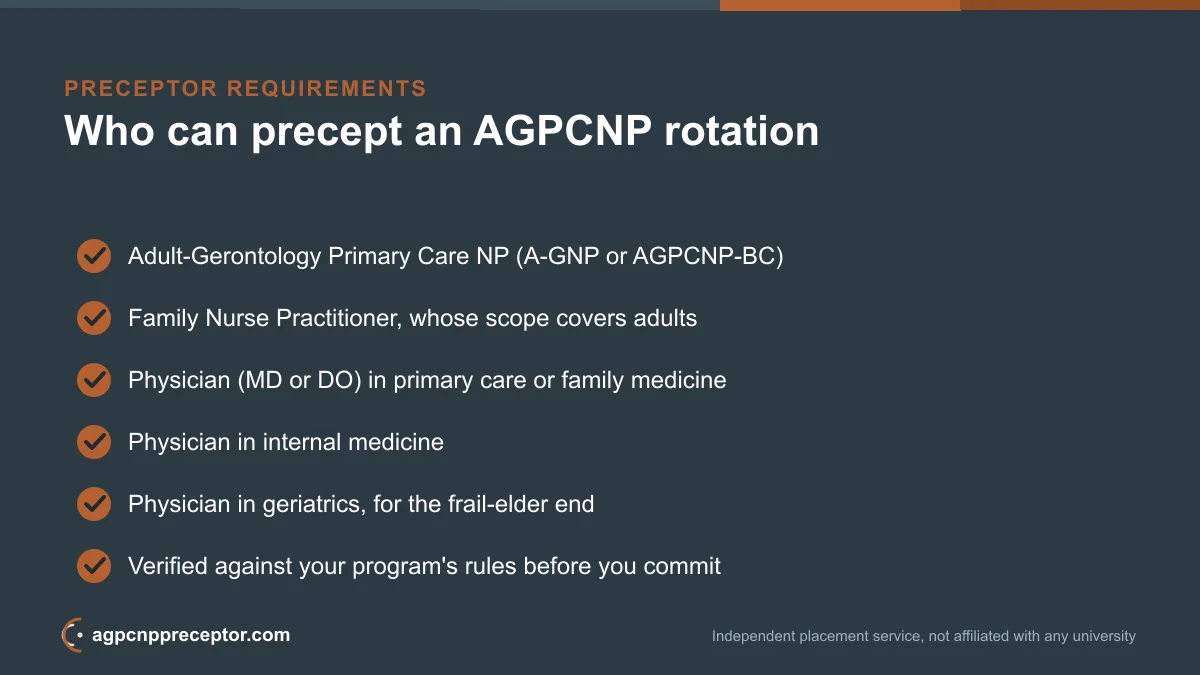
An AGPCNP preceptor is generally a licensed provider who practices adult or gerontology primary care and whom your program will accept. In practice the eligible pool usually includes:
- An Adult-Gerontology Primary Care NP (A-GNP, AGNP-C, or AGPCNP-BC), the most directly matched credential
- A Family Nurse Practitioner (FNP), whose scope overlaps the adult population
- A physician (MD or DO) in primary care or family medicine
- A physician in internal medicine, well matched to adult and older-adult primary care
- A physician in geriatrics, valuable for the frail-elder end of the arc
That breadth is deliberate: because AGPCNP spans the whole adult lifespan, programs generally accept preceptors across primary care, internal medicine, and geriatrics so students can cover both the continuity and the geriatric ends. But the eligible list, and the details that go with it, are set by your program, not by us.
What does eligibility actually turn on?
Credential is only the starting point. Programs commonly attach additional conditions, and any one of them can be the reason a preceptor is or is not accepted:
- Active, unencumbered licensure and, for NPs, national board certification in the relevant population
- Experience minimums, such as a required number of years in independent practice before precepting
- Practice setting and population, so the preceptor actually sees the patients your rotation needs
- Scope alignment, so the preceptor's role fits the primary-care continuity the credential is built on
- A signed affiliation agreement between the site and your school, which is separate from the preceptor's own eligibility
This is why we verify against your specific program rather than a generic checklist. A preceptor who is fully eligible at one school can fall short of another school's experience minimum or setting requirement. Confirming the details up front is what keeps a rotation from being disqualified after you have already started.
Does a preceptor have to be an AGPCNP?
No. A preceptor does not have to hold the exact AGPCNP credential to supervise your rotation. Family Nurse Practitioners and physicians in primary care, internal medicine, and geriatrics are commonly accepted, precisely because their scope overlaps the adult and older-adult population you are training to care for.
What matters more than an identical credential is that the preceptor practices the kind of primary care your rotation requires and meets your program's other conditions. An FNP with a heavy older-adult panel can be an excellent geriatric preceptor; an internal-medicine physician can anchor your continuity adult hours. The right question is not just what letters the preceptor holds, but whether their practice and your program's rules line up. We check both before you commit.
How do we verify your preceptor's eligibility?
Verification is the step that protects your hours. Before you rely on a preceptor, we check the specifics against your program's requirements so you are not counting on a placement that will not clear approval.
- We read your program's rules on preceptor credential, certification, experience, and setting first.
- We confirm the preceptor meets them, not just that they hold a relevant credential.
- We check the site and population so the preceptor can actually give you the rotation you need.
- We shepherd the affiliation agreement between the site and your school, since that is separate from the preceptor's own eligibility.
Final approval of any preceptor or site rests with your university, not with us, and we do not act for any school. We do not guarantee hours, grades, certification, or outcomes, and nothing here is a tuition refund. See how it works, or start on the find a preceptor page.
Good to know
Who can be an AGPCNP preceptor?
Generally an Adult-Gerontology Primary Care NP (A-GNP or AGPCNP-BC), a Family Nurse Practitioner, or a physician (MD or DO) in primary care, internal medicine, or geriatrics, subject to your program's rules. Because AGPCNP spans the whole adult lifespan, programs usually accept preceptors across primary care, internal medicine, and geriatrics. We verify eligibility against your school before you commit.
Does my AGPCNP preceptor have to be an AGPCNP too?
No. A preceptor does not have to hold the exact AGPCNP credential. Family Nurse Practitioners and physicians in primary care, internal medicine, and geriatrics are commonly accepted, because their scope overlaps the adult and older-adult population. What matters is that the preceptor practices the right kind of primary care and meets your program's other conditions.
What can disqualify an otherwise-qualified preceptor?
Beyond credential, programs often require active unencumbered licensure and board certification, a minimum number of years in practice, a matching practice setting and population, and a signed affiliation agreement between the site and the school. Any one of these can be the reason a preceptor is not accepted, which is why we verify the specifics up front.
Are you affiliated with my university?
No. We are an independent placement service that works separately from any university or certification body. We verify a preceptor's eligibility against your program's rules and help secure the site; final approval always rests with the university.
Secure both ends of the arc, not just one
Tell us your school, your city, and the hours you still need across the continuum. We will come back with a plan that reaches from continuity primary care to genuine frail-elder exposure, and a realistic path to placed.