Community Health and Outpatient Clinic Rotation Placement for AGPCNP Students
Community health and outpatient clinic rotations give Adult-Gerontology Primary Care NP students the ambulatory primary-care volume the credential is built on, often across a broad and diverse adult and older-adult population. Community health centers, federally qualified health centers, and general outpatient clinics tend to carry the kind of steady, mixed panel that lets a student see a lot of primary care in a short window, which is why they are such useful placements. We are an independent placement service that works separately from any university. This page explains what a community-health or outpatient rotation offers an AGPCNP and how we secure a qualified preceptor and an approved site for students at any school.
Tell us your school and city. It is free to ask, with no obligation.
What does a community health rotation offer an AGPCNP?
Community health and outpatient primary-care settings are, at their core, high-volume ambulatory continuity clinics. For an AGPCNP that means a lot of primary-care encounters across a wide range of adults and older adults: routine and preventive care, acute-on-chronic complaints, and ongoing chronic-disease follow-up, often in a population with real social and access complexity.
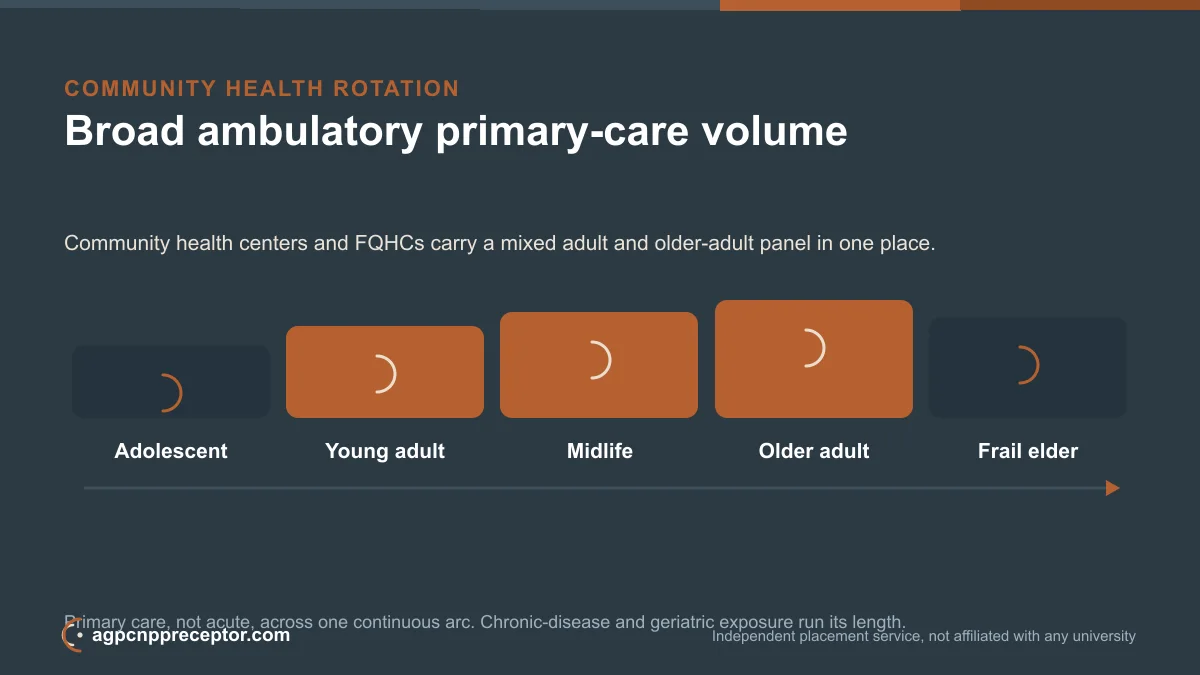
The value of these settings is breadth and volume. A community health center or FQHC frequently serves patients across the whole adult-gerontology span in one place, so you build primary-care judgment quickly and see the social determinants that shape adult and geriatric health up close. That makes community health a strong anchor for the continuity core of your hours.
Community health does not always, on its own, deliver the frail-elder or long-term-care end of the arc, so most students pair it with dedicated geriatric exposure. The point of this rotation is the ambulatory continuity volume, and it is one of the more reliable ways to accumulate it.
Where do community health and outpatient hours happen?
Common approvable community-health and outpatient settings for an AGPCNP include:
- Community health centers and federally qualified health centers (FQHCs) serving a broad adult and older-adult population
- General outpatient primary-care clinics with a steady ambulatory panel
- Nonprofit and safety-net clinics providing primary and preventive care
- Public-health and prevention-oriented programs that fit your program's intent
These settings supply the continuity primary-care volume the credential requires, but whether a specific site qualifies for your program is a school decision. We source community and outpatient settings that fit the ambulatory primary-care intent of your requirement and prepare the site for approval rather than assuming a location will pass. For the elder end you still need beyond community health, see our geriatrics rotation guide.
Who can precept a community health rotation?
The preceptor at a community-health or outpatient clinic generally has to be a provider practicing primary care there whom your program will accept. Subject to your school's rules, that usually means:
- An Adult-Gerontology Primary Care NP (A-GNP or AGPCNP-BC)
- A Family Nurse Practitioner, common in community-health settings
- A physician (MD or DO) in family medicine or internal medicine primary care
Because community clinics can be busy and short-staffed, the practical question is whether the preceptor has the bandwidth to actually teach and supervise you, not just co-sign hours. We verify eligibility against your program's rules and confirm the site can support a student before you commit. See our preceptor requirements guide for the full eligibility picture.
How do we place your community health rotation?
You tell us your school, your city, and the primary-care hours you still need, and we source a community health center, an FQHC, or a general outpatient clinic and a qualified preceptor near you, ahead of your rotation dates.
- Volume and breadth. We target settings that carry the ambulatory primary-care volume and the population range your program wants.
- Eligibility verified. We confirm each preceptor against your school's rules before you commit.
- Approval-ready. We shepherd the affiliation agreement the site and your program need.
- Planned around the whole arc. We make sure your community-health hours complement, rather than duplicate, your geriatric and long-term-care exposure.
Final approval of any site or preceptor rests with your university, not with us, and we do not act for any school. We do not guarantee hours, grades, certification, or outcomes, and nothing here is a tuition refund. See how it works, or start on the find a preceptor page.
Good to know
Does a community health rotation count toward AGPCNP clinical hours?
Yes, when the setting supplies continuity ambulatory primary care and your program approves it. Community health centers, FQHCs, and general outpatient clinics carry the adult and older-adult primary-care volume the credential is built on. Whether a specific site qualifies is a program decision, and we prepare the site for approval.
Can community health replace my geriatrics rotation?
Usually not entirely. Community health delivers strong ambulatory continuity volume across adults and older adults, but it does not always supply the frail-elder or long-term-care exposure the gerontology end of the arc requires. Most students pair community health with a dedicated geriatric or long-term-care placement.
Who can precept an outpatient community health rotation?
Generally an Adult-Gerontology Primary Care NP, a Family Nurse Practitioner, or a physician (MD or DO) in family or internal medicine practicing at the site, subject to your program's rules. Because community clinics can be busy, we also confirm the preceptor has bandwidth to actually teach before you commit.
Are you affiliated with my university?
No. We are an independent placement service that works separately from any university or certification body. We help AGPCNP students at any school secure a qualified preceptor and an approved outpatient site; final approval always rests with the university.
Secure both ends of the arc, not just one
Tell us your school, your city, and the hours you still need across the continuum. We will come back with a plan that reaches from continuity primary care to genuine frail-elder exposure, and a realistic path to placed.