Specialty Primary-Care Exposure Placement for AGPCNP Students
Some Adult-Gerontology Primary Care NP students round out their training with targeted outpatient specialty exposure, a block in a setting like cardiology, endocrinology, or another outpatient specialty that concentrates the conditions they will manage in primary care. It is not a replacement for the continuity core of your hours, but a focused way to deepen judgment on the chronic diseases that dominate adult and geriatric primary care. We are an independent placement service that works separately from any university. This page explains when specialty exposure helps an AGPCNP, how it fits your hour plan, and how we source a qualified specialty preceptor and an approved outpatient site for students at any school.
Tell us your school and city. It is free to ask, with no obligation.
What is specialty primary-care exposure for an AGPCNP?
Specialty primary-care exposure means a targeted block in an outpatient specialty clinic that maps onto the chronic conditions you will manage in general primary care. Outpatient cardiology, endocrinology, nephrology, pulmonology, and geriatric-medicine clinics are common examples. The intent is not to make you a specialist, but to let you see concentrated volume of a condition, such as heart failure or complex diabetes, so you manage it more confidently back in continuity primary care.
This is exposure, not the backbone of your program. Adult-Gerontology Primary Care NP is a primary-care credential, so the bulk of your hours belongs in continuity adult and geriatric primary care. A specialty block complements that core by deepening a specific area, which is why it usually sits alongside, not instead of, your adult primary care and geriatrics rotations.
Whether specialty hours count, and how many your program will accept toward the total, is a school decision. Some programs cap specialty or non-primary-care exposure to protect the primary-care focus, so confirm the rules for your program before you plan a specialty block.
When does a specialty block actually help?
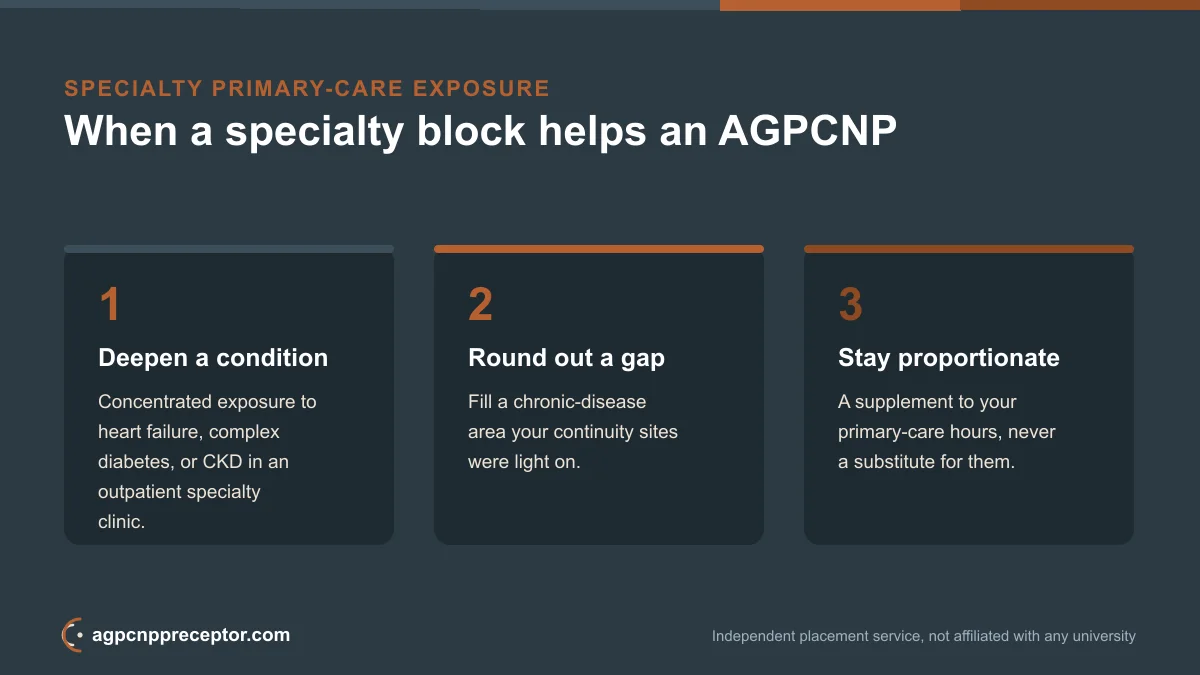
A focused specialty rotation tends to be most useful in a few situations:
- To deepen chronic-disease management. Concentrated exposure to a condition like diabetes, heart failure, or CKD sharpens the judgment you use every day in primary care.
- To round out a gap. If your continuity sites are light on a particular condition, a specialty block can fill it.
- To meet a program-specified exposure. Some programs want or allow a defined specialty experience within the plan of study.
It helps least when it crowds out the continuity primary-care volume that the credential and the certification exams are built on. Because AGPCNP is a primary-care role, a specialty block should be a supplement to, not a substitute for, your ambulatory continuity hours. Our chronic-disease management guide explains how these threads fit together.
Who can precept a specialty exposure block?
The preceptor for an outpatient specialty block generally has to be a provider practicing in that specialty whom your program will accept. Subject to your school's rules, that can include:
- An NP or physician (MD or DO) practicing in the outpatient specialty, such as cardiology or endocrinology
- An Adult-Gerontology Primary Care NP or Family Nurse Practitioner embedded in a specialty clinic
Because specialty preceptors are outside the general primary-care pool, eligibility and how the hours are counted matter even more here. We verify the preceptor against your program's rules and confirm how your school treats specialty hours before you commit, so a specialty block does not turn out not to count. See our preceptor requirements guide for the full eligibility picture.
How do we place a specialty exposure block?
You tell us your school, your city, the specialty exposure you want, and how your program treats specialty hours, and we source an appropriate outpatient specialty clinic and a qualified preceptor near you, without letting it displace your continuity core.
- Purpose first. We match the specialty to the chronic-disease area you want to deepen or the gap you need to fill.
- Counting confirmed. We check how your program treats specialty hours before we place, so the block counts as intended.
- Eligibility verified. We confirm each preceptor against your school's rules before you commit.
- Balanced plan. We keep the specialty block proportionate to your continuity primary-care hours.
Final approval of any site or preceptor rests with your university, not with us, and we do not act for any school. We do not guarantee hours, grades, certification, or outcomes, and nothing here is a tuition refund. See how it works, or start on the find a preceptor page.
Good to know
Does an AGPCNP need a specialty rotation?
Not necessarily. Adult-Gerontology Primary Care NP is a primary-care credential, so most hours belong in continuity adult and geriatric primary care. A targeted specialty block, such as outpatient cardiology or endocrinology, is an optional supplement that can deepen chronic-disease management. Some programs allow or cap specialty hours, so confirm the rules for yours.
Do outpatient specialty hours count toward AGPCNP clinical hours?
It depends on your program. Some schools count a limited amount of specialty or non-primary-care exposure toward the total, and some cap it to protect the primary-care focus. Total AGPCNP direct patient care hours run from roughly 500 to 750 or more, anchored to the 2022 NTF minimum of 750 per NP track and the older 500-hour certification floor. Confirm how your program treats specialty hours before you plan a block.
Which specialties are most useful for an AGPCNP?
Outpatient cardiology, endocrinology, nephrology, pulmonology, and geriatric medicine are common choices, because they concentrate conditions you manage in general primary care. The most useful block is the one that deepens a chronic-disease area you will actually see, or fills a gap your continuity sites did not cover.
Are you affiliated with my university?
No. We are an independent placement service that works separately from any university or certification body. We help AGPCNP students at any school secure a qualified preceptor and an approved site; final approval always rests with the university.
Secure both ends of the arc, not just one
Tell us your school, your city, and the hours you still need across the continuum. We will come back with a plan that reaches from continuity primary care to genuine frail-elder exposure, and a realistic path to placed.