Where New Jersey AGPCNP students find continuity hours
New Jersey moved to independent practice for experienced primary care nurse practitioners in 2026, which reshapes who can serve as your preceptor. It is a dense, mostly suburban state with deep primary-care, geriatric, and long-term-care networks, and a large aging population clustered along the Shore. We source AGPCNP preceptors and continuity sites so your adult and older-adult hours are confirmed before the term begins.
Tell us your school and city. It is free to ask, with no obligation.
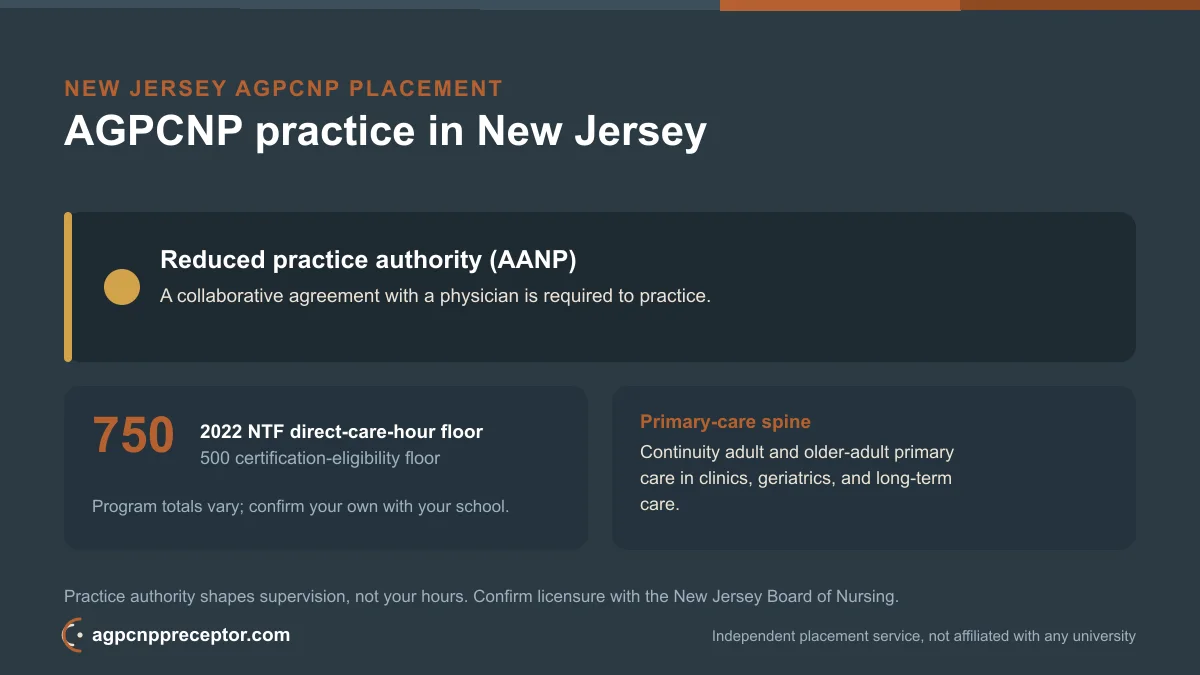
Where AGPCNP hours live in New Jersey
New Jersey packs a great deal of care into a small, densely settled state, which makes clinic supply less of a problem here than almost anywhere else. Continuity adult primary care sits in internal medicine and family medicine practices across the northern and central counties and in a strong network of federally qualified health centers, including Newark Community Health Centers, CAMcare in Camden, Henry J. Austin Health Center in Trenton, and Zufall Health in the northwest. These centers carry large adult panels heavy with chronic disease.
The older-adult end of the arc is unusually well developed. New Jersey supports a cluster of Programs of All-Inclusive Care for the Elderly, the LIFE programs that provide primary care to nursing-home-eligible seniors living in the community, alongside a dense field of skilled nursing facilities, assisted living residences, and home-based primary care. A LIFE or PACE panel is close to an ideal geriatrics rotation, because it folds continuity primary care, chronic-disease work, and interdisciplinary older-adult care into one setting.
Following the aging population to the Shore
Where the older population concentrates drives where geriatric and long-term-care hours are richest. In New Jersey that points to the Shore counties, above all Ocean County, where large retirement and active-adult communities around Toms River and Lakewood have made seniors a major share of residents. Newer PACE centers have opened there specifically to serve that population, and skilled nursing and assisted living capacity runs deep across Ocean and Monmouth counties.
The northern cities tell the other half of the story. Newark, Jersey City, Paterson, and Elizabeth concentrate the safety-net community health panels where adult primary care meets high chronic-disease burden. Between the urban north and the retiree Shore, New Jersey lets us build a plan that reaches genuinely across the adult and gerontology span without long travel.
Practice authority in New Jersey, updated for 2026
New Jersey changed its rules in 2026. Under a law signed that March, an advanced practice nurse who works in primary care or behavioral health, and who has passed a substantial experience threshold set at more than five thousand hours of active advanced practice in the matching population focus, may practice and prescribe without a joint protocol with a physician. Adult-gerontology primary care is one of the covered focuses, so the change applies squarely to AGPCNP preceptors.
For your rotation the effect is on the supervision arrangement. A seasoned adult-gerontology primary care NP who has crossed that threshold can now sign as your independent preceptor on their own, while a newer NP who has not yet reached it continues under a joint protocol with a collaborating physician and typically precepts alongside that physician. A primary care physician can precept you directly as well. Because this is a recent change, confirm the current requirements with the New Jersey Board of Nursing.
The hours that still take work
Density solves the supply problem but not the matching problem. General adult primary care is plentiful, so the piece that still takes planning is deliberately geriatric time, the long-term care rounds, PACE panels, and home-based visits that give you authentic frail-elder hours rather than a young adult panel alone. New Jersey has that capacity in abundance, but the specific preceptors are still claimed early, so we secure them first.
Program hour totals vary, so plan to your own. The 2022 National Task Force standards recommend at least 750 direct patient care hours, certification eligibility requires at least 500 faculty-supervised hours, and accredited AGPCNP programs commonly publish totals from roughly 500 to 750 or more. Confirm your program's requirement instead of assuming one figure, and our clinical hours guide explains how the counts are kept.
The rotations we assemble in New Jersey
We build your plan across the whole adult and gerontology arc from the state's deep networks:
- Adult and internal medicine primary care, the continuity core of the program.
- Geriatrics, including PACE and LIFE panels and clinic-based older-adult care.
- Long-term care in skilled nursing and assisted living settings.
- Chronic-disease management for diabetes, hypertension, and heart and kidney conditions.
- Community health in the federally qualified health centers of the northern cities.
- Specialty primary care in endocrinology, cardiology, or nephrology for continuity hours.
We use the Shore's geriatric depth to anchor the frail-elder hours, then build your continuity primary care around them.
How placement works in New Jersey
We match you with a board-certified adult-gerontology or family primary care NP, or a primary care physician, at a real New Jersey practice, then handle the affiliation agreement and onboarding the site requires. Our how it works page lays out the steps and the preceptor requirements page covers who qualifies. We are independent, we serve students at any university, and we never guarantee a placement or your school's approval of any preceptor or site.
Send your program's requirements and your county through the form at #match or our contact page, and we will map a plan from continuity primary care to genuine older-adult hours. Fees are on the cost page.
Good to know
Did New Jersey give nurse practitioners full practice authority?
Effectively, for experienced primary care NPs. A 2026 law lets an advanced practice nurse in primary care or behavioral health who has passed a large experience threshold, set at more than five thousand hours, practice and prescribe without a joint protocol. Adult-gerontology primary care is covered. Newer NPs still work under a joint protocol, so confirm your situation with the New Jersey Board of Nursing.
How does the 2026 law affect who can precept me?
It changes the supervision arrangement. An experienced adult-gerontology primary care NP who has met the hours threshold can now precept you independently, while a newer NP precepts alongside a collaborating physician under a joint protocol. A primary care physician can precept you directly. Your program sets the final rules for who qualifies.
Where are the best geriatric hours in New Jersey?
Often the Shore counties, especially Ocean County, where large retirement communities and newer PACE and LIFE centers serve a heavily older population. Skilled nursing and assisted living capacity is deep across Ocean and Monmouth, which makes authentic frail-elder hours easier to build there than in many states.
How many clinical hours will I need?
That is set by your program. National standards recommend at least 750 direct patient care hours and certification requires at least 500 faculty-supervised hours, but published totals vary, with many between roughly 500 and 750 or more. Confirm the exact number with your school before planning.
Are you affiliated with any university?
No. We are an independent placement service for AGPCNP students at any university, independent of any school. We cannot guarantee placement or a school's approval of a given preceptor or clinical site.
Secure both ends of the arc, not just one
Tell us your school, your city, and the hours you still need across the continuum. We will come back with a plan that reaches from continuity primary care to genuine frail-elder exposure, and a realistic path to placed.