Your adult-gerontology primary care hours in Nebraska
Nebraska is a full-practice state, so once a nurse practitioner clears the state's transition-to-practice period an experienced adult-gerontology primary care NP can precept you without a collaborating-physician contract required by law. The state splits neatly into two placement worlds, the clinic-dense corridor of Omaha and Lincoln and the wide rural stretch beyond it, and each shapes your rotation differently. We source AGPCNP preceptors and continuity sites in both so your adult and older-adult hours are set before the term starts.
Tell us your school and city. It is free to ask, with no obligation.
Two Nebraskas, two placement pictures
Most of Nebraska's clinic capacity sits in the eastern corridor. Omaha and Lincoln carry the densest supply of internal medicine and family medicine practices with adult panels, along with the community health centers that anchor primary care for lower-income adults, including OneWorld Community Health Centers and Charles Drew Health Center. For a student in that corridor, a continuity adult primary care rotation is usually within a reasonable drive.
West and north of that corridor the picture changes. The Panhandle, the Sandhills, and the many farming counties in between are served by a lighter network of rural clinics and critical-access hospitals, and several are federally designated primary-care shortage areas. State lawmakers have flagged a growing number of rural counties that no longer have a skilled nursing or assisted living facility at all, which pushes older residents toward regional towns for care and makes long-term-care hours harder to find close to home.
Where AGPCNP students train across the age span
Adult-gerontology primary care runs one long arc, from young adults through the frail elderly, and Nebraska hosts it in a familiar mix of settings. The continuity end lives in family and internal medicine clinics and in the federally qualified health centers that carry large adult panels heavy with diabetes, hypertension, and other chronic disease. The older end lives in skilled nursing facilities, assisted living residences, and home-based primary care.
One setting worth naming is the Program of All-Inclusive Care for the Elderly. Immanuel Pathways operates a PACE program in the Omaha area where adult-gerontology nurse practitioners serve as primary care providers for nursing-home-eligible seniors who still live in the community. A PACE panel is close to an ideal geriatrics rotation, because it combines continuity primary care, chronic-disease management, and interdisciplinary older-adult care in one place.
The hours that are hardest to secure here
General adult primary care is the easy part of a Nebraska plan, especially along the Omaha and Lincoln corridor. The scarce piece is dedicated older-adult time, the long-term care rounds and geriatric panels that a growing rural aging population needs but that a thinning facility network struggles to supply. In the counties losing their nursing homes, those hours may not exist locally at all, which is exactly the gap we plan around.
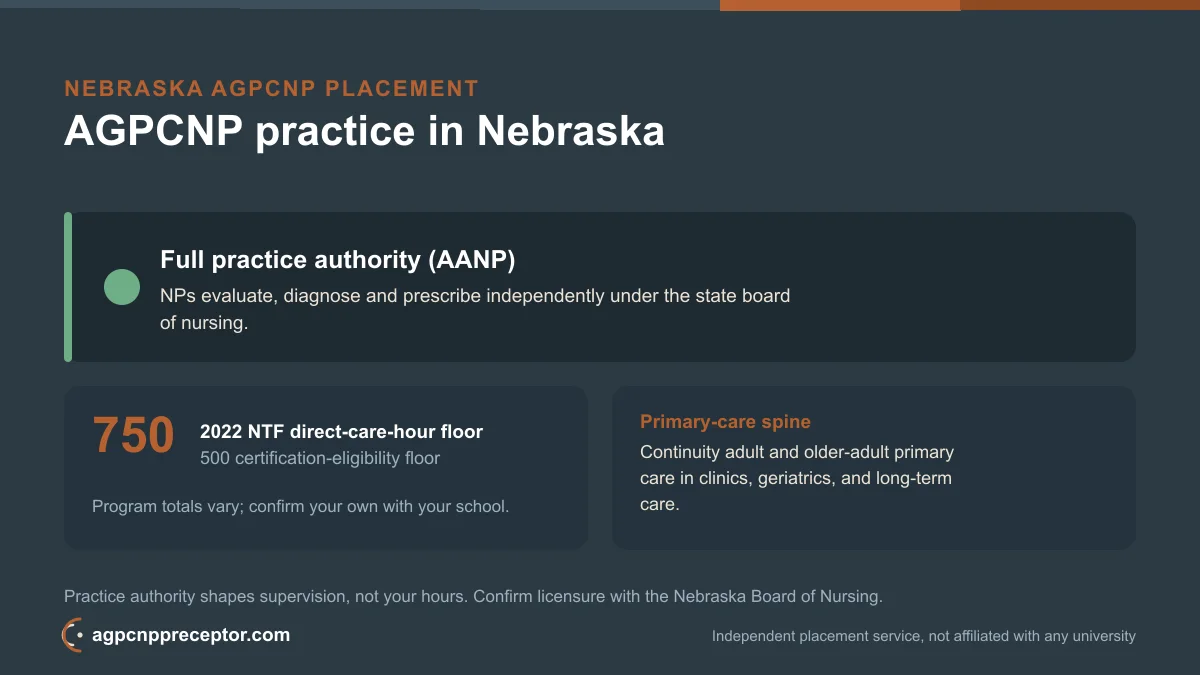
It helps to be exact about the numbers, because they vary by program. The 2022 National Task Force standards recommend at least 750 direct patient care hours, certification eligibility requires at least 500 faculty-supervised hours, and accredited AGPCNP programs commonly publish totals somewhere between roughly 500 and 750 or more. Rather than assume one figure, confirm your program's requirement, which our clinical hours guide explains.
Practice authority in Nebraska, in brief
Nebraska grants nurse practitioners full practice authority, with one wrinkle worth knowing. New NPs complete a transition-to-practice period of supervised hours before they move to fully independent practice, after which no collaborating-physician agreement is required by state law. That structure shapes who can precept you more than what your preceptor must know.
A seasoned adult-gerontology primary care NP who has cleared the transition can sign as your independent preceptor, while a newer NP still inside it will usually practice alongside a collaborating physician. A physician in internal medicine, family medicine, or geriatrics can precept you as well. Your school sets the final requirements, and you can confirm current rules with the Nebraska Board of Nursing, housed in the state Department of Health and Human Services.
The rotations we assemble in Nebraska
We build your plan from the settings that carry adult and older-adult care across the state:
- Adult and internal medicine primary care for the continuity core of the program.
- Geriatrics, including PACE panels and clinic-based older-adult care.
- Long-term care in skilled nursing and assisted living settings.
- Chronic-disease management for the diabetes, hypertension, and kidney and heart conditions that fill a Nebraska adult panel.
- Community health in the federally qualified health centers of Omaha, Lincoln, and the rural counties.
- Specialty primary care in endocrinology, cardiology, or nephrology for continuity hours.
Because the long-term-care end is the scarce one, we anchor the plan there first and build the continuity hours around it.
Getting matched in Nebraska
We pair you with a board-certified adult-gerontology or family primary care NP, or a primary care physician, at a real Nebraska site, then handle the affiliation agreement and onboarding the site asks for. The how it works page lays out the steps and the preceptor requirements page covers eligibility. We are independent, we serve students at any university, and we never guarantee a placement or a school's approval of any preceptor or site.
Tell us your program's requirements and your city through the form at #match or on our contact page, and we will map a plan that reaches from continuity primary care to genuine older-adult hours. Fees are on the cost page.
Good to know
Does Nebraska require a collaborating physician for NPs?
Not after the transition period. Nebraska is a full-practice state, but a new nurse practitioner completes a period of supervised transition-to-practice hours before moving to fully independent practice. Once that is done, no collaborating-physician agreement is required by state law. Confirm current details with the Nebraska Board of Nursing.
Can a PACE program count for my geriatric hours?
It can be one of the strongest settings for them. A Program of All-Inclusive Care for the Elderly, like the one Immanuel Pathways runs near Omaha, has adult-gerontology NPs providing primary care to nursing-home-eligible seniors, which blends continuity, chronic disease, and older-adult care in a single panel. Your program sets whether a given site qualifies.
I live in rural Nebraska. Can you still place me?
Usually yes, though it takes more planning. Adult primary care exists in most rural clinics, but dedicated long-term-care and geriatric hours can be thin where nursing homes have closed. We look for the nearest workable combination and plan blocks and travel so you are not driving for every visit.
How many clinical hours will I need?
That is set by your program. National standards recommend at least 750 direct patient care hours and certification requires at least 500 faculty-supervised hours, but published totals vary, with many between roughly 500 and 750 or more. Check the exact number with your school before you plan.
Are you affiliated with my university?
No. We are an independent placement service for AGPCNP students at any university, independent of any school. We cannot guarantee placement or a school's approval of any preceptor or clinical site.
Secure both ends of the arc, not just one
Tell us your school, your city, and the hours you still need across the continuum. We will come back with a plan that reaches from continuity primary care to genuine frail-elder exposure, and a realistic path to placed.