AGPCNP preceptor matching across Louisiana
Louisiana is a reduced practice state, so your preceptor's prescribing runs through a collaborative practice agreement with a physician, an arrangement the state board reviews before prescriptive authority begins. For adult-gerontology primary care students, the bigger challenge is that nearly every parish is a federally designated primary care shortage area, which makes continuity and geriatric preceptors worth securing early. We source both for students at any Louisiana program.
Tell us your school and city. It is free to ask, with no obligation.
Which Louisiana settings host AGPCNP rotations
Your training belongs in longitudinal, non-emergent primary care for patients from adolescence through the frail elderly, so it happens in clinics and residential care rather than the hospital. Across Louisiana that means adult and internal medicine primary care, family practices with a broad adult panel, and the federally qualified health centers that carry much of the safety-net care, clustered around New Orleans, Baton Rouge, and Monroe.
- Adult and internal medicine primary care for continuity panels
- Family medicine practices with older-adult patients
- Federally qualified health centers for community health hours
- Geriatrics practices, skilled nursing, long-term care, and assisted living
- Endocrinology, cardiology, and nephrology clinics for chronic-disease continuity
The parish map and where the gaps are
Primary care employers concentrate in Louisiana's larger cities: New Orleans, Baton Rouge, Shreveport, Lafayette, Lake Charles, Monroe, and Alexandria. That is where preceptor supply is deepest. Nearly all of the state's 64 parishes meet the criteria for a primary care shortage area, and the rural Acadiana, Delta, and northern parishes feel it most.
Aging compounds the gap, because many rural parishes are getting older even as clinicians leave. That raises demand for geriatric and chronic-disease care in exactly the parishes with the fewest preceptors. If you are outside a metro, we plan around a regional hub and realistic travel from the outset.
PACE, long-term care, and frail-elder hours
The hardest hours to pin down are the dedicated geriatric and long-term-care ones, since most adult care runs through general primary care. Skilled nursing facilities, assisted living, and home-based primary care are where you build real frail-elder experience.
Louisiana operates a Program of All-Inclusive Care for the Elderly in several regions, including greater New Orleans, the Lafayette area, and the Baton Rouge parishes, with the Shreveport area identified for future expansion. PACE centers, nursing facilities, and geriatrics practices are the settings we pursue first to close the geriatric end of your plan. See the geriatrics rotation guide for what these preceptors look for.
Chronic-disease continuity, a Louisiana strength
Louisiana carries a heavy chronic-disease load, with high rates of diabetes, hypertension, heart disease, and kidney disease across the adult population. For an adult-gerontology primary care student, that is a training advantage: continuity panels here are rich in exactly the conditions the certification exam and daily practice center on, from titrating medications to coordinating care for patients who carry several diagnoses at once.
Beyond general primary care, endocrinology, cardiology, and nephrology clinics can supply focused chronic-disease continuity hours when your program allows them, and nephrology practices in particular see a large older-adult population. We use these specialty settings to round out a plan when general primary care alone will not fill every hour. The specialty primary care rotation guide explains how they count.
Reduced practice and the collaborative agreement
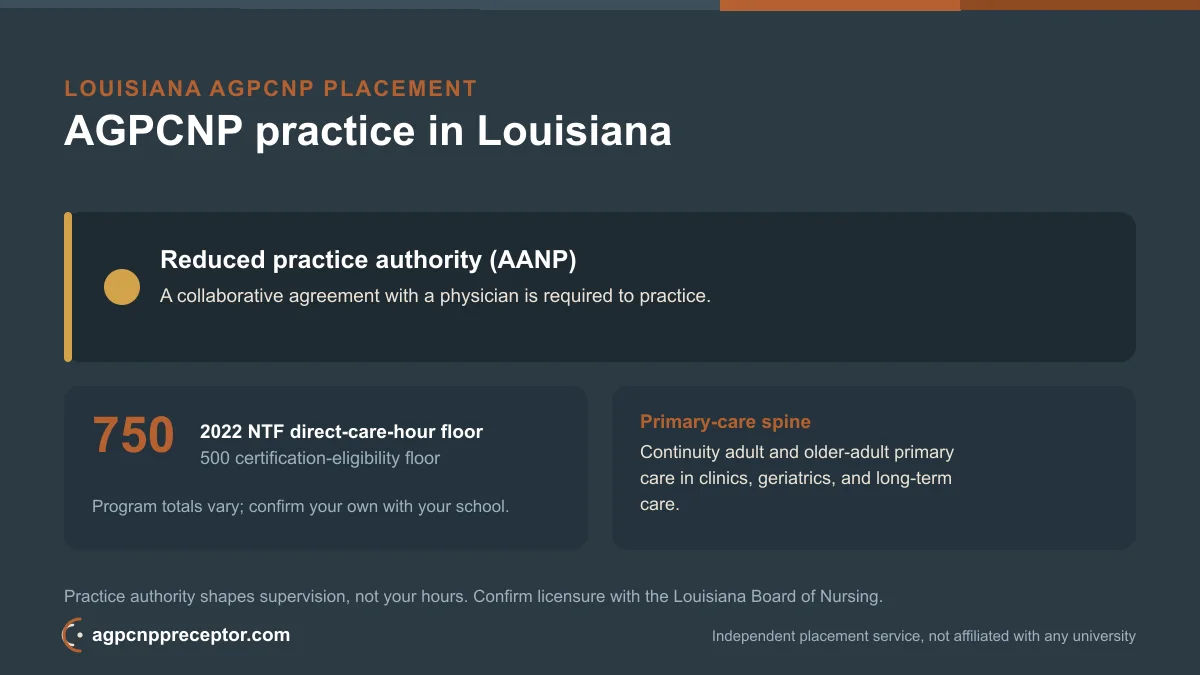
Louisiana classifies nurse practitioners as reduced practice. To diagnose, prescribe, or manage care, an APRN practices under a collaborative practice agreement with a qualifying physician, approved by the Louisiana State Board of Nursing before prescriptive authority is exercised. The state has taken steps toward broader independence, but it is not a full practice state.
For placement, this mainly shapes who precepts. Many Louisiana AGPCNP students train with a board-certified adult-gerontology or family primary care NP who has a collaborating physician, or with a physician in internal medicine, family medicine, or geriatrics. Your program sets the preceptor criteria, so confirm both your school's rules and the board's current requirements.
How your Louisiana placement comes together
We work from your parish, your remaining hours, and your program's rules, then source and vet preceptors, verify them against your school's requirements, and manage the affiliation agreements so a continuity panel and a geriatric setting land as one plan. Matching comes before payment; the pricing page has the detail.
Share your Louisiana city and program on the matching form or through contact, and we will tell you what the preceptor search looks like near you.
Good to know
Is Louisiana a full or reduced practice state?
Reduced. Nurse practitioners diagnose and prescribe under a collaborative practice agreement with a physician, which the Louisiana State Board of Nursing approves before prescriptive authority begins. In practice this shapes who signs on as preceptor rather than the core qualifications your program requires.
Where are the primary care shortage areas in Louisiana?
Nearly all of the 64 parishes meet the criteria for a primary care shortage area, with the rural Acadiana, Delta, and northern parishes hit hardest. If you live outside New Orleans, Baton Rouge, Shreveport, or Lafayette, we plan around a regional hub and realistic travel.
What settings give me geriatric hours in Louisiana?
Skilled nursing facilities, assisted living, home-based primary care, dedicated geriatrics practices, and Louisiana's PACE programs in the New Orleans, Lafayette, and Baton Rouge areas. These frail-elder settings are usually the hardest to secure, so we go after them first.
How many clinical hours will my program require?
Your program sets the total, not the state. The 2022 national standards recommend at least 750 direct patient care hours, certification eligibility requires at least 500 faculty-supervised hours, and many AGPCNP programs run between roughly 500 and 750 or more. Simulation does not count. Confirm your own program's number, and see our clinical hours guide.
Can you place students from any Louisiana program?
Yes. We are independent of every university. We help adult-gerontology primary care students at any Louisiana program, including online programs whose students complete hours in the state.
Secure both ends of the arc, not just one
Tell us your school, your city, and the hours you still need across the continuum. We will come back with a plan that reaches from continuity primary care to genuine frail-elder exposure, and a realistic path to placed.