Finding AGPCNP primary-care preceptors in Indiana
Indiana pairs a growing Indianapolis metro with a wide rural south, and it is in the middle of a real change in nurse practitioner practice rules. For an Adult-Gerontology Primary Care NP, the placement landscape runs from city clinics and a well-developed set of Programs of All-Inclusive Care for the Elderly to thinly staffed practices and long-term-care facilities in the older, rural counties. We source and vet adult primary-care and geriatric preceptors statewide so your longitudinal hours hold together.
Tell us your school and city. It is free to ask, with no obligation.
Where AGPCNP students train in Indiana
AGPCNP is longitudinal, non-emergent care for patients from adolescence, around age thirteen, through the frail elderly, so your rotations sit in ambulatory and residential settings, not the hospital. In Indiana that means adult and internal-medicine primary care, family medicine with an adult panel, geriatrics, skilled nursing and long-term care, assisted living, home-based primary care, and the more than thirty-five community health centers operating around the state.
The rotations we work most for Indiana students include:
- adult and internal-medicine primary care, the steadiest source of hours
- geriatrics for the older and frail-elderly panel
- skilled nursing and long-term care in residential facilities
- community health at federally qualified centers
- chronic-disease management for diabetes, heart, and kidney continuity
PACE and the settings built around older adults
Indiana has one of the more developed Program of All-Inclusive Care for the Elderly footprints in the Midwest, with sites operated by Franciscan Health in Indianapolis, Lafayette, Dyer, and Michigan City, a program serving Allen County around Fort Wayne, and a Reid Health program covering the east-central counties near the Ohio border. Each PACE participant is cared for by a team that includes a nurse practitioner, which makes these strong continuity settings for an AGPCNP.
Beyond PACE, skilled nursing facilities, assisted living, and hospital-affiliated senior-health clinics carry a large share of the state's geriatric care. These residential and clinic-based settings are where dedicated older-adult hours actually live, and they are exactly the piece students struggle to arrange on their own.
Indiana's primary-care geography
Clinic density concentrates in the Indianapolis metro, including Marion County and the fast-growing suburban ring of Hamilton, Hendricks, and Johnson counties, with more capacity in Fort Wayne, Evansville, South Bend and Elkhart, Bloomington, Lafayette, and the northwest Indiana counties near the Illinois line.
The rural south is a different story. Many of the hilly southern counties are federally designated primary-care shortage areas, they skew older as younger residents leave, and a federally qualified or rural health clinic is often the main door to adult care. If you live there, dedicated geriatrics and specialty continuity hours may require travel, and we plan that with you rather than leaving it to chance.
A practice-authority rule in transition
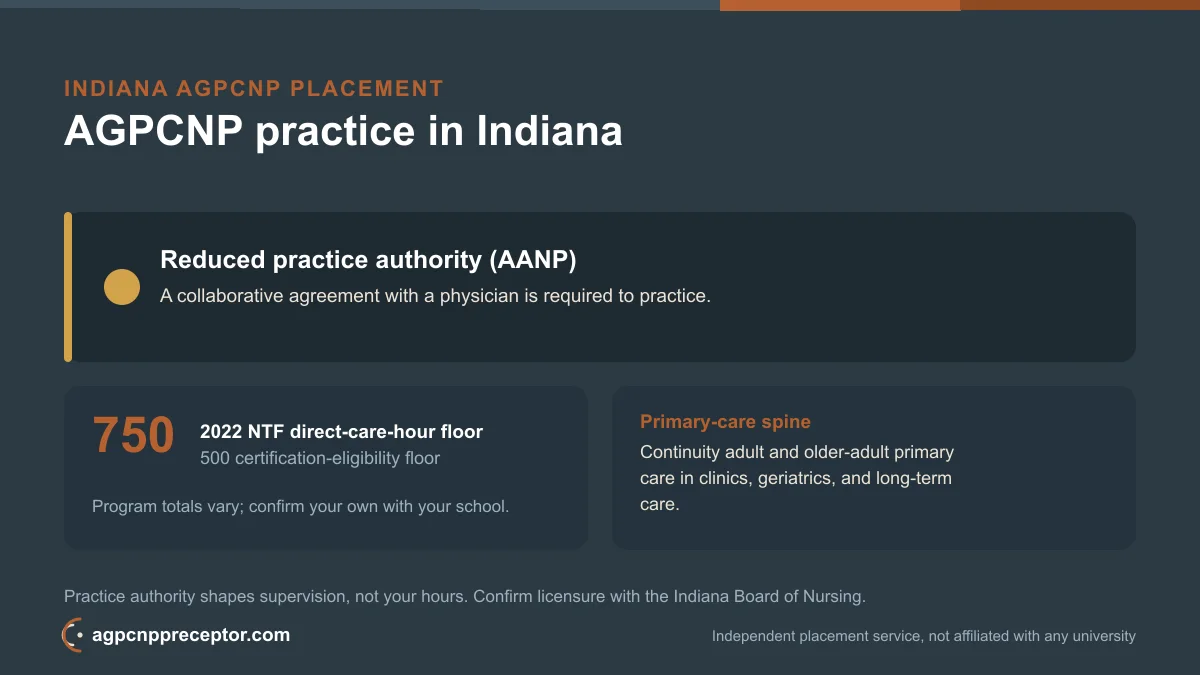
Indiana has been classified as reduced practice by the AANP, meaning nurse practitioners worked under a collaborative agreement with a physician. A 2026 law, House Bill 1129, removed the requirement that an advanced practice nurse hold that collaborative practice agreement, with an effective date of July 1, 2026, so the state's requirements are actively in transition. Because board rules and national classifications can lag a new statute, confirm the current arrangement with the Indiana State Board of Nursing before you finalize a site.
For placement, this shapes the supervision arrangement, not a preceptor's core qualifications. Many Indiana practices have long folded in a collaborating physician, and as that mandate sunsets an experienced AGPCNP can increasingly precept on their own signature. Your preceptor is generally a board-certified adult-gerontology or family primary-care NP, meaning A-GNP or AGPCNP-BC, or a physician in internal medicine, family medicine, or geriatrics; your program sets the criteria, so check its preceptor requirements.
The hours that are hardest to secure
Dedicated geriatrics and long-term-care hours are the tight piece in Indiana. Most adult care runs through general primary care, so preceptors focused on the frail elderly, nursing facilities, or house calls are fewer, and in the rural south they can be far apart.
The adolescent end of the panel, from about age thirteen, and specialty primary care such as endocrinology, cardiology, and nephrology used for continuity also take planning. We work the whole trace so a single hard-to-place block does not hold up your clinical hours.
Start your Indiana placement
Tell us your program, your region, and the primary-care rotations you still need. We source qualified preceptors, confirm the site will host you, and handle the affiliation paperwork that students should not be chasing between practices. Matched first, pay when secured; see pricing and how it works.
Use the match form on this page or contact us, and we will map a realistic path to your adult primary-care, geriatric, and long-term-care hours across Indiana.
Good to know
How many AGPCNP clinical hours will I need in Indiana?
Confirm the number with your own program. The 2022 NTF Standards recommend at least 750 direct patient care hours per NP track, and AANP and ANCC certification eligibility requires at least 500 faculty-supervised hours. Accredited AGPCNP programs commonly publish totals from roughly 500 to 750 or more, and some sit below 750. Simulation is excluded.
Is Indiana a full-practice state for nurse practitioners now?
Indiana has been classified as reduced practice, and a 2026 law removed the mandatory physician collaborative agreement with an effective date of July 1, 2026, so the rules are in transition. National classifications may not have caught up. Confirm the current requirement with the Indiana State Board of Nursing before you commit to a preceptor.
Where are AGPCNP geriatric hours easiest to find in Indiana?
The state's Program of All-Inclusive Care for the Elderly sites near Indianapolis, Lafayette, northwest Indiana, Fort Wayne, and the east-central counties pair primary care with geriatric day health, and skilled nursing and assisted-living facilities host hours statewide. Rural southern students often travel to a metro for dedicated geriatrics.
How is AGPCNP placement different from acute-care placement?
AGPCNP is adult-gerontology primary care: continuity and chronic-disease work in clinics, geriatrics, long-term care, and home-based settings for patients from about age thirteen through the frail elderly. It is not the hospital-based acute-care role, and it does not carry the pediatric and women's-health focus of the FNP track.
Do you guarantee placement at a specific Indiana site?
No. We are independent, we never guarantee placement or that a named clinic will accept you, and we do not control your school's approval of a site or preceptor. We source and vet qualified primary-care preceptors and sites and carry the paperwork to give you the strongest realistic shot.
Secure both ends of the arc, not just one
Tell us your school, your city, and the hours you still need across the continuum. We will come back with a plan that reaches from continuity primary care to genuine frail-elder exposure, and a realistic path to placed.