How AGPCNP primary-care placement works in Idaho
Idaho is a full-practice state, and it pairs a fast-growing metro core in the Treasure Valley with some of the most rural and frontier counties in the lower forty-eight. For an Adult-Gerontology Primary Care NP, that means clinic-dense placement around Boise and a scattered, aging landscape everywhere else. We source and vet adult primary-care and geriatric preceptors statewide so your longitudinal hours are covered without a scramble.
Tell us your school and city. It is free to ask, with no obligation.
Idaho's primary-care geography, valley to frontier
Outpatient capacity clusters in the Treasure Valley, where Boise, Meridian, Nampa, and Caldwell hold most of the state's internal-medicine and family clinics with adult panels. Idaho Falls and Pocatello anchor the east, Coeur d'Alene anchors the north, and Twin Falls serves the Magic Valley in the south-central part of the state.
Between those hubs, Idaho turns rural and frontier fast. Many counties are federally designated primary-care shortage areas, and in the hospital-desert counties a federally qualified health center or a rural health clinic is the main door to adult primary care. If you live outside a metro, expect your geriatric and specialty continuity hours to involve travel, and we plan the logistics with you rather than around you.
Where AGPCNP students log their hours
AGPCNP is longitudinal, non-emergent care for patients from adolescence, around age thirteen, through the frail elderly, so your rotations sit in ambulatory and residential settings, not the hospital ward. In Idaho that is adult and internal-medicine primary care, family medicine with an adult panel, geriatrics, skilled nursing and long-term care, assisted living, home-based primary care, and community health at the state's safety-net centers.
The rotations we work most for Idaho students include:
- adult and internal-medicine primary care, the steadiest source of hours
- community health at federally qualified and rural health clinics
- geriatrics for the older and frail-elderly panel
- skilled nursing and long-term care in residential facilities
- chronic-disease management for diabetes, heart, and kidney continuity
A retiree influx that drives geriatric demand
Idaho draws retirees with its scenery and lower cost of living, and roughly one in six residents is already sixty-five or older. The pull is uneven: Coeur d'Alene is close to one in five residents at that age, and the Boise area carries the largest concentration of senior-living communities in the state, with Twin Falls and Idaho Falls adding more.
That growth shows up as demand in assisted living, skilled nursing, and home-based care, some of it funded through Idaho's Aged and Disabled Medicaid waiver. For an AGPCNP, these residential and in-home settings are where geriatric continuity hours actually live, and they are expanding faster than the trained preceptor pool.
Full practice authority and your preceptor
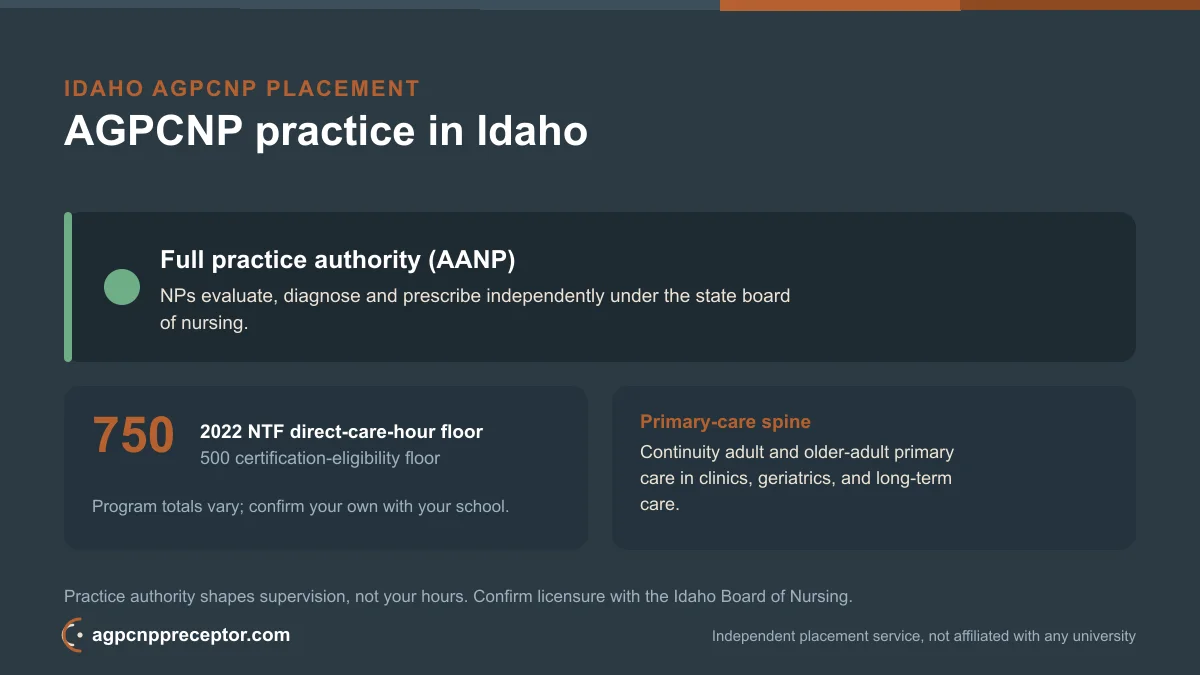
The Idaho Board of Nursing, housed in the Division of Occupational and Professional Licenses, grants nurse practitioners full practice authority. A licensed NP can evaluate, diagnose, order tests, and prescribe without a required collaborating physician, so an experienced AGPCNP who runs a clinic or a nursing-facility panel can precept on their own signature.
Your preceptor is generally a board-certified adult-gerontology or family primary-care NP, meaning A-GNP or AGPCNP-BC, or a physician such as an internist, family physician, or geriatrician. Each program sets its own criteria rather than following one national mandate, so match your rotation to a preceptor who practices in adult primary or geriatric care and confirm your school's preceptor requirements first.
The hardest hours to secure in Idaho
Dedicated geriatrics and long-term-care hours are the tight piece. Much of Idaho's adult care runs through general primary care, so preceptors who work mainly with the frail elderly, in nursing facilities, or on house calls are fewer, and rural counties often have none within easy reach.
The adolescent end of the panel, from about age thirteen, and specialty primary care such as endocrinology, cardiology, and nephrology used for continuity can also take planning outside the Treasure Valley. We work the full trace so a single hard-to-place block does not hold up your clinical hours.
Start your Idaho placement
Tell us your program, your town, and the primary-care rotations you still need. We source qualified preceptors, confirm the site will host you, and handle the affiliation legwork that students should not have to chase county to county. Matched first, pay when secured; see pricing and how it works.
Use the match form on this page or contact us, and we will map a realistic path to your adult primary-care and geriatric hours across Idaho.
Good to know
How many AGPCNP clinical hours will I need in Idaho?
Confirm the number with your own program. The 2022 NTF Standards recommend at least 750 direct patient care hours per NP track, and AANP and ANCC certification eligibility requires at least 500 faculty-supervised hours. Accredited AGPCNP programs commonly publish totals from roughly 500 to 750 or more, and some sit below 750. Simulation is excluded from the direct-care total.
Can I complete AGPCNP rotations in a rural Idaho county?
Often yes for adult primary care, since federally qualified and rural health clinics anchor care in many rural counties. Dedicated geriatrics and specialty continuity are harder to find locally, so those blocks may mean travel to Boise, Coeur d'Alene, or another hub. We plan that in from the start.
Does full practice authority remove the need for a physician preceptor?
No. Full practice authority describes independent practice for a licensed NP, not who precepts you. In Idaho an experienced adult-gerontology or family NP can precept on their own signature, and a physician in internal medicine, family medicine, or geriatrics can as well. Your program sets the requirements.
How is AGPCNP placement different from acute-care placement?
AGPCNP is primary care: continuity, prevention, and chronic-disease management in clinics, geriatrics, long-term care, and home-based settings for patients from about age thirteen through the frail elderly. It is not the hospital-based acute-care role and does not focus on young children or women's health across the lifespan.
Do you guarantee placement at a specific Idaho clinic?
No. We are independent, we never guarantee placement or that a named clinic will accept you, and we do not control your school's approval of a site or preceptor. We source and vet qualified primary-care preceptors and sites and carry the paperwork to give you the strongest realistic shot.
Secure both ends of the arc, not just one
Tell us your school, your city, and the hours you still need across the continuum. We will come back with a plan that reaches from continuity primary care to genuine frail-elder exposure, and a realistic path to placed.