Placing your AGPCNP primary-care hours across Hawaii
Hawaii grants nurse practitioners full practice authority, and the Adult-Gerontology Primary Care NP role here lives in clinics, care homes, and patients' living rooms rather than the hospital. Most of the islands' primary-care density sits on Oahu, while the neighbor islands carry federally designated shortage areas and one of the fastest-aging populations in the country. We source and vet adult primary-care and geriatric preceptors across the state so your longitudinal hours are planned rather than improvised.
Tell us your school and city. It is free to ask, with no obligation.
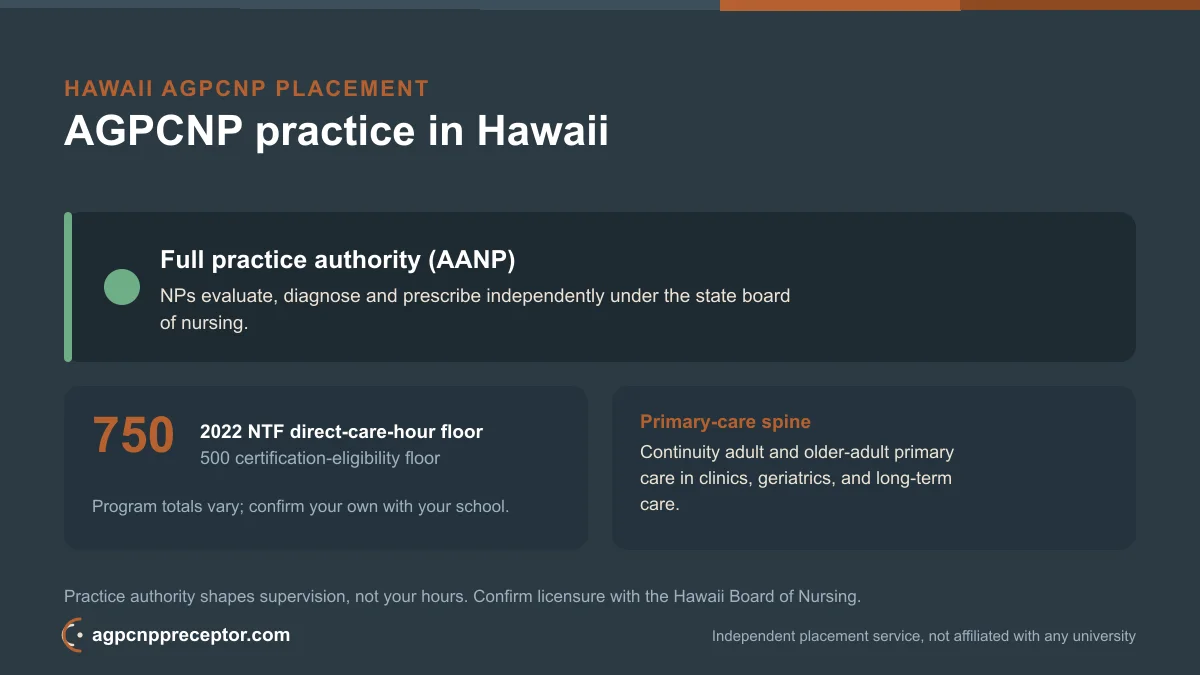
Where your AGPCNP hours actually happen here
AGPCNP is longitudinal, non-emergent care for patients from adolescence, around age thirteen, through the frail elderly. Your rotations belong in ambulatory and residential settings, not the intensive care unit: adult and internal-medicine primary care, family-medicine practices with a strong adult panel, dedicated geriatrics, skilled nursing and long-term care, assisted living, and home-based primary care that reaches homebound elders.
The rotations we work most for Hawaii students are:
- adult and internal-medicine primary care, the backbone of most placements
- dedicated geriatrics for the older and frail-elderly end of the panel
- skilled nursing and long-term care inside nursing facilities and care homes
- chronic-disease management for diabetes, heart, and kidney continuity
- community health at the islands' federally qualified centers
These sites rarely open with a cold call. Practices and facilities want to know who is precepting, whether your paperwork is in order, and that your school approves the match, which is the part we carry for you.
One island of clinics, and the neighbor-island reality
Oahu holds the bulk of Hawaii's outpatient capacity. The Waianae Coast Comprehensive Health Center is the largest community health center on the island and serves tens of thousands of adults across several sites, and Wahiawa Health runs a geriatric specialty center built around older adults. Large clinic networks and a Program of All-Inclusive Care for the Elderly also operate on Oahu, which concentrates adult primary-care and geriatric preceptors near Honolulu.
Off Oahu, the picture thins. Maui, Hawaii Island with its hubs in Hilo and Kona, and Kauai are more rural, and several of their communities are federally designated primary-care shortage areas served by centers such as the Hawaii Island Community Health Center. If you live on a neighbor island, some geriatric and specialty continuity hours may mean scheduled time on Oahu, and we build that into the plan rather than letting it surprise you.
The aging wave behind Hawaii's geriatric demand
Hawaii has the longest life expectancy of any state, and projections put residents aged sixty-five and older at roughly a quarter of the population by 2045, up from a small fraction in 1980. State supports like Kupuna Care keep thousands of elders, most of them over seventy, living at home instead of in institutional care.
That demographic weight is why geriatrics and long-term care matter more here than in younger states. The demand surfaces in nursing facilities, assisted living, adult day health, and house-call programs, concentrated on Oahu where most of the elderly population lives, and those are exactly the settings where an AGPCNP learns continuity care.
Full practice authority and who signs as your preceptor
Hawaii's Board of Nursing grants full practice authority, so a licensed nurse practitioner can evaluate, diagnose, and prescribe without a required collaborating physician. In practice this means an experienced AGPCNP who runs a clinic or a geriatrics panel can serve as your preceptor on their own signature, which widens the pool of who can take you on.
Your preceptor is generally a board-certified adult-gerontology or family primary-care NP, meaning A-GNP or AGPCNP-BC, or a physician such as an internist, family physician, or geriatrician. The exact criteria come from your own program, not one national rule, so confirm your school's preceptor requirements before you commit to a site.
The hours that are hardest to secure
The scarce piece in Hawaii is dedicated geriatrics and long-term-care time. Much adult care sits inside general primary care, so preceptors who work primarily with the frail elderly, in nursing facilities, or in home-based programs are fewer, and on the smaller islands that supply is genuinely thin.
Adolescent-end continuity, from about age thirteen, and specialty primary care such as endocrinology, cardiology, and nephrology used for chronic-disease continuity also take early planning. We work the whole trace so one hard block does not stall your clinical hours.
How we place AGPCNP students in Hawaii
Tell us your program, your island, and the primary-care rotations you still need. We source qualified preceptors, confirm the site will host you, and handle the affiliation paperwork that students should not be chasing between clinics. You are matched first and pay when the placement is secured; see pricing and how it works.
Ready to start? Use the match form on this page or contact us, and we will map a realistic path to your adult primary-care, geriatric, and long-term-care hours across Hawaii.
Good to know
How many clinical hours will I need for my AGPCNP program in Hawaii?
It depends on your school. The 2022 NTF Standards recommend a minimum of 750 direct patient care hours per NP track, while AANP and ANCC certification eligibility requires at least 500 faculty-supervised hours. Many accredited AGPCNP programs publish totals from roughly 500 to 750 or more, and some sit below 750, so confirm the exact figure with your own program. Simulation does not count toward the direct-care total.
Can I finish all of my AGPCNP hours on a neighbor island?
Often for the general adult primary-care portion, but not always for dedicated geriatrics or specialty continuity. Those preceptors concentrate on Oahu, so neighbor-island students sometimes plan a block of time in the Honolulu area. We tell you honestly what your island can support before you commit.
What is the difference between AGPCNP and acute-care placement here?
AGPCNP is primary care: longitudinal, non-emergent, health-promotion and chronic-disease work in clinics, geriatrics, long-term care, and home-based settings for patients from about age thirteen through the frail elderly. It is not the hospital-based acute-care role, and it does not center on young children or women's health across the lifespan.
Does Hawaii full practice authority mean I do not need a physician preceptor?
Not necessarily. Full practice authority describes what a licensed NP may do independently, not who must precept you. In primary care an experienced adult-gerontology or family NP can precept on their own, and a physician can as well. Your program sets the preceptor requirements, so confirm them early.
Do you guarantee a placement at a specific Hawaii clinic?
No. We are an independent service, we never guarantee placement or that any named clinic will accept you, and we do not control your school's approval of a site or preceptor. What we do is source and vet qualified primary-care preceptors and sites, then carry the paperwork to give you the strongest realistic shot.
Secure both ends of the arc, not just one
Tell us your school, your city, and the hours you still need across the continuum. We will come back with a plan that reaches from continuity primary care to genuine frail-elder exposure, and a realistic path to placed.