Adult-gerontology primary care rotations across Arkansas
Adult-gerontology primary care in Arkansas is shaped by a wide primary-care shortage and an aging, largely rural population, which makes site planning the central task for your AGPCNP rotations. Clinic density concentrates in central Arkansas around Little Rock, in Northwest Arkansas from Fayetteville to Bentonville, and around Fort Smith and Jonesboro, while the Delta counties along the Mississippi River are among the most underserved in the country. This page maps where AGPCNP students actually train in Arkansas and how we help you secure those hours. We serve students at any university and work independently of any school.
Tell us your school and city. It is free to ask, with no obligation.
The primary-care settings that host AGPCNP students in Arkansas
AGPCNP training is ambulatory and longitudinal, so your hours sit in clinics and residential care rather than the hospital. Across Arkansas, the settings that take adult-gerontology primary care students include adult and internal-medicine primary care, family practices with adult panels, and community health centers and federally qualified health centers, which carry much of the state's safety-net primary care through a statewide network.
For depth, students add chronic-disease management and adult specialty primary care clinics such as endocrinology, cardiology, and nephrology, along with geriatrics and long-term care for older-adult hours. What each site counts toward is set by your program, so confirm your requirements before building a rotation around a given clinic.
Arkansas's shortage geography and what it means for placement
Arkansas has a genuine primary-care access problem, and it drives where students can rotate. More than a third of Arkansans live in federally designated health professional shortage areas, dozens of counties are medically underserved, and the aging of the physician workforce is thinning supply further as older providers retire. The Delta counties in eastern Arkansas, along the Mississippi River, carry some of the highest poverty and the deepest shortages.
Federally qualified health centers fill much of that gap and are among the most reliable AGPCNP training sites in the state, since they serve large adult panels and manage heavy chronic-disease loads. In the rural counties, though, a single clinic may run lean and lack room for a student, which pushes some rotations toward the metros or requires travel.
Where Arkansas's aging population concentrates
The older end of the adult-gerontology range, which begins around age 13 and runs through the frail elderly, drives geriatric and long-term-care demand. In Arkansas, the rural Ozark and Delta counties skew older as younger residents leave for the metros, so the geriatric load is spread across small towns rather than concentrated in one place. Retiree pockets also sit around the lakes and near Hot Springs.
The state runs a Program of All-Inclusive Care for the Elderly in the North Little Rock area, serving the central counties, which is one structured option for long-term care and geriatric continuity. Most older-adult hours, though, come from nursing facilities, assisted living, and primary-care practices with a large elderly panel.
How Arkansas's reduced-practice rules shape your preceptor
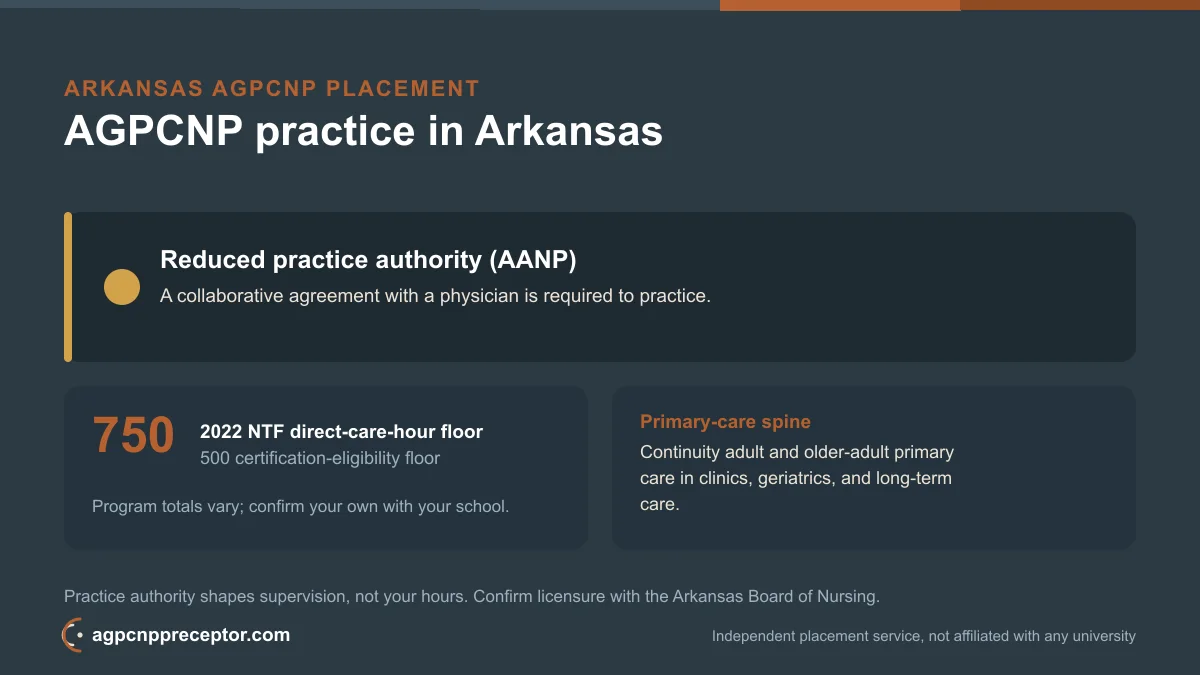
Arkansas is a reduced-practice state. An advanced practice registered nurse with prescriptive authority must hold a board-approved collaborative practice agreement with a physician. A 2021 law created a pathway to full independent practice for nurse practitioners who complete a large block of practice hours under that agreement, roughly 6,240 hours, and are approved by the state's independent-practice credentialing committee, but until that point a collaborative agreement is required.
For your rotation, this shapes who signs on as preceptor. Your preceptor is generally a board-certified adult-gerontology or family primary-care NP (AANP A-GNP or ANCC AGPCNP-BC) who holds a collaborative agreement, or a physician in internal medicine, family medicine, or geriatrics. The arrangement governs supervision, not the preceptor's core qualifications. Our preceptor requirements page covers the specifics.
The Arkansas hours that are hardest to line up
General adult primary care is the most available category, especially through the community health center network. The scarcer pieces are dedicated geriatrics and long-term-care time with a willing preceptor, since much older-adult care is folded into general practice, and rural specialty continuity, which can require travel to a metro.
Shortage areas cut both ways: they need providers, but the providers who are there are often stretched too thin to take a student. Planning early, and staying flexible about location, is what keeps the geriatric and specialty blocks from stalling your term. See our clinical hours guide for the usual breakdown.
How we place your Arkansas rotations
We run the search for you, aimed at where Arkansas's primary-care and geriatric capacity actually sits, including the community health center network. Tell us your city, your program, and the rotations you still need, and we source a qualified adult-gerontology primary care preceptor and an approvable site with enough lead time for any affiliation agreement.
We are independent and serve students at any university, and we never guarantee placement, hours, or your school's approval of a preceptor or site. To start, use the match form here or reach us through contact, and read how it works.
Good to know
Is Arkansas a full-practice state for nurse practitioners?
No. Arkansas is a reduced-practice state. An APRN with prescriptive authority needs a board-approved collaborative practice agreement. A 2021 law lets nurse practitioners reach full independent practice after about 6,240 hours under that agreement and committee approval, but the agreement is required until then. Confirm current rules with the Arkansas State Board of Nursing.
Where do AGPCNP students train in Arkansas?
Mostly the metros of central Arkansas, Northwest Arkansas, Fort Smith, and Jonesboro, plus the statewide network of federally qualified health centers, which are reliable adult primary-care sites. The Delta counties are underserved and harder for local placement.
Can I get geriatric hours in Arkansas?
Yes. A PACE program near North Little Rock serves the central counties, and nursing facilities, assisted living, and primary-care practices with older-adult panels supply the rest. The rural Ozark and Delta counties skew older, which spreads the geriatric load across small towns.
How many clinical hours will my program require?
Your program sets the total, not the state. The 2022 NTF Standards recommend a minimum of 750 direct patient care hours, while certification eligibility requires at least 500. Many AGPCNP programs publish totals from roughly 500 to 750 or more, and some sit below 750, so confirm your own. See our clinical hours guide.
Secure both ends of the arc, not just one
Tell us your school, your city, and the hours you still need across the continuum. We will come back with a plan that reaches from continuity primary care to genuine frail-elder exposure, and a realistic path to placed.