Placing AGPCNP students in Arizona's primary-care settings
Few states suit adult-gerontology primary care better than Arizona, which draws retirees by the hundreds of thousands and grants nurse practitioners full practice authority. The clinic density sits in metro Phoenix across Maricopa County and in Tucson in Pima County, with sizable retiree communities in Sun City, Scottsdale, Green Valley, Prescott, and Lake Havasu. This page maps where AGPCNP students actually train in Arizona and how we help you line up those hours. We are an independent service and serve students at any university.
Tell us your school and city. It is free to ask, with no obligation.
Why Arizona concentrates so much geriatric demand
Arizona is a retirement destination, and that demographic shapes adult-gerontology training here. Older adults are projected to outnumber children in the state within the next decade, and the winter influx of seasonal residents swells the older population further. Maricopa and Pima counties hold most of the retiree communities, from Sun City and the East Valley to Green Valley south of Tucson, while Prescott, Payson, and Lake Havasu draw older residents to the higher country and the river.
For students, that means the older end of the adult-gerontology range, which runs from adolescence at about age 13 through the frail elderly, is unusually easy to reach. Geriatrics, long-term care, assisted living, and home-based primary care all carry real volume in the metros, and the state supports Programs of All-Inclusive Care for the Elderly that combine primary care with adult day services for continuity.
The primary-care settings that host AGPCNP students in Arizona
AGPCNP hours in Arizona sit in ambulatory and residential care. The core settings are adult and internal-medicine primary care, family practices with adult panels, and community health centers and federally qualified health centers, which are dense across the Phoenix and Tucson metros and reach into the rural counties.
For continuity and chronic-disease depth, students rotate through chronic-disease management and adult specialty primary care clinics such as endocrinology, cardiology, and nephrology, which are plentiful given the older population. Skilled nursing, assisted living, and PACE round out the geriatric side. What each site counts toward is set by your program, so confirm your requirements first.
What full practice authority means for your Arizona preceptor
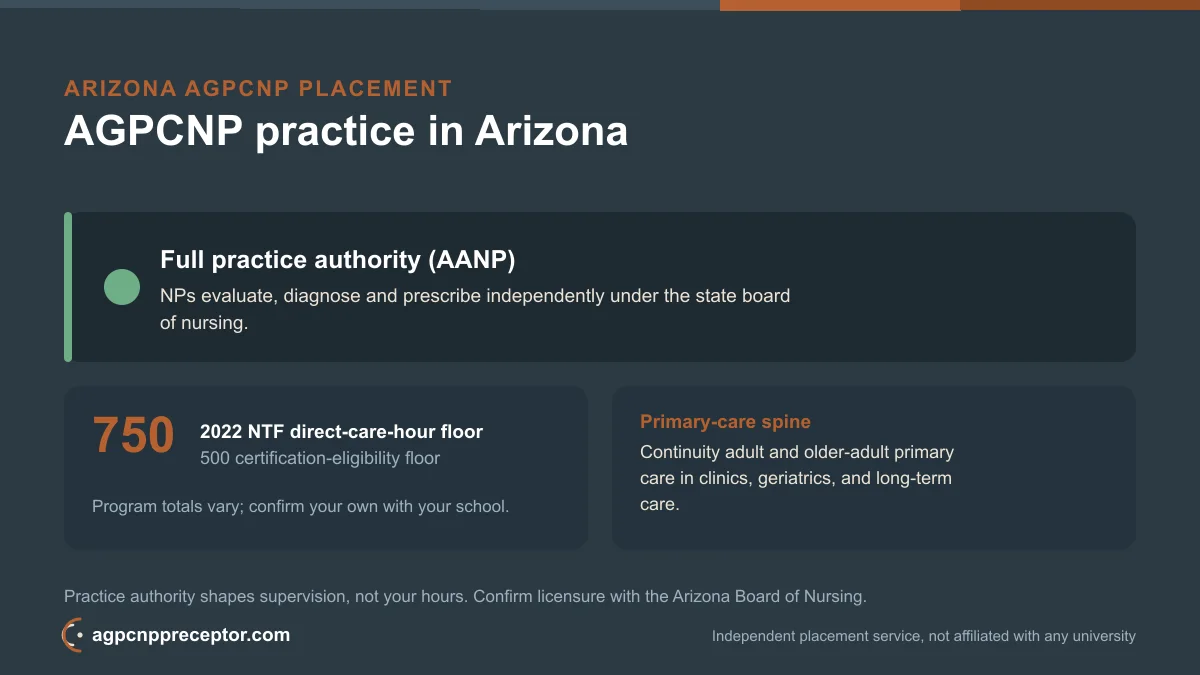
Arizona is a full-practice state, and its rules use the term registered nurse practitioner. An NP can evaluate, diagnose, and prescribe under the exclusive authority of the Arizona State Board of Nursing, with no collaborative or supervisory agreement required. The practical effect for your rotation is that an experienced adult-gerontology primary care nurse practitioner can precept you and sign off independently.
Your preceptor is generally a board-certified adult-gerontology or family primary-care NP (AANP A-GNP or ANCC AGPCNP-BC), or a physician in internal medicine, family medicine, or geriatrics. Full practice broadens the pool of NPs able to take students on their own authority. Our preceptor requirements page covers who qualifies.
Rural, border, and tribal Arizona
Outside the two big metros, Arizona thins out fast. Large stretches of the state, including the Navajo, Hopi, and Tohono O'odham lands and the border counties around Yuma and Santa Cruz, are federally designated primary-care shortage areas. Care there leans on rural health clinics, tribal health facilities, and community health centers, often with a single provider covering a wide area.
These sites can offer strong continuity and a distinctive older-adult population, and state aging initiatives have pushed to fold geriatrics into rural primary care. They also take more lead time for travel and credentialing, so if you want a rural or tribal rotation, plan it early.
Which Arizona hours are hardest to secure locally
General adult primary care and chronic-disease continuity are the easy categories in metro Arizona, thanks to the sheer size of the older population. The tighter piece is a dedicated geriatrics or long-term-care block with a preceptor who will sign, because so much older-adult care is delivered inside general primary care rather than a standalone geriatric practice.
Competition is the other factor. The Phoenix and Tucson metros host many nursing and health-professions programs, so desirable clinic slots fill early. Booking your geriatric and specialty blocks ahead of the term is what keeps them from slipping. See our clinical hours guide for how the categories usually divide.
How we place your Arizona rotations
We run the search for you and aim it where Arizona's primary-care and geriatric capacity sits. Tell us your city, your program, and the rotations you still need, and we source a qualified adult-gerontology primary care preceptor and an approvable site, early enough to clear any affiliation agreement your school requires.
We serve students at any university and never guarantee placement, hours, or your school's approval of a preceptor or site; final sign-off rests with the site and your program. Start with the match form on this page or through contact, and see how it works.
Good to know
Is Arizona a full-practice state for nurse practitioners?
Yes. Arizona grants full practice authority under the Arizona State Board of Nursing, using the term registered nurse practitioner, with no collaborative agreement required. An experienced AGPCNP can serve as your preceptor and sign off independently. Confirm the current rules with the board.
Why is Arizona good for adult-gerontology hours?
It is a major retirement state. Maricopa and Pima counties hold large older-adult populations, and geriatrics, long-term care, assisted living, and PACE all carry real volume, so the older end of the AGPCNP range is easier to reach here than in most states.
Where are the primary-care shortage areas in Arizona?
Mostly the rural counties, tribal lands such as the Navajo and Tohono O'odham nations, and the border areas near Yuma and Santa Cruz. Care there runs on rural health clinics, tribal facilities, and community health centers, often with one provider covering a wide area.
How many clinical hours will my Arizona program require?
Your program sets the total, not the state. The 2022 NTF Standards recommend a minimum of 750 direct patient care hours, while certification eligibility requires at least 500. Many AGPCNP programs publish totals from roughly 500 to 750 or more, and some sit below 750, so confirm your own. See our clinical hours guide.
Secure both ends of the arc, not just one
Tell us your school, your city, and the hours you still need across the continuum. We will come back with a plan that reaches from continuity primary care to genuine frail-elder exposure, and a realistic path to placed.