Adult-gerontology primary care rotations in Alaska
Alaska pairs full practice authority for nurse practitioners with one of the fastest-growing senior populations in the country, which makes it an unusual place to train in adult-gerontology primary care. Most of the state's clinic capacity sits in Anchorage, the Matanuska-Susitna Borough, Fairbanks, and Juneau, while vast frontier regions rely on tribal health organizations and community clinics reached mainly by air. This page maps where AGPCNP students actually log primary-care and geriatric hours in Alaska and how we help you arrange them. We serve students at any university and work independently of any school.
Tell us your school and city. It is free to ask, with no obligation.
Alaska's primary-care geography, road system and beyond
Alaska's primary care runs on two tracks. In and around Anchorage, the Mat-Su, Fairbanks, and the Kenai Peninsula you find conventional clinics, internal-medicine and family practices with adult panels, and community health centers. Beyond the road system, care is delivered largely through the tribal health system, from regional hubs to village clinics staffed by community health aides, with the Indian Health Service and Alaska Native tribal health organizations anchoring the network.
That split shapes where student hours are realistic. The bulk of AGPCNP placements happen in the urban and road-connected areas where clinic density and preceptor supply are highest. Rural and frontier rotations are possible and valuable, especially for continuity with older Alaska Native patients, but they take more planning and often travel or seasonal housing. Nearly the whole state outside the main metros is a federally designated primary-care shortage area.
Why Alaska's aging boom drives geriatric demand
Alaska is aging faster than almost any other state. The population aged 60 and over climbed sharply over the past decade, and residents over 65 more than doubled in the same window, which turns geriatric and long-term-care experience from a niche into a growing share of adult practice. Adult-gerontology scope covers adolescence, about age 13, through the frail elderly, and in Alaska the older end is expanding quickly.
The state's six Pioneer Homes provide assisted living and dementia care and are a distinctive Alaskan setting for long-term care hours, alongside skilled nursing facilities and home-based primary care in the larger towns. Older Alaska Natives also reach care through tribal long-term services, urban Indian health centers, and Older Americans Act programs, which ties geriatrics here closely to the tribal and community systems.
The settings that host AGPCNP students in Alaska
The core AGPCNP settings in Alaska are adult and internal-medicine primary care, family practices with adult panels, and community health centers and federally qualified health centers, including the large tribal health campuses in Anchorage and the regional hubs. These sites carry the longitudinal, chronic-disease-heavy caseload that defines the track.
For continuity and complexity, students add chronic-disease management and adult specialty primary care clinics such as endocrinology and cardiology, plus long-term care and assisted living for geriatric depth. What each site counts toward is set by your program, so confirm your requirements before planning around a particular clinic.
What full practice authority means for your Alaska preceptor
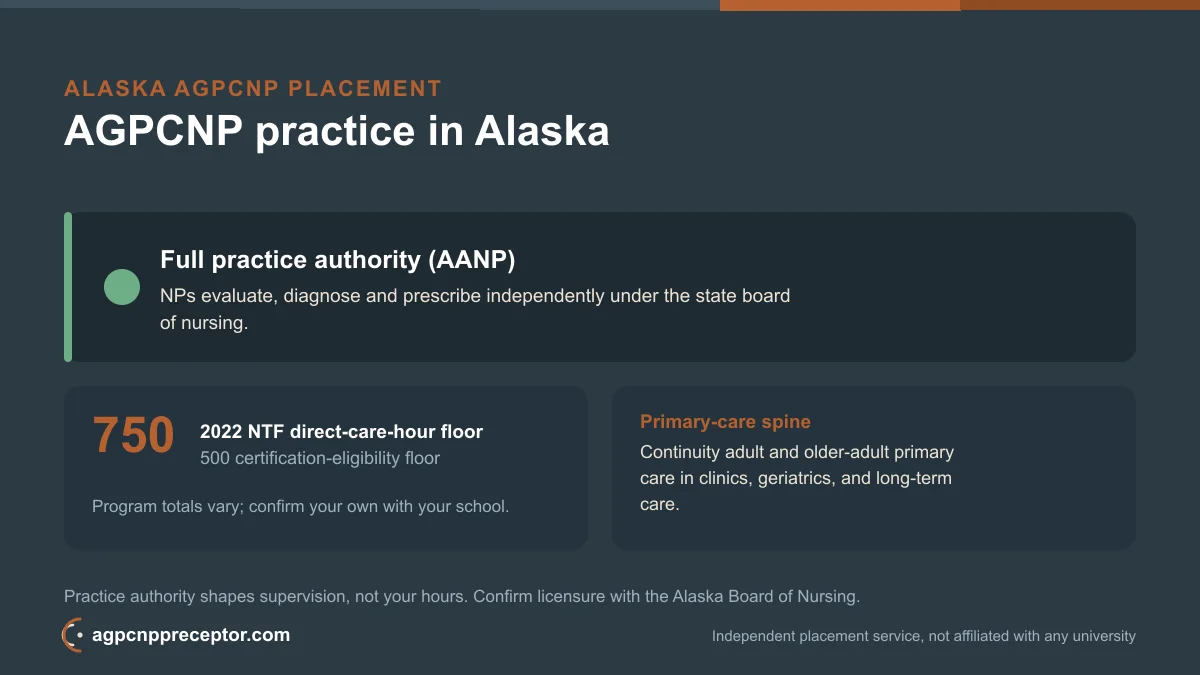
Alaska is a full-practice state. A nurse practitioner can evaluate, diagnose, and prescribe under the exclusive authority of the Alaska Board of Nursing, with no collaborative agreement required. For your rotation, the practical benefit is that an experienced adult-gerontology primary care nurse practitioner can serve as your preceptor and sign off independently, without a physician needing to co-sign the arrangement.
Your preceptor is generally a board-certified adult-gerontology or family primary-care NP (AANP A-GNP or ANCC AGPCNP-BC), or a physician in internal medicine, family medicine, or geriatrics. Full practice widens the pool of NPs who can precept on their own, which helps in a state where providers are spread thin. Our preceptor requirements page has the details.
Which Alaska hours are hardest to secure
The limiting factor in Alaska is supply, not category. General adult primary care is available in the metros, but the sheer number of providers is small, and a single clinic may already host students from other programs. Dedicated geriatrics with a willing preceptor is the scarcest piece, as it is nationally, and here it is concentrated in a handful of towns and the Pioneer Homes.
Distance is the other constraint. Frontier and village rotations can offer rich continuity, but travel, housing, and credentialing take lead time, so they reward early planning. If you are set on a rural or tribal experience, start the conversation well before your term and stay flexible on location.
How we place your Alaska rotations
We run the search for you and aim it where Alaska's primary-care and geriatric capacity actually sits. Tell us your city or region, your program, and the rotations you still need, and we work to source a qualified adult-gerontology primary care preceptor and an approvable site with enough lead time for any affiliation agreement.
We are independent and serve students at any university, and we never guarantee placement, hours, or your school's approval of a preceptor or site. To begin, use the match form here or reach us through contact, and read how it works.
Good to know
Is Alaska a full-practice state for nurse practitioners?
Yes. Nurse practitioners practice under the exclusive authority of the Alaska Board of Nursing with no collaborative agreement, so an experienced AGPCNP can serve as your preceptor and sign off independently. Confirm the current rules with the board.
Where do AGPCNP students train in Alaska?
Mostly Anchorage, the Mat-Su, Fairbanks, Juneau, and the Kenai Peninsula, where clinics and community health centers cluster. Frontier and village care runs through the tribal health system and is possible with extra planning for travel and housing.
Can I get geriatric hours in Alaska?
Yes, though dedicated geriatrics is the scarce piece. The six Pioneer Homes, skilled nursing facilities, and primary-care practices with older-adult panels supply most of it, and Alaska's senior population is growing quickly, so the demand is real.
How many clinical hours will my program require?
Your program sets the total, not the state. The 2022 NTF Standards recommend a minimum of 750 direct patient care hours, while certification eligibility requires at least 500. Many AGPCNP programs publish totals from roughly 500 to 750 or more, and some sit below 750, so confirm your own. See our clinical hours guide.
Secure both ends of the arc, not just one
Tell us your school, your city, and the hours you still need across the continuum. We will come back with a plan that reaches from continuity primary care to genuine frail-elder exposure, and a realistic path to placed.