Finding adult-gerontology primary care rotations in Alabama
Adult-gerontology primary care in Alabama happens mostly in clinics, community health centers, and long-term care settings rather than the hospital, so planning your AGPCNP rotations here is about finding the right ambulatory and residential sites near you. The clinical density sits in Birmingham, Huntsville, Montgomery, Mobile, and the Tuscaloosa and Dothan regions, while much of the Black Belt and the rural counties are federally designated primary-care shortage areas. This page maps where AGPCNP students actually train in Alabama and how we help you secure those hours. We are an independent service and serve students at any university.
Tell us your school and city. It is free to ask, with no obligation.
The primary-care settings that host AGPCNP students in Alabama
AGPCNP training is longitudinal and non-emergent, so your hours sit in ambulatory and residential care rather than the inpatient floors. Across Alabama, the settings that take adult-gerontology primary care students include adult and internal-medicine primary care practices, family-medicine offices carrying a large adult panel, community health centers and federally qualified health centers with adult patients, dedicated geriatrics practices, and skilled nursing and long-term care facilities. Home-based primary care and assisted living round out the mix in the metros.
For continuity hours, students also rotate through chronic-disease management and adult specialty primary care clinics such as endocrinology, cardiology, and nephrology, where the same patients return across a semester. What each site counts toward is set by your program, not the state, so confirm your requirements before you build a rotation around a given clinic.
Where Alabama's aging population and geriatric demand concentrate
Adult-gerontology scope runs from adolescence, roughly age 13, through the frail elderly, and the older end of that range is what drives geriatric and long-term-care demand. Alabama's retirees cluster along the Gulf Coast in Baldwin County, around Fairhope and the beach communities, and in the smaller rural counties whose younger residents have moved away, leaving an older population behind. The metros carry the volume of general adult primary care, while the coast and the rural counties concentrate the geriatric load.
The state runs a single Program of All-Inclusive Care for the Elderly, Mercy LIFE, in the Mobile and Baldwin county area, so PACE experience is geographically limited here. Most geriatric hours therefore come from nursing homes, assisted living, and primary-care practices with a heavy older-adult panel rather than a dedicated program. The Alabama Department of Public Health has flagged geriatric health as a rising priority as the share of residents over 65 grows.
How Alabama's reduced-practice rules shape your preceptor
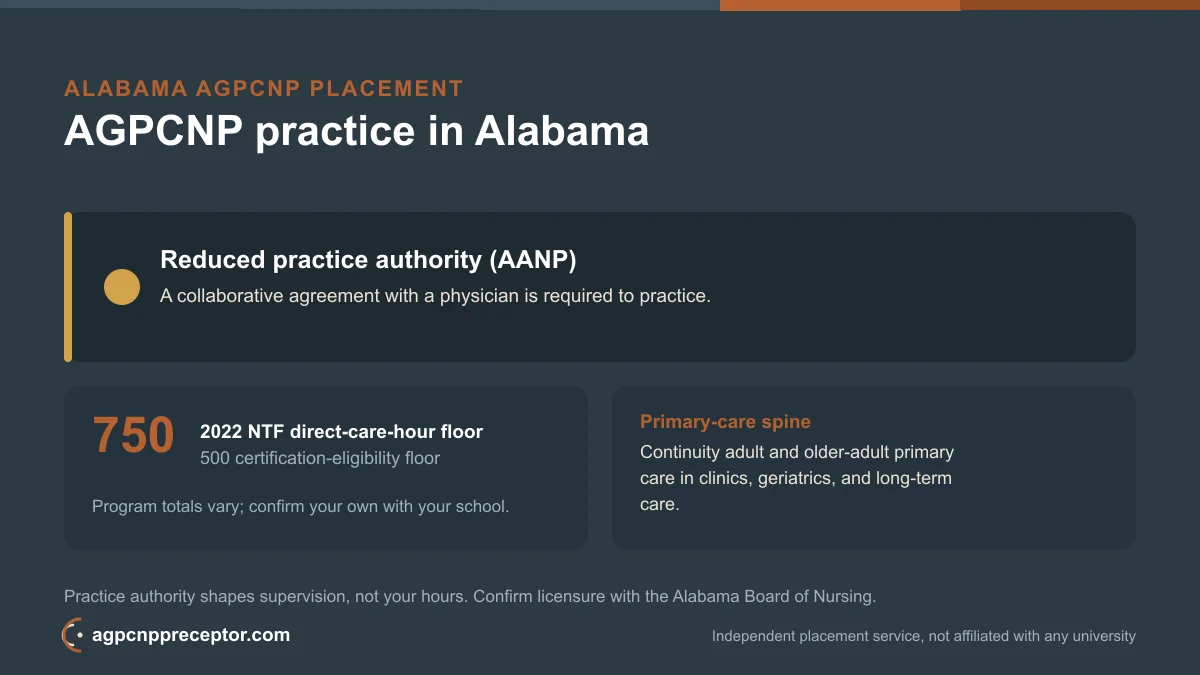
Alabama is a reduced-practice state. A certified registered nurse practitioner works under a collaborative practice agreement that the Alabama Board of Nursing and the Alabama Board of Medical Examiners approve jointly, with a separate certificate for controlled substances. That framework decides the supervision structure, and it shapes who signs on as your preceptor.
In practice this is manageable. Your preceptor is generally a board-certified adult-gerontology or family primary-care nurse practitioner (AANP A-GNP or ANCC AGPCNP-BC), or a physician in internal medicine, family medicine, or geriatrics, and in a reduced-practice state a collaborating physician is often already part of the clinic. The collaboration governs the arrangement, not the preceptor's core qualifications. Our preceptor requirements page covers who qualifies.
The Alabama hours that are hardest to line up
General adult primary care is the easiest category to fill in Alabama, because family and internal-medicine practices sit wherever the population does. The scarce piece is dedicated geriatrics and long-term-care time with a preceptor who will sign, since much older-adult care is folded into general primary care rather than a standalone geriatric practice. With only one PACE site statewide, students who need a structured geriatric block often look to nursing facilities and assisted living.
Rural placement adds friction. In the Black Belt and other shortage areas, clinics run lean and a single provider may not have room to take a student, which pushes some rotations toward the metros or requires travel. Planning early is what keeps the geriatric and long-term-care hours from becoming the block that stalls your term. See our clinical hours guide for how the categories usually break down.
How we place your Alabama primary-care rotations
We run the search for you, aimed at where Alabama's ambulatory and residential capacity actually sits. You tell us your city, your program, and the rotations you still need, and we source a qualified adult-gerontology primary care preceptor and an approvable site, early enough to clear any affiliation agreement your school requires.
We serve students at any university and never guarantee placement, hours, or your school's approval of a given preceptor or site; final sign-off rests with the site and your program. To start, use the match form on this page or reach us through contact, and see how it works for the full process.
Good to know
Is Alabama a full-practice state for nurse practitioners?
No. Alabama is a reduced-practice state. A CRNP practices under a collaborative practice agreement approved jointly by the Alabama Board of Nursing and the Alabama Board of Medical Examiners, with a separate certificate for controlled substances. In primary care a collaborating physician is often already in the clinic, so this shapes the supervision structure more than your preceptor's qualifications. Confirm current rules with the state board.
Where do AGPCNP students find geriatric hours in Alabama?
Dedicated geriatrics is the scarce piece. Alabama runs one PACE program, Mercy LIFE, in the Mobile and Baldwin area, so most geriatric time comes from nursing homes, assisted living, and primary-care practices with a large older-adult panel. Retirees concentrate on the Gulf Coast and in the rural counties.
How many primary-care hours will I need in Alabama?
That is set by your program, not the state. The 2022 NTF Standards recommend a minimum of 750 direct patient care hours per NP track, while AANP and ANCC certification eligibility requires at least 500. Many AGPCNP programs publish totals from roughly 500 to 750 or more, and some sit below 750, so confirm your own. Simulation is excluded. See our clinical hours guide.
What kind of preceptor do I need for AGPCNP primary care?
Generally a board-certified adult-gerontology or family primary-care NP (AANP A-GNP or ANCC AGPCNP-BC), or a licensed MD or DO in internal medicine, family medicine, or geriatrics. Your program sets the final rule. See our preceptor requirements page.
Can you guarantee a placement in Alabama?
No honest service can. Sites approve students individually and preceptor time is limited, especially in geriatrics and rural clinics. We source and verify a qualified preceptor and an approvable site, prepare the paperwork, and start early, but final approval rests with the site and your school.
Secure both ends of the arc, not just one
Tell us your school, your city, and the hours you still need across the continuum. We will come back with a plan that reaches from continuity primary care to genuine frail-elder exposure, and a realistic path to placed.