AGPCNP primary care preceptors across Wisconsin
Wisconsin pairs busy adult primary care in its southern cities with a rapidly aging rural north that is short on providers, and both sides give adult-gerontology primary care students real longitudinal work. We are an independent service that helps AGPCNP students at any program find a preceptor matched to non-emergent, chronic-disease-focused adult care. The state's practice rules are in transition in 2026, and we track that closely so your arrangement fits the law in force when you rotate.
Tell us your school and city. It is free to ask, with no obligation.
Where AGPCNP students find hours in Wisconsin
The southern and eastern population belt does the heavy lifting for clinic volume. Milwaukee, Madison, Green Bay, the Fox Valley around Appleton, Kenosha, Racine, Eau Claire, and La Crosse hold most of the internal medicine and multispecialty groups, and they are the quickest place to build a general adult primary care base.
Typical host settings for the track include:
- Internal medicine and adult primary care practices in the metros
- Federally qualified and community health centers with adult panels
- Dedicated geriatrics clinics and team-based elder-care programs
- Skilled nursing, rehabilitation, and assisted living communities
- Home-based primary care and house-call teams
- Chronic-disease specialty clinics such as endocrinology, cardiology, and nephrology for continuity hours
An adult primary care rotation in one of these cities is usually the most straightforward block to secure, with specialty continuity time available when a general panel does not cover every requirement.
The aging north and long-term care deserts
Wisconsin's demographic weight is shifting north. In a number of rural northern counties, projections put the share of residents age sixty and older near half of the population within the next decade, and the statewide count of people seventy-five and older is expected to climb sharply over the next twenty years.
That surge is colliding with what researchers describe as long-term care deserts, rural areas where facility beds and home-care workers are scarce and the nearest hospital can be an hour away. For an AGPCNP student, the north offers deep, complex geriatric panels and often close preceptor mentorship, but fewer sites overall, so placements there reward early planning and some flexibility about location.
Geriatrics and team-based elder care
Wisconsin runs several managed long-term care models for older adults, including Family Care, PACE, and Partnership programs overseen through the state's aging and long-term care system. These programs, along with skilled nursing and assisted living communities, are where purpose-built geriatric hours live.
As in most states, dedicated geriatrics and long-term care are the scarce piece, because so much older-adult care happens inside general primary care panels. If your program expects distinct geriatric or facility time, we open a geriatrics rotation or long-term care rotation search first and build the primary care block around it.
Practice rules today and the 2026 change
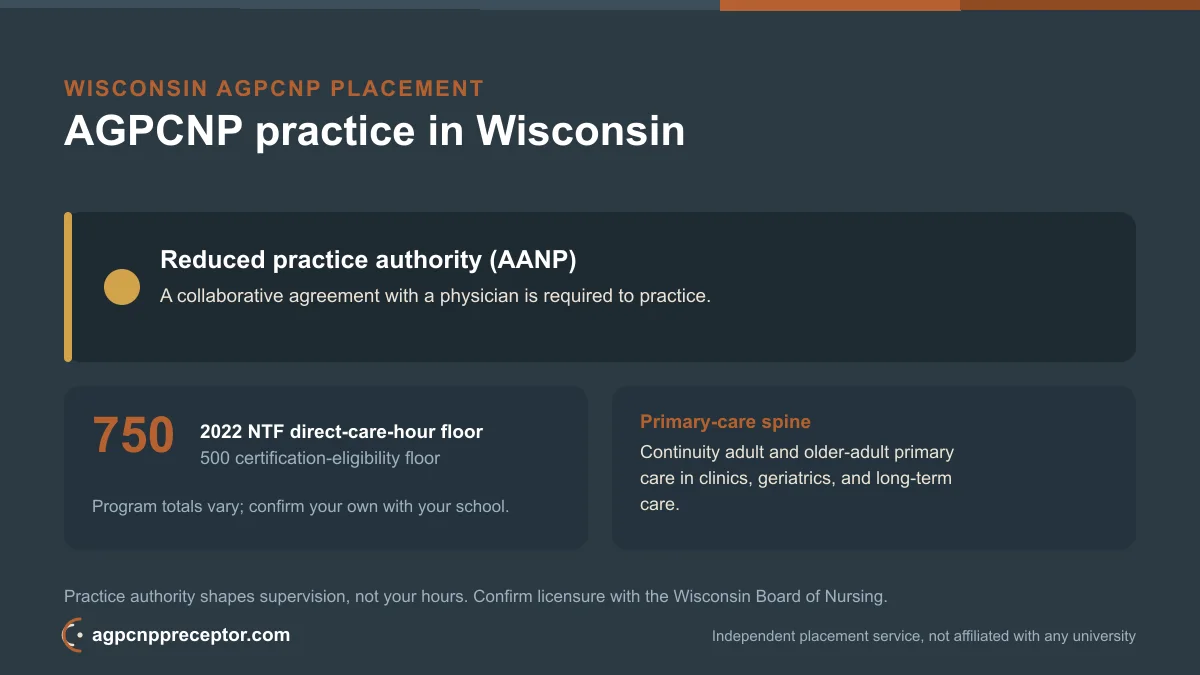
Wisconsin is a reduced-practice state under the AANP State Practice Environment. Advanced practice nurse prescribers currently work with physician collaboration for prescribing. A significant change is arriving: 2025 Wisconsin Act 17, the APRN Modernization Act, takes effect on September 1, 2026, and creates a pathway to independent practice after an APRN completes a defined period of practice hours in the registered nurse role and additional hours in the APRN role with a physician or dentist available for consultation.
Until that date, and for prescribers who have not yet met the new pathway, collaboration remains the operating reality, so we plan your arrangement around the rules actually in force during your term. The Wisconsin Board of Nursing within the Department of Safety and Professional Services regulates the credential and is drafting the implementing rules. Whoever anchors your placement, a preceptor is generally a board-certified adult-gerontology or family primary care NP, or a licensed physician in internal medicine, family medicine, or geriatrics; our AGPCNP preceptor requirements summarize the general standard, and current details should be confirmed with the board.
Community health centers and continuity
Beyond the big systems, Wisconsin's community health centers and rural health clinics carry adult panels that return for ongoing care, which is what longitudinal AGPCNP hours are meant to capture. These sites are common across the state and are used to hosting students.
They also concentrate the chronic-disease work the track is built on, so a community health rotation or a targeted chronic-disease management rotation often rounds out a schedule that started with a metro primary care base.
How we match you
We handle outreach, confirm that a preceptor's certification and license fit the adult-gerontology primary care scope, and help assemble the affiliation paperwork your school asks for. We serve students at any university, we assist and coordinate, and we never guarantee placement or your school's approval of any preceptor or site.
Plan around your own program's hours. The 2022 National Task Force standards recommend a minimum of 750 direct patient care hours, national certification requires at least 500 faculty-supervised hours, and many accredited AGPCNP programs publish totals below 750, so confirm your number and note that simulation is excluded. See AGPCNP clinical hours and how it works, then start with the form at #match.
Good to know
How does Wisconsin's 2026 practice-law change affect my rotation?
The APRN Modernization Act, effective September 1, 2026, opens a pathway to independent practice once an APRN completes the required practice hours. Until then, and for prescribers who have not met the pathway, physician collaboration still applies, so we match your arrangement to the rules in force during your specific term.
Is the aging north a realistic place to train?
Yes, and it offers unusually deep geriatric panels because so much of the population is older. The trade-off is fewer sites and longer drives in long-term care desert regions, so those placements reward planning ahead and some flexibility about which county you rotate in.
Where are geriatric and long-term care hours hardest to secure?
Dedicated geriatrics and facility hours are the tight spot statewide, since most older-adult care sits inside general primary care. Managed elder-care programs, nursing facilities, and assisted living communities fill quickly, so we start that search before the primary care block.
Which Wisconsin cities are easiest for an adult primary care base?
Milwaukee, Madison, Green Bay, the Fox Valley, Eau Claire, and La Crosse have the most internal medicine and community clinic volume, so a general primary care block is usually quickest to arrange in or near those areas.
Can you help if my program requires fewer than 750 hours?
Yes. Hour totals are set by each program, and many AGPCNP programs sit below 750 while others meet or exceed the recommended minimum. Tell us your exact requirement and we build the plan around it.
Secure both ends of the arc, not just one
Tell us your school, your city, and the hours you still need across the continuum. We will come back with a plan that reaches from continuity primary care to genuine frail-elder exposure, and a realistic path to placed.