AGPCNP primary care preceptors in West Virginia
West Virginia is one of the oldest and most rural states in the country, and its adult-gerontology primary care work is defined by long-term chronic-disease management for an aging Appalachian population. We are an independent service that helps AGPCNP students at any program find a preceptor whose panel matches that longitudinal focus. The state uses a reduced-practice model, so a collaborating physician is usually part of the arrangement, and we plan for that from the start.
Tell us your school and city. It is free to ask, with no obligation.
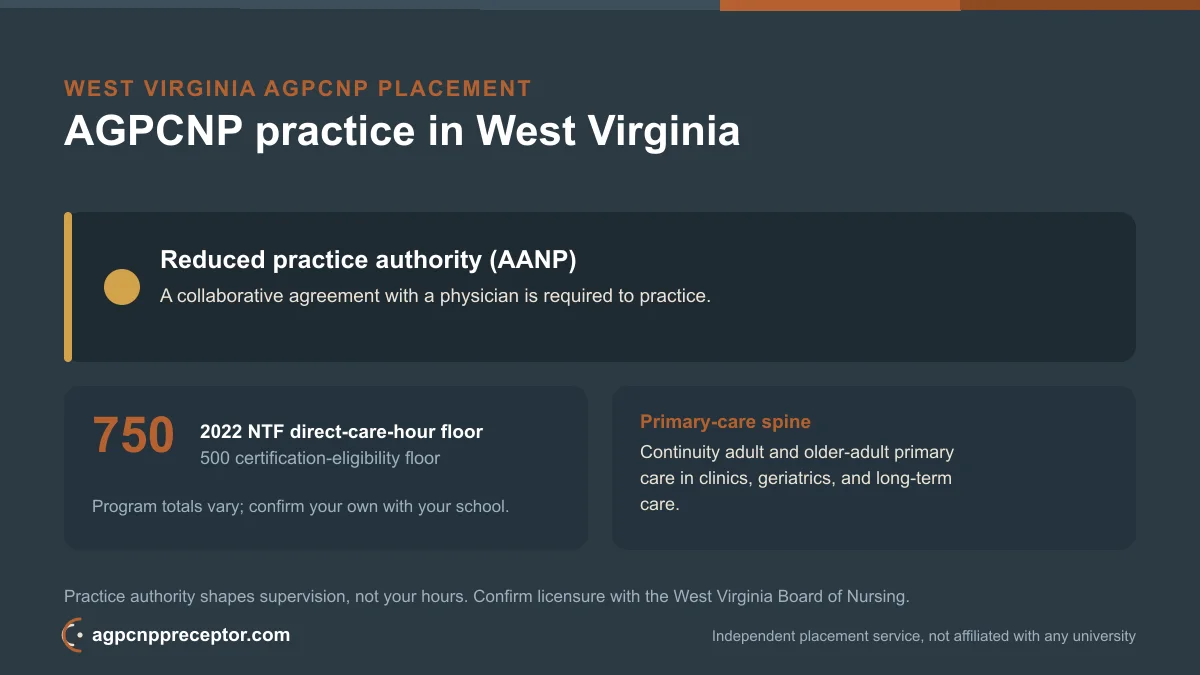
An older, rural state with heavy chronic-disease need
West Virginia's population skews older than the national average, and out-migration of younger residents from the southern coalfields has left many communities weighted toward seniors. That demographic drives a caseload rich in diabetes, hypertension, chronic obstructive pulmonary disease, heart disease, and multiple co-occurring conditions, which is the core of adult-gerontology primary care.
For a student, this means the everyday panel you follow will lean squarely toward the older adult and complex-chronic patient the AGPCNP track is built around. A chronic-disease management rotation is rarely hard to justify here because that work is simply what most primary care visits involve.
The community health center backbone
West Virginia has a long history with community-based primary care, and today the state is served by a large network of federally qualified health center sites along with dozens of rural health clinics. For AGPCNP students, this network is the single most reliable source of continuity hours, especially outside the few metro areas.
These sites carry adult panels that return month after month, and they are used to teaching. Practical hubs where students most often rotate include:
- Charleston and the Kanawha Valley
- Huntington and the Ohio River corridor
- Morgantown and the north-central region
- Wheeling and the northern panhandle
- Parkersburg, Beckley, and the southern coalfield towns
Because nearly every county in the state includes a designated shortage area, an community health rotation often doubles as a primary care base and a window into underserved-population care.
Geriatrics, nursing homes, and the PACE gap
Dedicated geriatrics is the harder ask in West Virginia. Much of the older-adult care happens inside general primary care and family practices rather than standalone geriatric clinics, so purpose-built geriatric preceptors are thin on the ground.
The state does have a substantial base of skilled nursing and long-term care facilities, which are a strong avenue for residential geriatric hours. One planning note that matters here: West Virginia does not operate a PACE program of its own, so unlike some neighboring states you cannot lean on PACE sites for that model of team-based elder care. That makes nursing facilities, assisted living communities, and any home-based primary care options more important to line up early. If your program requires distinct geriatric or facility time, start a long-term care rotation or geriatrics rotation search well ahead of the term.
Practice rules, collaboration, and the three-year path
West Virginia is a reduced-practice state under the AANP State Practice Environment. Nurse practitioners hold prescriptive authority through a written collaborative agreement with a physician that sets shared guidelines and periodic review. After at least three years of documented collaborative practice with granted prescriptive authority, an NP may apply to the board to prescribe without a further collaborative agreement, a meaningful step toward autonomy that many experienced providers pursue.
For your placement, this mostly determines who anchors the arrangement. A newer NP practices within the collaborative structure, while a seasoned NP who has completed the pathway can operate more independently. Either can be a fine preceptor. The core standard does not change: a preceptor is generally a board-certified adult-gerontology or family primary care NP, or a licensed physician in internal medicine, family medicine, or geriatrics. Licensing is handled by the West Virginia Board of Registered Nurses, and your program sets the paperwork. See AGPCNP preceptor requirements for the general picture.
How the terrain shapes your search
Geography is the quiet constraint in West Virginia. The mountainous landscape and long, winding drives mean that the nearest suitable practice can be an hour away even when it looks close on a map, and provider shortages touch nearly every rural county.
We factor real drive times into the plan rather than the straight-line distance, and we look for a preceptor whose panel and setting fit your program's requirement so you are not commuting for hours to log the wrong kind of visit. Students who are flexible about which valley or river town they train in usually have the widest set of options.
Working with the AGPCNP Preceptor team
We handle outreach, confirm that a preceptor's certification and license fit the adult-gerontology primary care scope, and help organize the affiliation documents your school requires. We are independent and serve students at any university; we assist and coordinate, and we never guarantee placement or your school's approval of a preceptor or site.
Match your plan to your program's hours. The 2022 National Task Force standards recommend a minimum of 750 direct patient care hours, national certification requires at least 500 faculty-supervised hours, and many accredited AGPCNP programs publish totals below 750, so confirm your own requirement and remember simulation does not count. Read AGPCNP clinical hours, then start with the form at #match or reach us through find a preceptor.
Good to know
Why is West Virginia a good fit for AGPCNP training?
Its older, rural population means most primary care panels are rich in the chronic-disease and geriatric care the AGPCNP track centers on. The state's large community health center network gives students dependable continuity hours, even in counties with provider shortages.
How does reduced practice affect my preceptor arrangement?
It usually folds a collaborating physician into the setup. A newer NP practices under a written collaborative agreement, while an NP who has completed three years in that arrangement can apply to prescribe independently. Either can precept you; it mainly changes who signs on, not the qualifications.
Where do I find geriatric and long-term care hours in West Virginia?
Skilled nursing and long-term care facilities are your main avenue, since the state has no PACE program and dedicated geriatric clinics are limited. Because those facility slots are scarcer than general primary care, we start that search early when your program requires distinct geriatric time.
Is travel a real obstacle for rotations here?
It can be. Mountainous terrain makes drive times longer than they look, and shortage areas cover most rural counties. We plan around actual travel time and your program's requirement so you are not driving hours to log visits that do not fit your track.
Do you guarantee a placement or a set number of hours?
No. We coordinate qualified preceptors and paperwork, but hour totals are set by your program and final approval rests with your school and the board. We are upfront about that before you commit.
Secure both ends of the arc, not just one
Tell us your school, your city, and the hours you still need across the continuum. We will come back with a plan that reaches from continuity primary care to genuine frail-elder exposure, and a realistic path to placed.