AGPCNP primary care preceptors across Washington
Washington gives adult-gerontology primary care nurse practitioner students two very different worlds to train in: dense internal medicine and community clinics around Puget Sound, and spread-out rural practices east of the Cascades where an older population leans hard on a handful of providers. We are an independent service that helps AGPCNP students at any program find a preceptor suited to longitudinal, non-emergent adult care. Because Washington grants full practice authority, an experienced AGPCNP can precept you without a physician in the arrangement, which widens your options.
Tell us your school and city. It is free to ask, with no obligation.
Puget Sound density versus the rural east
The western corridor from Seattle and Bellevue through Tacoma and Everett holds most of the state's clinic volume. Internal medicine groups, large multispecialty systems, and community health centers there see high adult volume, and they are the fastest place to build a general primary care base.
East of the Cascades the picture changes. Spokane anchors the northeast, while Yakima, the Tri-Cities of Kennewick, Pasco, and Richland, Wenatchee, and Walla Walla serve agricultural regions with fewer providers per resident. Rural Washingtonians travel much farther for routine care; studies of the state have found rural patients with Alzheimer's disease driving roughly three times as far to reach a primary care provider as their metro counterparts. For an AGPCNP student, that distance is also the reason a rural preceptor often gives you a deeper, more continuous panel to follow.
Settings that host AGPCNP students in Washington
Adult-gerontology primary care is the ongoing management of adolescents through frail elders in ambulatory and residential settings, so your placement should center on continuity rather than episodic visits.
Common host settings across the state include:
- Internal medicine and adult primary care practices in the metro corridors
- Federally qualified and migrant or community health centers with large adult panels
- Dedicated geriatrics clinics and PACE programs serving older adults
- Skilled nursing, rehabilitation, and assisted living communities
- Home-based primary care and house-call teams for home-bound elders
- Chronic-disease specialty clinics, including endocrinology, cardiology, and nephrology, used for continuity hours
Washington's community health center network is deep, with dozens of rural sites, so an community health rotation is often a realistic option even outside the big cities. Where a general panel does not cover every requirement, a focused chronic-disease management rotation can complete the longitudinal picture.
Aging communities and where geriatric demand sits
Older adults are not evenly distributed in Washington. The Olympic Peninsula, the San Juan and other island counties, and many rural counties in the east and northeast carry a higher share of residents over sixty-five, and their care systems feel the strain first.
Several rural Washington systems have pursued age-friendly recognition, building primary care clinics, a critical access hospital, and a nursing home into a coordinated model for older patients. PACE programs operate in the Seattle and Spokane areas, and skilled nursing and assisted living communities are spread statewide. These are exactly the sites that give an AGPCNP student real geriatric depth, and they are worth targeting deliberately rather than hoping one turns up near a primary care placement.
Geriatric and long-term care hours are the tight spot
As in most states, the hours that are hardest to secure in Washington are not general adult primary care; they are dedicated geriatrics and long-term care. So much adult care sits inside broad family and internal medicine panels that purpose-built geriatric practices and nursing facilities have fewer preceptor openings and fill them early.
We treat that as the anchor of the plan. If your program expects distinct geriatric or long-term care time, we open a geriatrics rotation or long-term care rotation search first and fit the primary care block around it, since primary care sites are the more plentiful side of the equation.
Full practice authority and who can precept
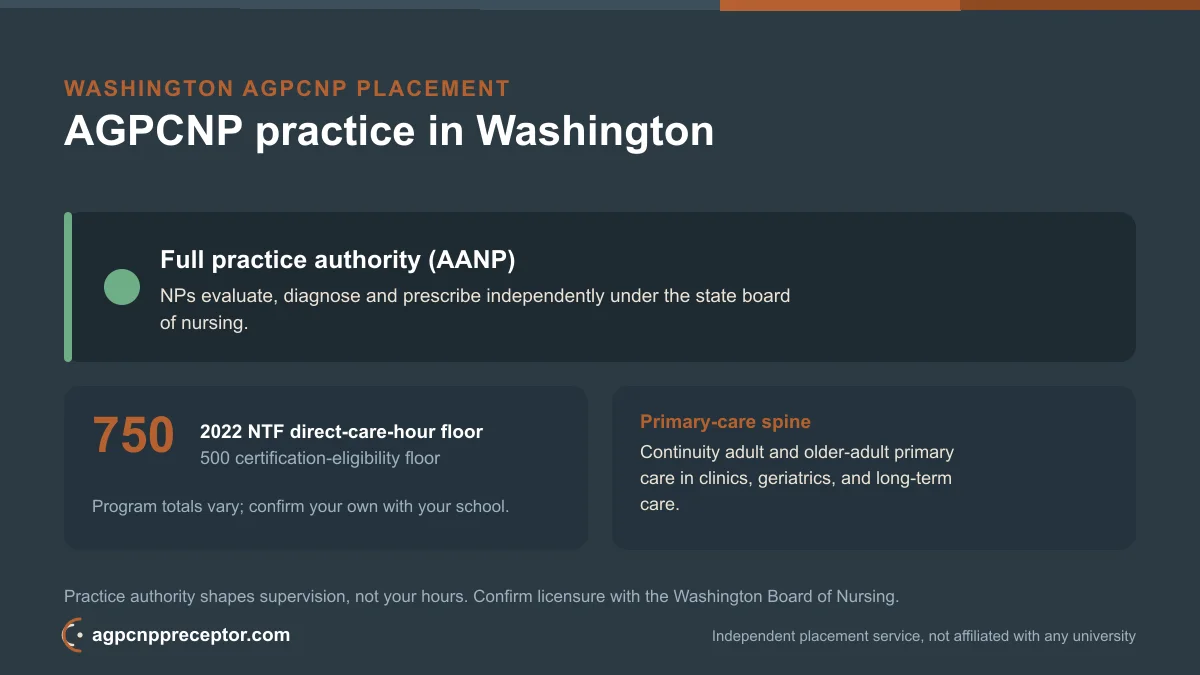
Washington is a full-practice state under the AANP State Practice Environment. Advanced registered nurse practitioners evaluate patients, order and interpret testing, diagnose, and prescribe, including controlled substances, without a required collaboration or supervision agreement. The Nursing Care Quality Assurance Commission within the Department of Health regulates ARNP licensure and standards.
For your rotation this is an advantage. An experienced AGPCNP can serve as your preceptor on their own authority, so you are not limited to physician-led practices. A preceptor is generally a board-certified adult-gerontology or family primary care NP, or a licensed physician in internal medicine, family medicine, or geriatrics, and the specific expectations come from your program rather than one national rule. Our AGPCNP preceptor requirements page lays out the general standard; confirm licensure specifics with the commission.
How we help you place
We do the outreach, verify that a preceptor's certification and license match the adult-gerontology primary care scope, and help assemble the affiliation documents your school needs. We serve students at any university, we assist and coordinate, and we do not guarantee placement or your school's approval of any preceptor or site.
Plan your hours around your own program. The 2022 National Task Force standards recommend a minimum of 750 direct patient care hours, national certification requires at least 500 faculty-supervised hours, and many accredited AGPCNP programs publish totals below 750, so verify your number and note that simulation is excluded. See AGPCNP clinical hours and how it works, then start with the form at #match.
Good to know
Where is it easiest to find an AGPCNP preceptor in Washington?
The Puget Sound corridor around Seattle, Bellevue, Tacoma, and Everett has the most internal medicine and community clinic volume, so a general primary care base is usually quickest there. Eastern hubs like Spokane, Yakima, and the Tri-Cities offer fewer but often deeper continuity placements.
Does full practice authority actually change my placement?
Yes, in a helpful way. Because Washington ARNPs practice independently, an experienced AGPCNP can precept you directly, so you are not restricted to physician-supervised sites. That tends to widen the pool of qualified preceptors compared with reduced or restricted states.
How do I get geriatric or long-term care hours in Washington?
Target dedicated geriatrics clinics, PACE programs in the Seattle and Spokane areas, and skilled nursing or assisted living communities early, since those slots are scarcer than general primary care. We build the schedule around the geriatric block first when your program requires it.
Can rural eastern Washington work for an AGPCNP rotation?
It can be a strong fit. Rural and agricultural regions have a higher share of older adults and a deep community health center network, which often means more one-on-one preceptor time and a heavily adult panel, though you should plan for longer travel distances.
Do you promise a certain number of hours or a specific site?
No. We coordinate qualified preceptors and paperwork, but hour totals are set by your program and final approval rests with your school and the state. We are clear about what we can and cannot promise before you commit.
Secure both ends of the arc, not just one
Tell us your school, your city, and the hours you still need across the continuum. We will come back with a plan that reaches from continuity primary care to genuine frail-elder exposure, and a realistic path to placed.