Finding an AGPCNP primary care preceptor in Virginia
Virginia places adult-gerontology primary care nurse practitioner students in everyday, non-emergent settings, from internal medicine offices in Northern Virginia and Richmond to community health centers deep in the coalfields. As an independent service, we help AGPCNP students at any program find a preceptor who fits the longitudinal, chronic-disease focus of the track. Virginia is a restricted-practice state, so most arrangements still fold in a collaborating physician, and we plan around that from the first conversation.
Tell us your school and city. It is free to ask, with no obligation.
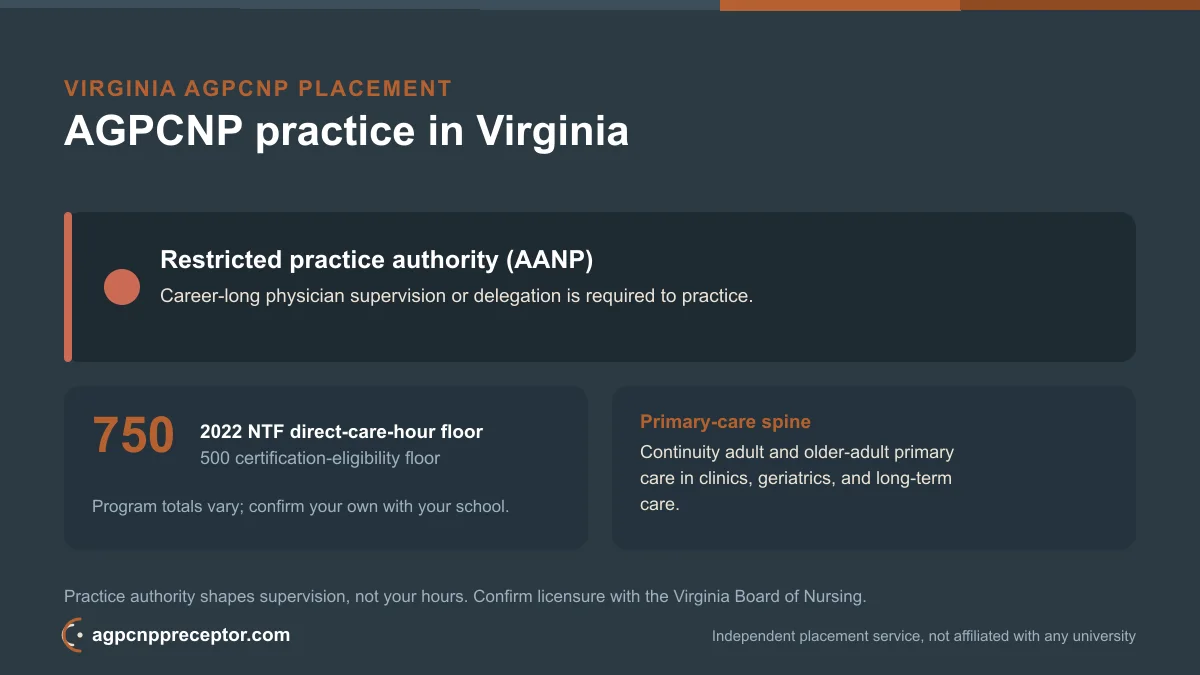
Where adult-gerontology primary care happens in Virginia
AGPCNP training is longitudinal and ambulatory or residential care for patients from adolescence through the frail elderly, not hospital acute care. In Virginia that translates into a spread of settings that see the same adult panel over months, which is exactly what your logged hours should reflect.
The settings that most often host AGPCNP students here include:
- Internal medicine and adult primary care groups in the larger metros
- Family medicine practices that carry a mostly adult and older-adult panel
- Dedicated geriatrics practices and Program of All-Inclusive Care for the Elderly (PACE) sites
- Skilled nursing, long-term care, and assisted living communities
- Home-based primary care and house-call programs
- Community health centers and federally qualified health centers with adult panels
- Chronic-disease specialty clinics used for continuity, such as endocrinology, cardiology, and nephrology
Clinic density is highest in Northern Virginia (Fairfax, Arlington, Loudoun, and Prince William), the Richmond region, and Hampton Roads around Virginia Beach, Norfolk, and Newport News, with secondary hubs in Roanoke, Charlottesville, and Lynchburg. If you live near one of these, an adult primary care rotation is usually the most straightforward block to fill.
The primary care map, from the suburbs to the coalfields
Virginia's real challenge is geography. The state carries roughly one hundred primary care Health Professional Shortage Area designations spread across more than eighty counties and independent cities, and most of them sit outside the urban crescent.
Far Southwest Virginia and the Appalachian coalfields, the Southside counties along the North Carolina border, the Eastern Shore, and the Northern Neck are where the aging population concentrates and where primary care thins out. Community health systems in the southwest run multi-site networks that serve older, rural adults with limited transportation, and those sites are a strong source of continuity hours for students who can reach them.
That split shapes preceptor supply. Metro students compete for a large but crowded pool of internal medicine offices, while rural students find fewer sites but often more one-on-one time with a preceptor who manages a heavily geriatric panel. We map your commute against both patterns before we start outreach.
Geriatrics and long-term care, the hours to plan early
Across Virginia, the scarce piece is rarely general adult primary care; it is the dedicated geriatrics and long-term care time. Most adult care happens inside broad primary care panels, so purpose-built geriatrics practices, nursing facilities, and PACE sites fill their preceptor slots quickly.
Virginia does run PACE programs, including community-based sites in the far southwest serving rural seniors and additional programs in the Tidewater and central regions. Skilled nursing and assisted living communities exist statewide, and a growing number of house-call and home-based primary care groups cover home-bound elders. Because these settings are the bottleneck, we encourage students to open a geriatrics rotation or long-term care rotation search well ahead of the term rather than after the primary care block is booked.
How Virginia's practice rules shape your preceptor
Virginia is classified as a restricted-practice state by the AANP State Practice Environment. New nurse practitioners work under a written practice agreement with a patient care team physician. An NP may apply for an autonomous practice designation after attesting to the equivalent of three years of full-time clinical experience, a threshold reduced from five years in 2024; you should confirm the current hour count and process with the board.
For your rotation, this mostly affects who signs on as preceptor rather than the qualifications you need. An AGPCNP who holds the autonomous designation can precept you directly, while a newer NP or a physician-led practice typically supervises within the collaborating-physician structure. Either way, a preceptor is generally a board-certified adult-gerontology or family primary care NP, or a licensed physician in internal medicine, family medicine, or geriatrics. Licensing sits with the Virginia Board of Nursing under the Department of Health Professions, and the exact expectations for your paperwork come from your own program. See our summary of AGPCNP preceptor requirements for the general standard.
Specialty clinics that round out continuity hours
When a general primary care panel does not fully cover a program's chronic-disease expectations, Virginia's specialty clinics can supply focused continuity time. Endocrinology practices carry heavy diabetes and thyroid caseloads, cardiology groups manage hypertension and heart failure, and nephrology clinics follow chronic kidney disease over years.
These blocks work best as a complement to a primary care base, not a replacement for it, and they keep the emphasis on ongoing management rather than one-time visits. A chronic-disease management rotation or a targeted specialty primary care rotation is often how students in Richmond, Roanoke, or the Hampton Roads area finish a longitudinal requirement.
Working with the AGPCNP Preceptor team
We handle the outreach, confirm that a prospective preceptor's certification and license fit the adult-gerontology primary care scope, and help organize the affiliation paperwork your school asks for. We are independent and serve students at any university; we assist and coordinate, and we never guarantee placement or your school's approval of a given preceptor or site.
On hours, plan around your own program's number. The 2022 National Task Force standards recommend a minimum of 750 direct patient care hours, national certification requires at least 500 faculty-supervised hours, and many accredited AGPCNP programs publish totals below 750, so confirm what yours requires and remember that simulation does not count. Our overview of AGPCNP clinical hours and the how it works page explain the process. When you are ready, use the match form at #match or reach us through contact.
Good to know
Is Virginia a practical state to complete AGPCNP primary care hours?
Yes. The metros around Northern Virginia, Richmond, and Hampton Roads offer dense adult primary care, while rural community health centers in the southwest give strong continuity time with older adults. The main planning point is to line up geriatrics and long-term care blocks early, since those are the tighter slots.
Does restricted practice make it harder to find an AGPCNP preceptor here?
It shapes the supervision arrangement more than the core qualifications. An AGPCNP with Virginia's autonomous designation can precept you directly, while other practices fold in a collaborating patient care team physician. We account for that when we identify sites so the arrangement matches board expectations.
Which Virginia rotations are hardest to secure?
Dedicated geriatrics and long-term care are usually the scarce piece, because most adult care sits inside general primary care panels. PACE sites, nursing facilities, and home-based primary care programs in the southwest and Tidewater fill quickly, so we start those searches ahead of the primary care block.
Can you help if my program requires fewer than 750 hours?
Yes. Hour totals are set by each program, not one national mandate, and many AGPCNP programs sit below 750 while others meet or exceed the recommended minimum. Tell us your program's exact requirement and we build the placement plan around it.
Do you guarantee my school will approve the preceptor?
No. We identify and coordinate suitable preceptors and help with paperwork, but final approval of any preceptor or site rests with your program and the state board. We are transparent about that at every step.
Secure both ends of the arc, not just one
Tell us your school, your city, and the hours you still need across the continuum. We will come back with a plan that reaches from continuity primary care to genuine frail-elder exposure, and a realistic path to placed.