Adult-gerontology primary care rotations across Vermont
Vermont is a full practice authority state and one of the oldest states in the country by median age, so adult-gerontology primary care demand runs through nearly every county. Your AGPCNP hours here sit in a strong network of community health centers, family and internal medicine clinics, and the nursing homes, residential care homes, and home-based programs that an aging rural population depends on. We help you line up both the continuity primary care and the genuine geriatric hours when your program leaves the search to you.
Tell us your school and city. It is free to ask, with no obligation.
An aging state, where geriatric demand is everywhere
Vermont's defining feature for AGPCNP training is its age. It is among the oldest states in the country, and older adults account for a large share of the state's health care use, including roughly half of all hospital inpatient discharges. That means the frail-elder end of the AGPCNP arc is not a niche here; it runs through primary care in almost every town.
For a student, that is an advantage on the geriatric side and a challenge on supply, since the same rural geography that ages the population also spreads clinicians thin. The settings that host adult-gerontology primary care rotations in Vermont include:
- Community health centers, a dense network of federally qualified health centers with primary care sites reaching every county
- Adult and internal medicine primary care in the Burlington area and regional towns
- Long-term care and geriatrics in nursing homes, assisted living, and residential care homes
- Home-based primary care and house-call programs that reach older adults where they live, including through home-and-community support models
A community health center backbone
For a small state, Vermont has an unusually strong primary care safety net. Its federally qualified health centers run dozens of primary care sites reaching into every county, and they serve a large share of the state's residents. For an AGPCNP student, these centers are genuine adult-gerontology classrooms, with continuity panels, high chronic-disease volume, and older patients who have been followed for years.
Burlington and the Chittenden County area hold the densest clinic supply and the state's academic medicine, while the rest of Vermont, including the rural Northeast Kingdom, runs on these health centers and regional practices. Chronic-disease clinics in fields such as endocrinology, cardiology, and nephrology add continuity hours where they are available.
Long-term care and home-based primary care
The geriatric end of the arc in Vermont is carried by a real long-term-care infrastructure: nursing homes, assisted living residences, and a large number of residential care homes, backed by home health agencies and hospice. Home-based primary care matters here too, since a house call is sometimes the most practical way an older Vermonter in a rural town sees a clinician.
For placement, that means genuine frail-elder hours usually come from a facility or a home-visit practice rather than a general clinic. Weaving those in, instead of hoping to log geriatric time in a family office, is what makes an AGPCNP plan here hold up across the full range.
Full practice, with a transition to independence
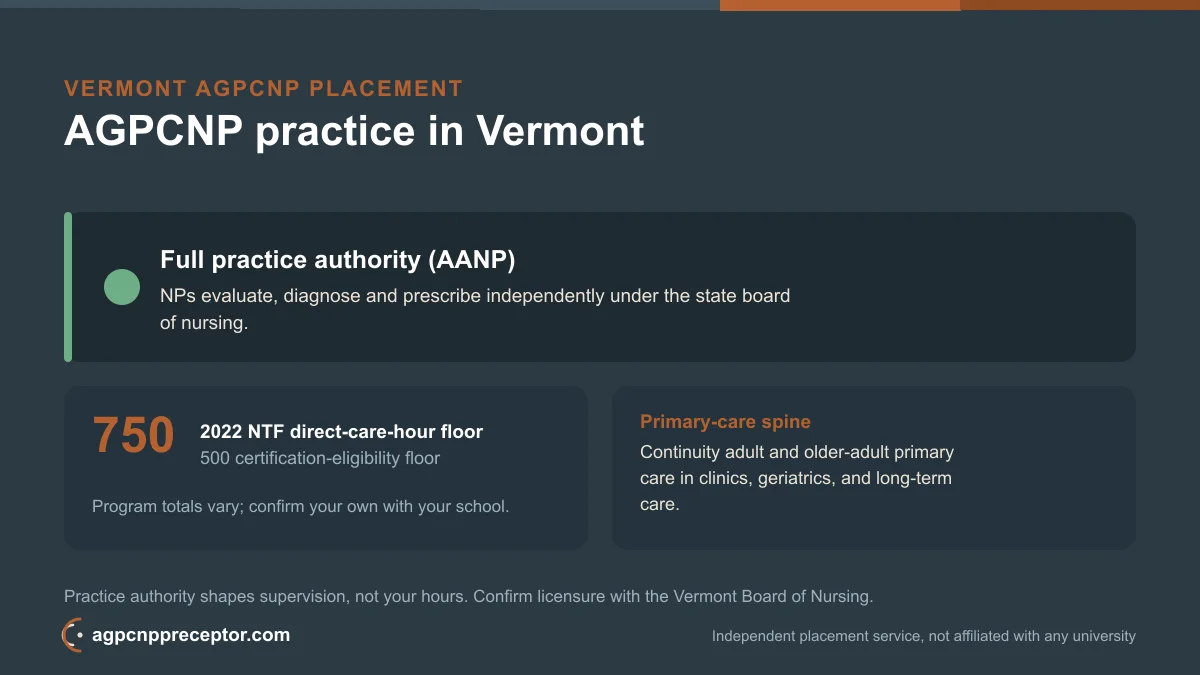
Vermont grants nurse practitioners full practice authority, so an experienced adult-gerontology or family primary care NP can own a panel and precept without a supervising physician folded into the arrangement. One detail worth knowing: Vermont nurse practitioners complete a defined transition-to-practice period, working under a collaborative arrangement before moving to full independence, so a very new NP may not yet precept on their own signature.
Your preceptor can be a board-certified adult-gerontology primary care or family nurse practitioner, or a physician in internal medicine, family medicine, or geriatrics, licensed in Vermont and practicing where you rotate. The Vermont Board of Nursing, within the Office of Professional Regulation, publishes the current terms.
Distance, and the hours hardest to lock down
Outside Burlington, Vermont is rural, and primary care clinicians are spread across small towns and long valleys, so students often travel to reach a clinic or facility with capacity. The scarce block, though, is not general primary care, which the health center network supplies well. It is a dedicated geriatrics or long-term-care preceptor who will sign for the frail-elder end of the range, since much of that care is delivered by staff clinicians who do not always take students.
Locking that geriatric piece early, alongside your continuity site, is the difference between finishing your clinical hours on time and stalling a term.
How we place AGPCNP students in Vermont
We source and vet adult-gerontology primary care preceptors, then handle the affiliation-agreement paperwork that slows most students down. Tell us your town, your program, and the mix of continuity, chronic-disease, and geriatric hours you still need, and we build a plan around the Burlington area, the community health center network, and the nursing homes or home-based practices within reach. Review the pricing, then start with the match form on this page. We match first, so the site and preceptor are real before anything is due.
Good to know
Why is Vermont a good state for AGPCNP geriatric hours?
Because it is one of the oldest states in the country, older adults are a large part of nearly every primary care panel, and long-term care is a visible part of the health system. That makes genuine frail-elder exposure easier to justify and arrange than in younger states, though a committed geriatrics preceptor still takes planning to secure.
Does full practice authority help me find a preceptor in Vermont?
Yes. Vermont nurse practitioners can practice under the sole authority of the Board of Nursing, so an experienced adult-gerontology or family primary care NP can precept independently. Newer NPs complete a transition-to-practice period first, so your preceptor will usually be a more established clinician who can sign on their own.
Where is primary care concentrated in Vermont?
Burlington and Chittenden County hold the densest clinic supply and the state's academic medicine, but the real backbone is the federally qualified health center network, which runs primary care sites in every county, including the rural Northeast Kingdom. That network makes continuity hours easier to find than in many rural states.
Can a physician precept my AGPCNP hours in Vermont?
Yes. A Vermont-licensed physician in internal medicine, family medicine, or geriatrics can precept, as can a board-certified adult-gerontology or family primary care nurse practitioner. Your program sets the final requirements, so we verify eligibility against your school's rules before you commit.
How many clinical hours will I need?
The 2022 NTF Standards recommend at least 750 direct patient care hours, while AANP and ANCC certification eligibility requires at least 500 supervised hours. Many AGPCNP programs publish totals from roughly 500 to 750 or more, and some sit below 750, so confirm your own program's number. Simulation does not count.
Secure both ends of the arc, not just one
Tell us your school, your city, and the hours you still need across the continuum. We will come back with a plan that reaches from continuity primary care to genuine frail-elder exposure, and a realistic path to placed.