Adult-gerontology primary care rotations across South Dakota
South Dakota grants nurse practitioners full practice authority, and its adult-gerontology primary care happens in two clinic hubs, Sioux Falls in the east and Rapid City in the west, wrapped by a wide band of rural and frontier counties. Most AGPCNP hours here sit in family and internal medicine offices with adult panels, community health centers, and the nursing homes and assisted living residences that small towns depend on. We help you line up both the continuity primary care and the genuine geriatric hours when your program leaves the search to you.
Tell us your school and city. It is free to ask, with no obligation.
Where adult primary care actually happens here
South Dakota is a mostly rural state with two real population centers. Sioux Falls anchors the east and holds the densest cluster of internal medicine and family medicine practices, adult chronic-disease clinics, and multispecialty groups with adult panels. Rapid City anchors the west and the Black Hills, serving as the referral and clinic hub for a huge, thinly settled region that reaches toward Wyoming and the reservations. Between and around them, primary care is delivered in small clinics, critical access hospital outpatient departments, and community health centers.
For an AGPCNP student, that geography usually decides where your ambulatory hours begin. The settings that host adult-gerontology primary care rotations here include:
- Adult and internal medicine primary care in the Sioux Falls and Rapid City clinic groups
- Community health centers run by the state's federally qualified health center organizations, which operate dozens of sites
- Chronic-disease clinics in endocrinology, cardiology, and nephrology used for continuity hours
- Geriatrics and long-term care in nursing homes, assisted living, and home-based visits
The geriatric and long-term-care end of the arc
AGPCNP training runs one long arc, from young adults through the frail elderly, and in South Dakota the older end is where demand is quietly concentrated. As younger residents leave many rural counties for work, the people who remain skew older, which loads geriatric and long-term-care need onto small towns that have few clinicians. Nursing homes, assisted living residences, and county long-term-care settings carry much of that care.
This is also where home-based primary care matters. In frontier counties a house call or a facility-based visit is sometimes the only realistic way an older adult sees a clinician, so those visits are a real part of the continuity picture. Building genuine frail-elder exposure into your rotation, rather than logging it all in a general clinic, is what makes an AGPCNP plan here credible.
Full practice, and what it means for your preceptor
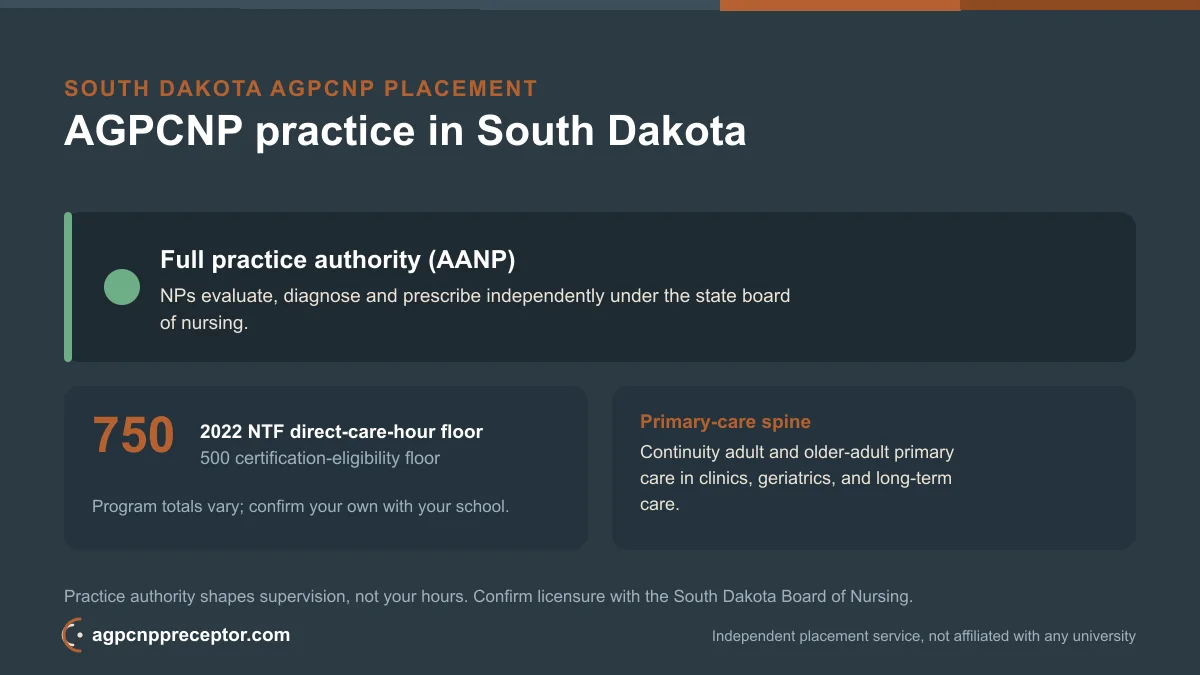
South Dakota is a full practice authority state, so an experienced adult-gerontology or family primary care nurse practitioner can own a panel and precept without a supervising physician folded into the arrangement. One caution worth knowing: newly licensed nurse practitioners in South Dakota complete a defined period of collaborative practice hours before they move to full independence, so a very new NP may not yet be positioned to serve as your sole preceptor. The South Dakota Board of Nursing publishes the current terms.
In practice this widens your options. Your preceptor can be a board-certified adult-gerontology primary care or family nurse practitioner, or a physician in internal medicine, family medicine, or geriatrics, licensed in South Dakota and practicing where you rotate. Full practice tends to mean more independent NP-led clinics that can take a student without a second signature.
Distance and the shortage-area reality
A large majority of South Dakota counties are designated rural or frontier, and only a handful sit without a primary care shortage. That has two effects on placement. First, primary care preceptors are spread thin, so the clinic that will take you may not be in your town. Second, students from the western ranch country, the central plains, or the reservations often relocate for a block to reach a clinic or geriatrics site with capacity.
Reservation and Indian Health Service settings add another primary care context across the state, serving communities with heavy chronic-disease and geriatric need. Planning travel and housing early, rather than after a term starts, is what keeps a South Dakota rotation from slipping.
Which hours are the hardest to secure
Because so much adult care sits in general primary care, the scarce piece here is dedicated geriatrics and long-term-care time with a preceptor who will sign for it. A family medicine office can usually cover continuity primary care and chronic-disease management. A committed geriatrics or nursing-home preceptor, willing to take a student through the frail-elder end of the range, is the harder find, and it is the block students most often stall on.
Locking that piece early, alongside your continuity site, is the difference between finishing your clinical hours on schedule and losing a term to the search.
How we place AGPCNP students in South Dakota
We source and vet adult-gerontology primary care preceptors, then carry the affiliation-agreement paperwork that slows most students down. Tell us your city, your program, and the mix of continuity, chronic-disease, and geriatric hours you still need, and we build a plan around the Sioux Falls or Rapid City hubs and any rural clinic or long-term-care site within reach. Review the pricing, then start with the match form on this page. We match first, so you know the site and preceptor are real before anything is due.
Good to know
Does full practice authority make it easier to find an AGPCNP preceptor in South Dakota?
It helps. Because South Dakota nurse practitioners can practice under the sole authority of the Board of Nursing, an experienced adult-gerontology or family primary care NP can precept independently, without a supervising physician written into the arrangement. That tends to mean more NP-led clinics able to take a student. Newly licensed NPs still complete a collaborative practice period first, so your preceptor will usually be a more established clinician.
Where are the primary care hours concentrated?
Sioux Falls in the east and Rapid City in the west hold the densest clusters of adult and internal medicine practices, chronic-disease clinics, and community health centers. Much of the rest of the state is rural or frontier, so students outside those hubs often travel or relocate for a block to reach a clinic or geriatrics site with an open preceptor.
Which rotation is hardest to arrange in South Dakota?
Dedicated geriatrics and long-term-care hours. Most adult care here sits in general primary care, so continuity and chronic-disease time is easier to cover than a committed nursing-home or geriatrics preceptor who will sign for the frail-elder end of the range. We prioritize that scarce block early.
Can a physician precept my AGPCNP rotation?
Yes. A South Dakota-licensed physician in internal medicine, family medicine, or geriatrics can precept, as can a board-certified adult-gerontology or family primary care nurse practitioner. Your program sets the final requirements, so we verify eligibility against your school's rules before you commit.
How many clinical hours will I need?
The 2022 NTF Standards recommend at least 750 direct patient care hours, while AANP and ANCC certification eligibility requires at least 500 supervised hours. Many AGPCNP programs publish totals from roughly 500 to 750 or more, and some sit below 750, so confirm your own program's number. Simulation does not count.
Secure both ends of the arc, not just one
Tell us your school, your city, and the hours you still need across the continuum. We will come back with a plan that reaches from continuity primary care to genuine frail-elder exposure, and a realistic path to placed.