Finding an adult-gerontology primary care preceptor in Oklahoma
Yes, we help adult-gerontology primary care nurse practitioner students in Oklahoma line up qualified preceptors for their clinical hours. AGPCNP training is longitudinal and ambulatory, so this page maps where those rotations really happen here, from internal medicine offices in Oklahoma City and Tulsa to rural federally qualified health centers and the geriatrics and long-term care settings that give the track its shape.
Tell us your school and city. It is free to ask, with no obligation.
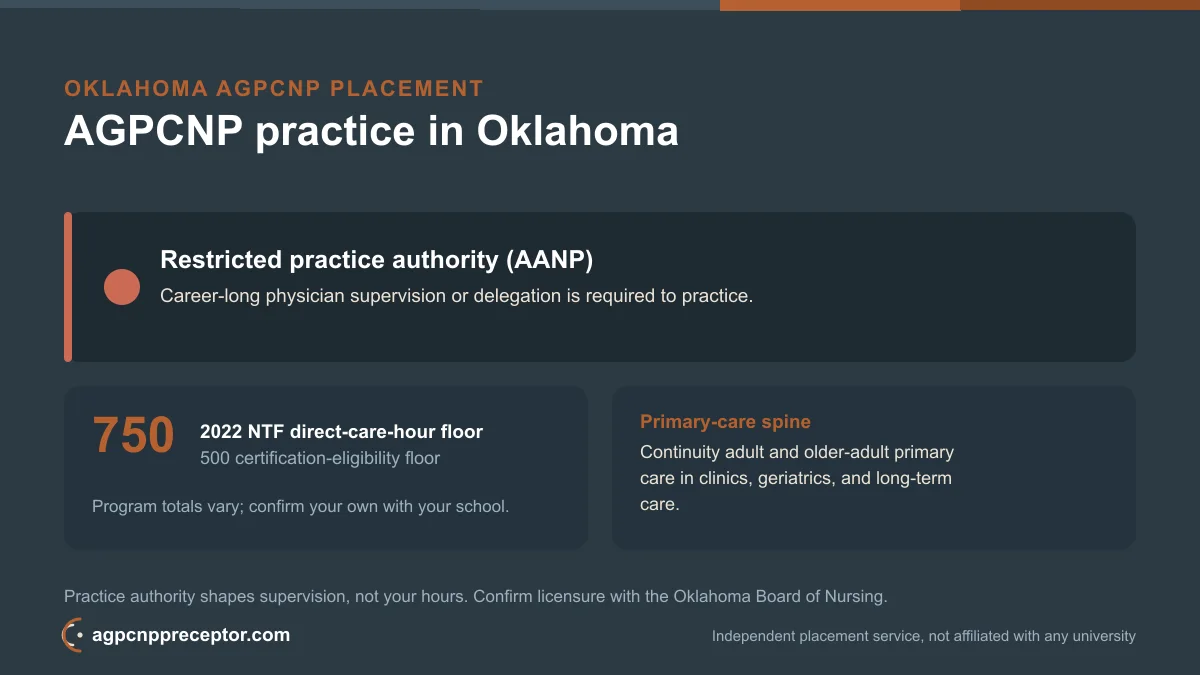
Where AGPCNP students train in Oklahoma
Adult-gerontology primary care is health promotion and chronic-disease care for patients from adolescence through the frail elderly, and it is delivered in offices and homes rather than hospitals. In Oklahoma that points students toward adult and internal-medicine primary care, family-medicine practices that carry a mostly adult panel, community health centers, and dedicated geriatrics. The Oklahoma City and Tulsa metros hold the densest supply of these clinics, with additional pockets around Norman, Edmond, Lawton, and Stillwater.
The settings that most often host an adult primary care rotation in the state include:
- Internal medicine and adult primary care practices
- Federally qualified health centers with adult panels
- Geriatrics practices and Programs of All-Inclusive Care for the Elderly
- Skilled nursing and long-term care facilities
- Assisted living and home-based primary care
- Chronic-disease specialty clinics used for continuity, such as endocrinology, cardiology, and nephrology
The rural picture that shapes preceptor supply
Oklahoma is one of the most shortage-heavy states in the country for primary care. The large majority of its 77 counties carry a federal primary-care Health Professional Shortage Area designation, and the state has far fewer primary care providers per resident than the national average, with a projected shortfall of hundreds more. That scarcity concentrates preceptors in the metros and leaves many rural students choosing between a long commute and the nearest safety-net clinic.
The state's roughly one hundred and eighteen federally qualified health centers are the backbone of rural adult care, and they are frequently the most realistic placement for a student outside the two big metros. When you tell us your county, we start from that map: who is nearby, which sites carry an adult panel, and how far you can reasonably drive for continuity hours.
Geriatrics and long-term care, the scarce hours
Oklahoma's older-adult population already exceeds three quarters of a million and is growing fast; by the mid-2030s adults over 65 are projected to outnumber children. That demand sits heaviest in rural counties, which have older residents and thinner services. For AGPCNP students the practical consequence is familiar across the country: dedicated geriatrics and long-term care preceptors are the hardest single piece to secure, because most adult care in the state sits inside general primary care rather than a geriatrics specialty.
One bright spot is the state's active expansion of Programs of All-Inclusive Care for the Elderly into rural areas. These interdisciplinary sites keep frail elders in their communities and are natural adult-gerontology primary care environments, so they widen the pool of genuine geriatric and long-term care hours as they open.
What Oklahoma practice rules mean for your preceptor
Oklahoma has long been classified as a restricted-practice state by the AANP, meaning nurse practitioners worked under a supervised prescriptive arrangement with a physician. That is changing. A 2025 law, effective November 1, 2025, allows APRNs who complete 6,240 hours of supervised practice to apply for independent prescriptive authority, including certain controlled-substance schedules, without a physician agreement. Newer APRNs continue to practice under supervised prescriptive authority while they build those hours.
For a student, this affects the supervision arrangement more than the preceptor's core qualifications. Your preceptor may be an experienced AGPCNP who now holds independent prescriptive authority, or one who still works alongside a collaborating physician. Either way, a preceptor is generally a board-certified adult-gerontology or family primary-care NP, or a licensed MD or DO in internal medicine, family medicine, or geriatrics. Confirm the current requirements with the Oklahoma Board of Nursing.
Matching your AGPCNP hours in Oklahoma
Clinical-hour totals are set by your program, not by one national number. The 2022 National Task Force standards recommend a minimum of 750 direct patient-care hours, national certification through the AANP A-GNP or the ANCC AGPCNP-BC requires at least 500 faculty-supervised hours, and accredited AGPCNP programs commonly publish totals from roughly 500 to 750 or more, with many sitting below 750. Simulation does not count toward those hours. Check your own program's requirement before you plan a schedule, and see our note on AGPCNP clinical hours if you want the details.
When you are ready, tell us your county, the settings you need, and your hour target through the form at #match or through contact. We search adult primary care, geriatrics, and long-term care sites, then help coordinate the agreement and paperwork. We are independent and serve students at any university; we assist and never guarantee a placement or your school's approval of a given preceptor or site. You can also review how it works first.
Good to know
Is Oklahoma a workable state for AGPCNP primary care hours?
Yes, especially in and around Oklahoma City and Tulsa, where adult primary care and geriatrics sites are concentrated. Rural students often place at a nearby federally qualified health center and should plan for some travel.
Can a nurse practitioner precept me without a physician in Oklahoma?
It depends on the preceptor. Under the 2025 law, an AGPCNP who has completed 6,240 supervised hours can apply for independent prescriptive authority; others still work with a collaborating physician. Confirm current status with the Oklahoma Board of Nursing.
How many clinical hours will I need?
That is set by your program. National standards recommend at least 750 direct patient-care hours and certification requires at least 500 faculty-supervised hours, but published totals vary and many programs sit below 750. Confirm your own program's number.
Which settings count as adult-gerontology primary care?
Longitudinal, non-emergent settings: adult and internal-medicine primary care, community health centers, geriatrics, long-term care, assisted living, and home-based primary care. Hospital acute care belongs to the acute-care track, not AGPCNP.
Do you guarantee a placement in Oklahoma?
No. We help you search and coordinate, but your school approves the preceptor and site, and we never promise a specific placement or approval.
Secure both ends of the arc, not just one
Tell us your school, your city, and the hours you still need across the continuum. We will come back with a plan that reaches from continuity primary care to genuine frail-elder exposure, and a realistic path to placed.