Placing AGPCNP students in Ohio's clinics, senior programs, and long-term care
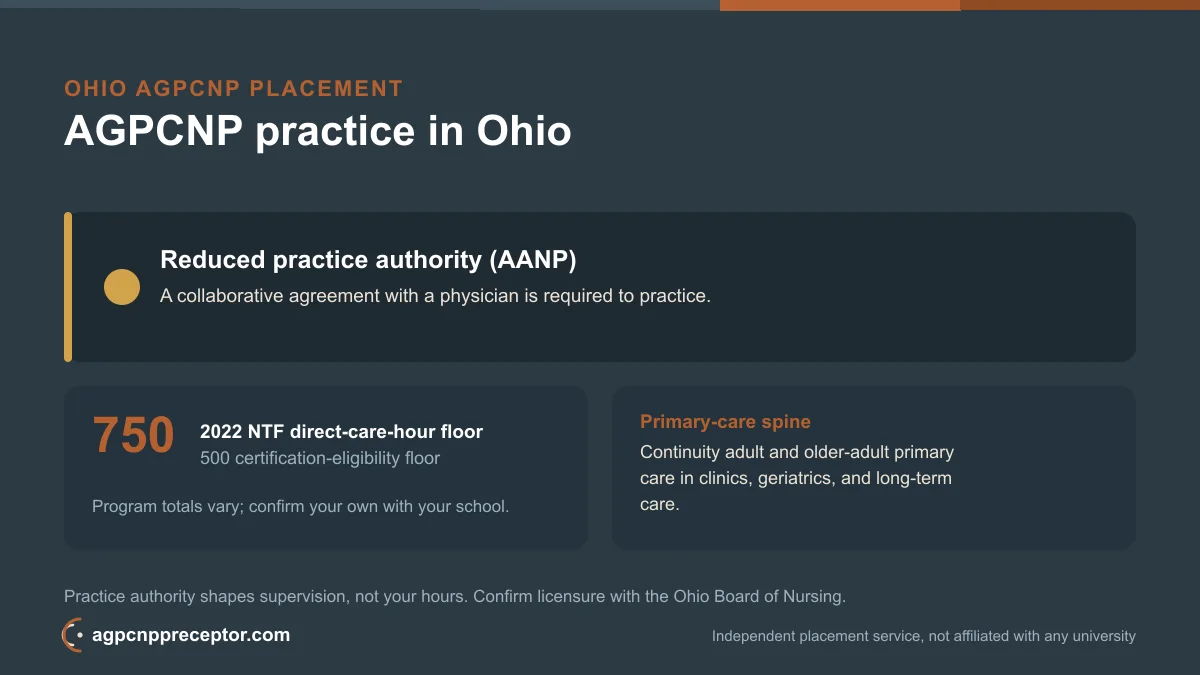
Ohio is a reduced practice state, so an adult-gerontology primary care nurse practitioner works under a standard care arrangement with a collaborating physician, an arrangement that mostly determines who signs on as your preceptor. For placement the state is a good one: several large metros give you clinic density, an aging population sits across both the cities and a poorer rural southeast, and Ohio is in the middle of expanding all-inclusive elder care beyond Cleveland for the first time. This page shows where the AGPCNP hours are.
Tell us your school and city. It is free to ask, with no obligation.
The settings that host AGPCNP hours here
AGPCNP is longitudinal, non-emergent adult and elder care, so your hours come from clinics, senior programs, and long-term-care settings rather than the hospital floor.
- Internal-medicine and family practices with adult panels, plus federally qualified health centers coordinated through the Ohio Association of Community Health Centers
- Programs of All-Inclusive Care for the Elderly: long centered on the Cleveland program in Cuyahoga County, PACE is now expanding into additional counties under a state initiative, widening where frail-elder hours can be logged
- Skilled nursing and long-term care facilities and assisted living, a large sector statewide
- Home-based primary care, plus the state's home and community-based waiver services that keep older adults in place
- Adult chronic-disease and specialty primary care clinics used for continuity hours
For a mixed adult panel, a community health center or general adult primary care practice is the usual first stop, while nursing facilities and PACE carry the frail, complex elder hours.
PACE is growing beyond Cleveland
For years, all-inclusive elder care in Ohio meant one place: the long-running PACE program in Cuyahoga County, serving greater Cleveland. That is changing. Under a state-funded expansion, PACE is moving into new counties, including sites in the Akron area of Summit County and in Lorain County, with additional providers selected to build out service areas across the state.
For an AGPCNP student, this matters because PACE is one of the cleanest ways to log concentrated frail-elderly, community-dwelling hours. As the map fills in, a purpose-built geriatrics block becomes reachable for students who previously would have traveled to Cleveland for it. Availability still varies by county, so confirm what is open in your area.
Reading Ohio's map: metros and the Appalachian southeast
Ohio spreads its population across several metros rather than one, which is an advantage for placement. Cleveland, Columbus, and Cincinnati anchor the state, with Toledo, Dayton, Akron, Canton, and Youngstown adding real clinic depth. In those areas, general adult primary care and chronic-disease continuity hours are not hard to find.
The older and underserved edge of the state is the Appalachian southeast, a stretch of rural counties with a higher share of aging residents, more chronic disease, and federally designated primary-care shortage areas. Students there can usually find adult primary care locally but may travel to Columbus, Cincinnati, or a regional center for a dedicated geriatrics or long-term-care rotation. Because Ohio's metros sit relatively close together, that travel is often shorter than in the western states.
Reduced practice and the standard care arrangement
Ohio is a reduced practice state. A certified nurse practitioner enters a standard care arrangement with one or more collaborating physicians under the Ohio Board of Nursing and state law, and the collaborating physician generally practices in the same or a similar area. The arrangement does not need advance board approval, though the board may review it.
For your placement, this mostly decides who precepts you. Your preceptor is often a board-certified adult-gerontology or family primary care NP working under a standard care arrangement, or a physician directly, such as an internist, family physician, or geriatrician. It shapes the supervision structure, not the core qualifications: your preceptor still needs an unencumbered Ohio license, adult and older-adult practice, and whatever your program requires. See preceptor requirements.
The hours that take the most planning
As almost everywhere, general adult primary care is the easy part in Ohio, and the metros supply it readily. The scarce piece is a dedicated geriatrics or long-term-care preceptor, since much elder care runs through general primary care and purpose-built geriatric rotations concentrate in nursing facilities, PACE, and academic-affiliated practices. The PACE expansion is slowly widening that supply, but it is not statewide yet.
If your program wants concentrated long-term care or geriatrics time, arrange it early. The nursing-facility and PACE blocks are the ones that fill, and they are worth targeting before you lock in your general primary-care site.
Hours: confirm your program's number
Totals vary by program, so open your handbook first. The 2022 National Task Force standards published through AACN recommend a minimum of 750 direct patient care hours for a nurse practitioner population focus, while certification eligibility through AANP or ANCC requires at least 500 faculty-supervised hours. Accredited AGPCNP programs commonly publish totals from roughly 500 to 750 or more, and many sit below 750, so confirm your own figure. Simulation does not count. Our clinical hours page explains the pieces.
Whatever the total, AGPCNP hours span the adult-gerontology range, from about age thirteen through the frail elderly. In Ohio the count is rarely the problem; weighting the hours toward the older, complex end is where planning pays off.
How we help you place in Ohio
We are an independent placement service for AGPCNP students at any university. We work independently of a school and never guarantee a placement or your program's approval of a preceptor or site; that decision is your school's. We run the outreach, confirm the license, the standard care arrangement, and the adult-gerontology match, and handle the affiliation paperwork practices and facilities require.
Send your city, the hours still open, and your start window through the form at #match or our contact page. How it works and cost cover the mechanics.
Good to know
What does reduced practice mean for an AGPCNP student in Ohio?
It means a nurse practitioner works under a standard care arrangement with a collaborating physician in the same or a similar area. In primary care this mostly determines who can serve as your preceptor and how supervision is documented, rather than changing what you do during a clinic day.
Is PACE really expanding in Ohio?
Yes. For years Ohio's only PACE program was in Cuyahoga County around Cleveland. Under a state-funded expansion, PACE is moving into additional counties, including the Akron area and Lorain County, with more providers selected. It widens where students can log concentrated frail-elderly hours, though availability still varies by county.
Which Ohio areas are best for geriatric and long-term-care hours?
The metros, Cleveland, Columbus, Cincinnati, and the mid-size cities, carry the deepest nursing-facility and PACE capacity. The aging Appalachian southeast has real demand but fewer dedicated geriatric preceptors, so rural students there often travel to a regional center for that block.
Can a physician precept my AGPCNP hours in Ohio?
Yes. Your preceptor is often a board-certified adult-gerontology or family primary care NP under a standard care arrangement, or a physician directly, such as an internist, family physician, or geriatrician. Your school sets the final criteria; the state rule mainly governs the NP's collaboration structure.
Does the Board of Nursing approve my preceptor?
No. The Ohio Board of Nursing licenses nurse practitioners and administers the standard care arrangement rules; it does not approve anyone as your clinical preceptor. That approval is your school's. Use the board to confirm a license is current and unencumbered.
Secure both ends of the arc, not just one
Tell us your school, your city, and the hours you still need across the continuum. We will come back with a plan that reaches from continuity primary care to genuine frail-elder exposure, and a realistic path to placed.