Placing AGPCNP students across New York's clinics and elder-care programs
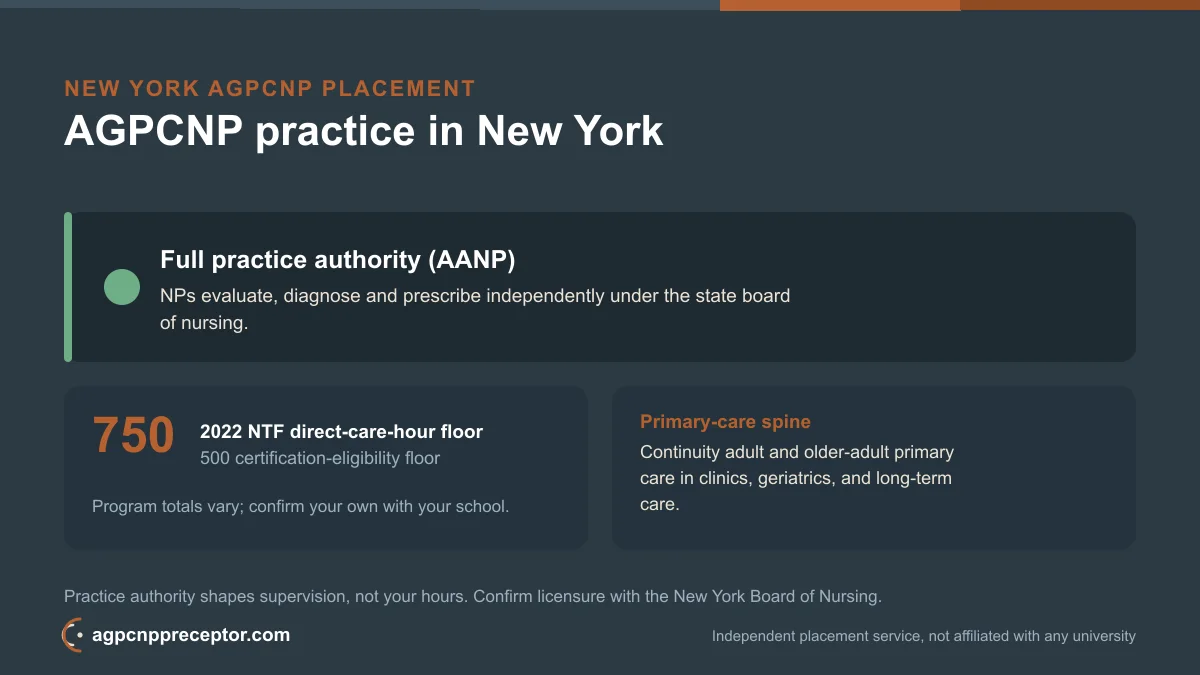
New York is a full practice state with a wrinkle worth understanding: an adult-gerontology primary care nurse practitioner can precept on their own license once they have logged 3,600 hours of qualifying experience, and until then works under a written collaborative agreement with a physician. Either way, the state is unusually rich in the settings AGPCNP students need, from dense city primary care to one of the deepest networks of all-inclusive elder-care programs in the country. The real work is matching your hours to the right corner of a very uneven map.
Tell us your school and city. It is free to ask, with no obligation.
Two New Yorks, and what each offers an AGPCNP student
For placement, New York splits into the downstate metro and a long rural upstate. New York City and its suburbs, Long Island, Westchester, and the Hudson Valley hold an enormous absolute number of older adults, along with the clinics, geriatrics practices, and home-based programs to match. Upstate, the picture shifts to smaller cities such as Buffalo, Rochester, Syracuse, and Albany, then to rural counties across the Southern Tier, the North Country, and the Adirondacks where a single practice may anchor a whole town.
That geography drives supply. Downstate has the most sites and the most students chasing them; upstate clinics are fewer but often quicker to say yes. Your adult primary care hours are reachable almost anywhere, but the specialized elder-care blocks cluster in specific places.
The settings that host AGPCNP hours here
AGPCNP is ambulatory and residential adult and elder care, so your hours come from clinics, senior programs, and long-term-care settings rather than the hospital.
- Internal-medicine and family practices with adult panels, plus federally qualified health centers, coordinated statewide through the Community Health Care Association of New York State
- Programs of All-Inclusive Care for the Elderly, a real strength here: the state runs about ten, including large not-for-profit programs in New York City and others serving Buffalo, Rochester, Syracuse, the Capital Region, and the North Country
- Skilled nursing and long-term care facilities and assisted living, a large sector statewide
- Home-based primary care and house-call practices, especially deep in the five boroughs
- Adult chronic-disease and specialty primary care clinics used for continuity hours
The all-inclusive elder-care programs are worth targeting. They are built around frail, medically complex older adults living in the community, which is exactly the population many AGPCNP students struggle to reach through general primary care.
The 3,600-hour pathway and your preceptor
New York earns its full practice label through the Nurse Practitioner Modernization Act. A nurse practitioner who has completed 3,600 hours of qualifying practice may work without a written collaborative agreement or practice protocols; a newer NP, below that threshold, must keep a written collaborative agreement with a physician and file the required verification. State lawmakers extended this framework in 2026, keeping it in place through mid-2030. Nursing is regulated by the New York State Board for Nursing within the State Education Department's Office of the Professions.
For you, this shapes who signs on rather than the daily work. An experienced adult-gerontology primary care NP can precept independently; a less experienced NP may bring a collaborating physician along. Either way your preceptor still needs to practice in adult and older-adult care and meet your program's criteria, often A-GNP or AGPCNP-BC certification. Physicians in internal medicine, family medicine, or geriatrics precept as well. See preceptor requirements.
Where the frail-elderly hours concentrate, and which are scarce
General adult primary care is the easy part in New York; the metro alone holds more internal-medicine and family practices than most states carry in total. The harder piece, as almost everywhere, is a dedicated geriatrics or long-term-care preceptor. The difference here is that the state's PACE programs, large nursing-home sector, and home-based practices give you more real options than a rural state can, if you are near one.
That last clause matters. A student in Brooklyn or Rochester can often find a geriatrics or all-inclusive elder-care block within the city; a student in a rural Adirondack or Southern Tier county may have general primary care next door but need to travel to a regional hub for concentrated geriatric time. Plan that block early either way, because it is the one that fills.
Hours: confirm your own program's total
Programs set their own totals, so open your handbook first. The 2022 National Task Force standards published through AACN recommend a minimum of 750 direct patient care hours for a nurse practitioner population focus, while certification eligibility through AANP or ANCC requires at least 500 faculty-supervised hours. Accredited AGPCNP programs commonly publish figures from roughly 500 to 750 or more, and many land below 750, so confirm your own. Simulation is excluded. Our clinical hours page breaks it down.
Across whatever total your school sets, AGPCNP hours must span the adult-gerontology range, from roughly age thirteen through the frail elderly. In New York the raw count is rarely the obstacle; distributing it toward the older, complex end is.
How we place you in New York
We are independent and work with AGPCNP students at any university. We work independently of a school and never guarantee a placement or your program's approval of a preceptor or site; that approval is always your school's. We handle the outreach, confirm the license, the experience level, and the adult-gerontology match, and manage the affiliation paperwork clinics and facilities require.
Tell us your borough or city, the hours still open, and your start window through the form at #match or our contact page. How it works and cost explain the rest.
Good to know
Is New York really a full practice state for nurse practitioners?
Yes, with a threshold. Under the Nurse Practitioner Modernization Act, an NP with 3,600 hours of qualifying experience can practice without a written collaborative agreement, while a newer NP keeps one. Lawmakers extended this framework in 2026 through mid-2030. It affects who can precept you independently, not your scope as a student.
Which New York settings are best for geriatric and long-term-care hours?
The state's Programs of All-Inclusive Care for the Elderly, skilled nursing and assisted-living facilities, and home-based primary care practices are the strongest sources. Downstate has the deepest supply; upstate students often travel to Buffalo, Rochester, Syracuse, or the Capital Region for a concentrated block.
I live upstate. Will I have to travel for placement?
For general adult primary care, usually not; a local family or internal-medicine practice can cover it. For a dedicated geriatrics or all-inclusive elder-care rotation, possibly, since those cluster in the regional cities. Ask about drive time before you commit to a distant block.
Can a physician precept my AGPCNP hours in New York?
Yes. Physicians in internal medicine, family medicine, or geriatrics precept AGPCNP students, as do board-certified adult-gerontology and family primary care NPs. Your program sets the final preceptor criteria; the state rule mainly decides whether an NP needs a collaborating physician of their own.
Does the state approve my preceptor?
No. The New York State Board for Nursing licenses nurse practitioners and administers the collaborative-agreement rules; it does not approve anyone as your clinical preceptor. That approval is your school's. Use the state's license verification to confirm a preceptor's status.
Related
Secure both ends of the arc, not just one
Tell us your school, your city, and the hours you still need across the continuum. We will come back with a plan that reaches from continuity primary care to genuine frail-elder exposure, and a realistic path to placed.