Placing AGPCNP students in Mississippi primary-care and geriatric settings
Mississippi is where the community health center movement began, and that heritage shapes Adult-Gerontology Primary Care NP training here as much as any statute. Your continuity, chronic-disease, and geriatric hours run through a network of federally qualified health centers, rural clinics, and long-term-care facilities serving a population with heavy chronic-disease burden and long distances to care. We help students at any university find and verify a qualified primary-care preceptor and handle the site paperwork, without ever guaranteeing a placement.
Tell us your school and city. It is free to ask, with no obligation.
A safety-net state, and the continuity it creates
The nation's first rural federally qualified health center opened in the Mississippi Delta in the 1960s, and the state has leaned on community health centers ever since. For an AGPCNP student that matters, because these centers carry exactly the adult panels a primary-care rotation needs: patients managed over time for diabetes, hypertension, heart disease, and kidney disease, the daily material of chronic-disease continuity.
Mississippi also carries one of the heaviest chronic-disease burdens in the country, which means the continuity hours are rich even where clinicians are few. A rotation built around an FQHC or a rural primary-care clinic can generate strong longitudinal experience, while the scarcer part of the plan, dedicated frail-elder care, usually has to be sourced separately.
The primary-care map, from the Delta to the coast
Clinic supply concentrates in a handful of centers. Jackson anchors the largest pool of adult primary care and specialty clinics, the Gulf Coast around Gulfport and Biloxi carries the south, Hattiesburg serves the Pine Belt, and Tupelo anchors the northeast. Between them lies a lot of rural Mississippi, most of it designated as primary-care shortage territory.
The Delta is the sharpest example. It holds the state's most concentrated poverty and poorest health outcomes, and some residents travel long distances, in places an average approaching seventy-five miles, to reach primary care. The aging population is spread through these rural counties rather than the cities, so the geriatric and long-term-care demand sits where the preceptor pool is thinnest. That is the gap a sourcing service is built to close.
Reduced practice, and the collaborative agreement
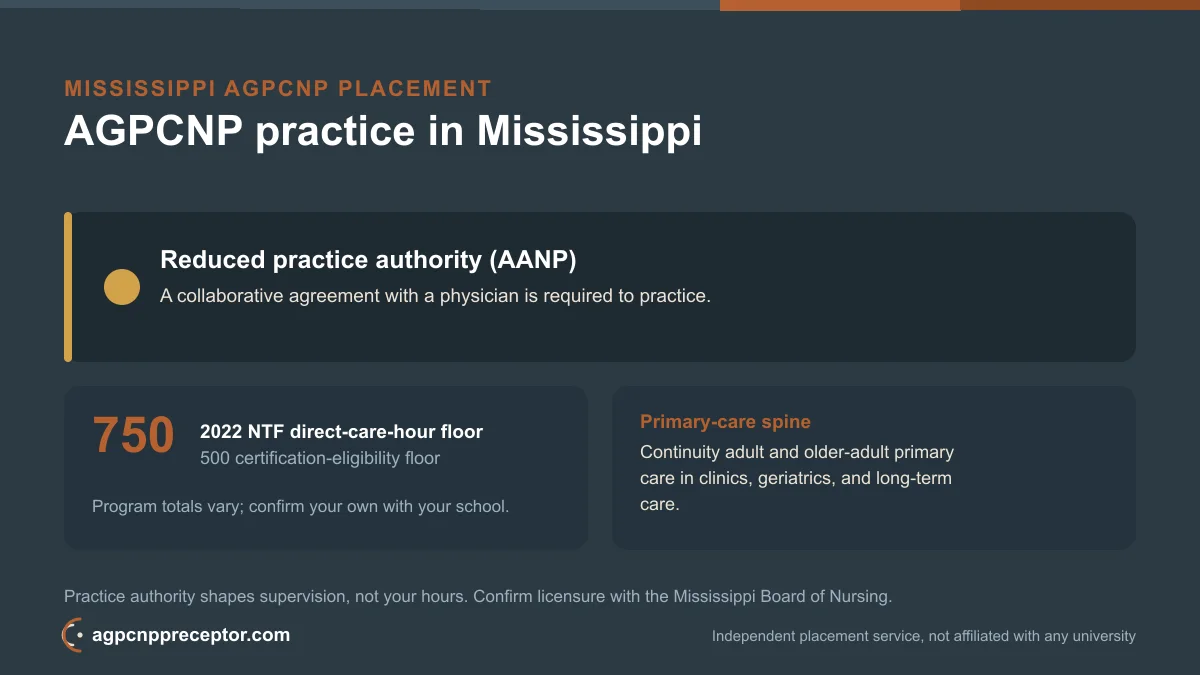
The American Association of Nurse Practitioners classifies Mississippi as a reduced practice state. Every advanced practice nurse must maintain a collaborative or consultative agreement with a Mississippi physician, and controlled-substance prescribing runs through a separate Controlled Substance Prescriptive Authority. Legislation has been discussed that would let NPs end the collaborative agreement after a large number of supervised hours, but the agreement remains the rule for now.
In primary care this shapes the supervision arrangement, not the preceptor's core qualifications. A collaborating physician is generally part of the practice already, so your preceptor may be that physician or an adult-gerontology or family NP practicing under such an agreement. Your preceptor is typically a board-certified A-GNP or AGPCNP-BC, a family NP, or a physician in internal medicine, family medicine, or geriatrics, subject to your program's rules. Confirm current requirements with the Mississippi Board of Nursing.
The settings that host your hours
Your adult primary-care and gerontology hours can sit across several Mississippi settings, and a complete plan usually reaches more than one.
- Federally qualified health centers and rural primary-care clinics with adult panels
- Internal-medicine and family practices in Jackson, the Gulf Coast, Hattiesburg, and Tupelo
- Skilled nursing and long-term-care facilities and assisted-living communities in the smaller towns
- Home-based primary care for homebound elders
- Adult specialty clinics in endocrinology, cardiology, and nephrology used for continuity
Dedicated geriatrics is the hardest piece to secure, because most adult care here runs through general primary care rather than a geriatrics practice. If your plan needs authentic nursing-home or home-based frail-elder hours, treat those as the block to reserve first.
The hours your program requires
Mississippi does not set your clinical-hour total; your program and its accreditor do. The 2022 National Task Force standards recommend a minimum of 750 direct patient care hours, and AANP and ANCC certification eligibility requires at least 500 supervised hours. Accredited AGPCNP programs publish totals across a range, commonly from about 500 to 750 or more, and many sit below 750. Simulation does not count toward direct patient care.
Confirm your figure with your school early, since it sets how many settings you need to combine. Our clinical hours guide explains how the continuity and geriatric hours add up.
Securing your Mississippi placement
Tell us your program, the part of the state you can reach, and the continuity and geriatric hours you still owe. We source and vet a qualified primary-care preceptor, confirm they meet your school's requirements, and work the affiliation-agreement paperwork so you are not driving the Delta cold-calling clinics on your own. See how it works and our pricing.
Start with the match form below or reach out. We are independent, we serve students at any university, and we assist with placement without guaranteeing a site or your school's approval of a preceptor.
Good to know
Does Mississippi's reduced-practice rule make placement harder?
Not much for primary care. A collaborating physician is usually already part of the clinic, so the agreement a reduced state expects tends to be in place. The bigger challenge is geography and thin preceptor supply across the rural counties and the Delta.
Can I do my hours in the Delta or another rural area?
Often the continuity primary-care hours, through a federally qualified health center or rural clinic, since those carry strong adult chronic-disease panels. Dedicated geriatrics is harder to find locally, so plan that block early and expect a wider radius. We help map it.
Who can serve as my preceptor in Mississippi?
Generally a board-certified adult-gerontology or family primary-care NP (A-GNP or AGPCNP-BC), or a physician in internal medicine, family medicine, or geriatrics, in a setting that matches your rotation. Your program sets the exact rule, so check its preceptor form.
How many clinical hours does Mississippi require?
The state does not set your hours; your program and its accreditor do. The 2022 NTF standards recommend at least 750 direct-care hours and certification eligibility requires at least 500, and accredited programs vary, with many under 750. Confirm your total with your school.
Do you work with students from any school?
Yes. We are independent of every university. We place Adult-Gerontology Primary Care NP students from any accredited program and vet each preceptor against your program's requirements.
Secure both ends of the arc, not just one
Tell us your school, your city, and the hours you still need across the continuum. We will come back with a plan that reaches from continuity primary care to genuine frail-elder exposure, and a realistic path to placed.