Adult-gerontology primary care preceptors, Atlanta to rural Georgia
Georgia pairs a fast-growing metro around Atlanta with a large rural south where older residents are concentrated and primary care is thin, and both create demand for adult-gerontology primary care. If you are an AGPCNP student here, your hours belong in longitudinal outpatient and residential care, not the hospital, and we help students at any program find board-certified primary care preceptors close to home. Georgia is a restricted-practice state, so a nurse practitioner preceptor here works under a written protocol with a physician, which shapes who signs on to teach you.
Tell us your school and city. It is free to ask, with no obligation.
Two Georgias, one growing demand
Georgia is really two states for an AGPCNP student. Metro Atlanta and its suburbs, counties like Cobb, Gwinnett, DeKalb, and the fast-growing exurbs to the north, hold most of the state's clinics and a large population that is aging in place. Rural south and middle Georgia are older still in relative terms, with many small counties where a rising share of residents is past 65 and where clinicians are scarce.
Adult-gerontology primary care fits both. The track follows patients from adolescence, around age 13, through the frail elderly, and it centers on the chronic-disease management, preventive care, and geriatric coordination that both the aging suburbs and the rural south need. That demand is steady, but where you can actually train varies sharply between the two Georgias.
Settings that host AGPCNP students in Georgia
Your rotations belong where adults and elders receive care over time, not in acute hospital units. Across Georgia that includes:
- Internal medicine and adult primary care practices
- Family medicine offices carrying a strong adult and older-adult panel
- Dedicated geriatrics clinics and memory care
- Skilled nursing, assisted living, and long-term care facilities
- Home-based primary care for homebound elders
- Community health centers and chronic-disease specialty clinics used for continuity
Emergency departments, intensive care, and inpatient hospitalist services belong to the acute care track, and we do not place AGPCNP students there.
The primary-care map and where care runs short
Clinic density in Georgia concentrates heavily in the Atlanta metro, along with the smaller hubs of Augusta, Savannah, Columbus, Macon, and Albany. Students in those areas usually find an adult primary care preceptor without much travel, and the metro also holds most of the state's dedicated geriatrics practices and memory-care programs.
Outside those hubs, much of rural Georgia is federally designated as a primary care Health Professional Shortage Area, and provider supply is genuinely thin. The state's federally qualified health centers and rural health clinics carry a large share of adult primary care in those counties, and they often welcome students, which makes them a practical anchor for community-based hours in the rural south.
Concentrated geriatric settings are harder to come by. Georgia has only a small PACE presence, with a single Program of All-Inclusive Care for the Elderly operating in the Atlanta metro as of 2026, though the state has signaled interest in expanding. For most students that means dedicated geriatric hours come from nursing facilities, assisted living, and home-based care rather than from PACE.
Restricted practice and the nurse protocol agreement
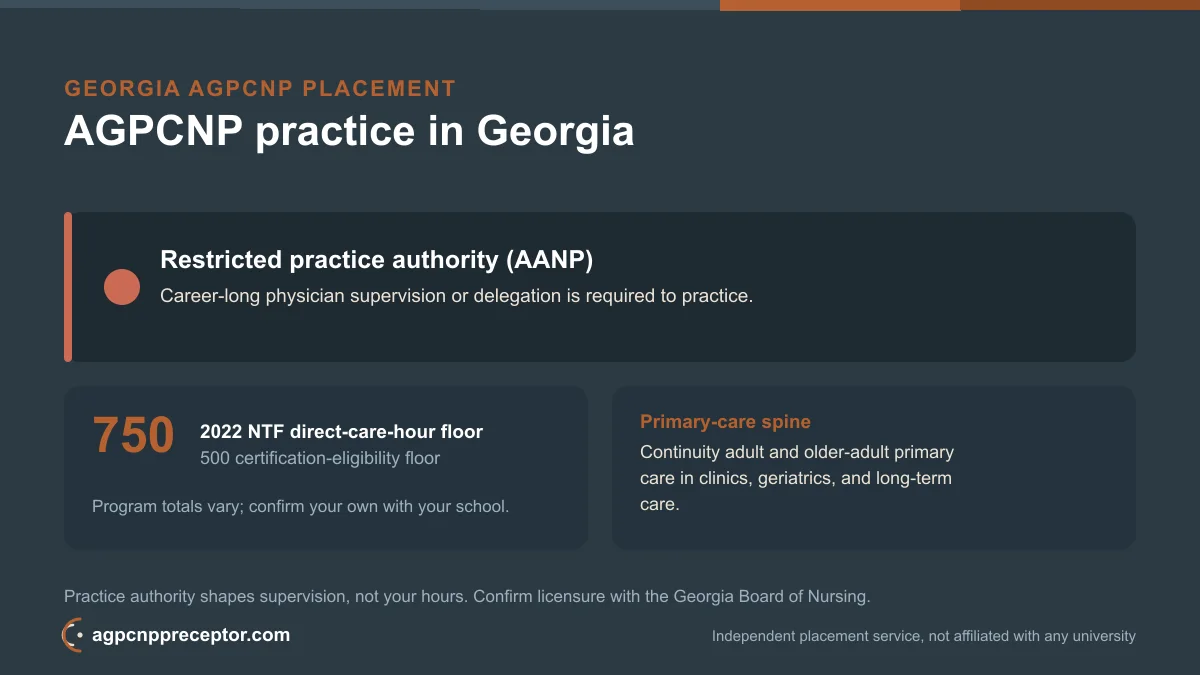
Georgia is a restricted-practice state, and the arrangement is career-long rather than a phase for new graduates. A nurse practitioner practices under a written protocol agreement with a delegating physician, and Georgia's rules attach specific conditions to that agreement, including board filing, reasonable geographic proximity between the physician and the practice, periodic chart review, and defined oversight for controlled-substance prescribing.
For your preceptor search, that shapes who can sign on. An AGPCNP preceptor in Georgia will have a collaborating or delegating physician already in place, so you are typically joining a practice where that relationship exists. Your preceptor may be a board-certified AGPCNP-BC or A-GNP working under such a protocol, or a physician in family medicine, internal medicine, or geriatrics serving as your preceptor directly. The preceptor's core qualifications do not change; the supervision structure around them does. Because Georgia's rules can shift with new board guidance, confirm the current requirements with the Georgia Board of Nursing.
The hours hardest to secure, and the totals your program sets
In Georgia, general adult primary care is reachable in the metro areas, but two pieces are tighter. Dedicated geriatrics and long-term care hours are limited by the state's thin PACE presence and by the concentration of specialists in Atlanta, and rural students often travel for a geriatrics or specialty block. The adolescent end of the range, which begins around age 13, also appears rarely in adult practices, so it may need its own rotation. We map these gaps early.
Hour totals come from your program, not one national rule. The 2022 National Task Force standards recommend a minimum of 750 direct patient care hours for a nurse practitioner track, while AANP or ANCC certification requires at least 500 faculty-supervised hours. Accredited AGPCNP programs commonly publish totals from roughly 500 to 750 or more, and many sit below 750, so confirm your own figure. Simulation generally does not count.
How we match Georgia AGPCNP students
We are an independent placement service, not a school, and we work with students at any program. Tell us your region, the settings you still owe, adult primary care, geriatrics, long-term care, or a chronic-disease continuity block, plus your hour target and timeline, and we look for a board-certified primary care preceptor and a site that fit within Georgia's protocol structure. We assist and advocate; we never guarantee a placement or your school's approval of any preceptor or site, because those approvals belong to your program.
If a geriatrics or long-term care requirement is looming with no lead, start with how it works, review our clinical hours guidance, and tell us what you need through the match form or the contact page.
Good to know
Do AGPCNP students in Georgia train in hospitals?
No. Adult-gerontology primary care is longitudinal and outpatient, so your hours come from primary care and geriatrics clinics, long-term care and assisted living, home-based care, and chronic-disease continuity sites. Inpatient and intensive care hours belong to the acute care track, and we do not place primary care students there.
How does Georgia's restricted practice affect my preceptor?
A nurse practitioner in Georgia practices under a written protocol agreement with a physician for their whole career, not just as a new graduate. So your AGPCNP preceptor will already have a collaborating physician in place, or a physician may precept you directly. The preceptor's qualifications are the same; only the supervision structure differs.
Where is it hardest to find AGPCNP hours in Georgia?
Outside metro Atlanta and the regional hubs, much of rural Georgia is a federally designated primary care shortage area with few clinicians. Dedicated geriatric hours are also limited by the state's small PACE presence. Rural students often keep general hours local, often at a community health center, and travel for a geriatrics or specialty block.
Does Georgia have PACE programs for geriatric training?
Only a little. As of 2026 Georgia has a single Program of All-Inclusive Care for the Elderly in the Atlanta metro, with interest in expanding. For most students, dedicated geriatric hours come from nursing facilities, assisted living, and home-based primary care rather than PACE.
Can you guarantee a placement in Georgia?
No. We search for and help arrange primary care preceptors and sites and advocate for you, but we cannot guarantee a placement or your program's approval of any preceptor or site. Those decisions belong to your school.
Secure both ends of the arc, not just one
Tell us your school, your city, and the hours you still need across the continuum. We will come back with a plan that reaches from continuity primary care to genuine frail-elder exposure, and a realistic path to placed.