Primary-care AGPCNP preceptors in the nation's retirement capital
Florida has the largest older-adult population in the country, which makes it one of the richest states anywhere for adult-gerontology primary care training. For an AGPCNP student, that means real depth in geriatrics, chronic-disease management, and long-term care, spread across retirement metros and both coasts. Florida is a restricted-practice state, but its autonomous-practice pathway is limited specifically to primary care, so the supervision picture here looks different for AGPCNP students than it does for acute care.
Tell us your school and city. It is free to ask, with no obligation.
The country's largest older-adult population
No state concentrates older adults like Florida. More than one in five residents is past 65, and the numbers keep climbing as the national wave of new retirees crests. That single fact shapes everything about AGPCNP training here, because adult-gerontology primary care, which follows patients from adolescence, around age 13, through the frail elderly, is exactly the care this population needs most.
The oldest pockets are striking. Sumter County, home to The Villages north of Orlando, has the oldest median age of any county in the country. In Southwest Florida, close to three in ten residents of the Cape Coral and Fort Myers area are past 65, and the Naples region reports one of the longest life expectancies in the nation. Retirement communities, chronic-disease clinics, and long-term care facilities cluster wherever these residents settle, which means the geriatric and continuity hours that are scarce elsewhere are comparatively plentiful in Florida.
Settings where AGPCNP students belong
The adult-gerontology primary care role is ambulatory and residential, not acute, so your hours belong in settings that manage health over time:
- Internal medicine and adult primary care practices, including the large senior-focused clinics common in Florida
- Dedicated geriatrics practices and PACE centers
- Skilled nursing, assisted living, and long-term care communities
- Home-based primary care for homebound elders
- Community health centers and chronic-disease clinics in cardiology, endocrinology, and nephrology for continuity
We do not place AGPCNP students in emergency departments or intensive care. Those hours build acute care competency, a separate track, while primary care skill grows in the ongoing management of the same patients.
Florida's primary-care geography
Florida's older-adult care spreads across several clusters rather than one hub. The Villages and the wider Orlando area, the Tampa Bay region, Southeast Florida from Miami through Palm Beach, and the Southwest coast around Fort Myers and Naples each carry dense networks of senior-oriented primary care, geriatrics, and long-term care. That breadth is a genuine advantage when you are hunting for a specific kind of rotation.
The state also has a strong PACE presence for concentrated geriatric hours. Programs such as Hope PACE across the Southwest counties of Lee, Collier, and Charlotte, and Suncoast PACE in the Pinellas area, manage panels of frail, nursing-home-eligible elders in one interdisciplinary setting. Florida's federally qualified health centers, including large operations serving agricultural communities like Immokalee, add adult and older-adult panels in areas with fewer private clinics.
The rural interior tells a quieter story. The Big Bend, the Panhandle away from Pensacola and Tallahassee, and the agricultural heartland have thinner clinic supply and include federally designated primary care shortage areas, so students there often travel to the nearest coastal metro for a dedicated geriatrics or specialty block.
Restricted practice with a primary-care autonomy pathway
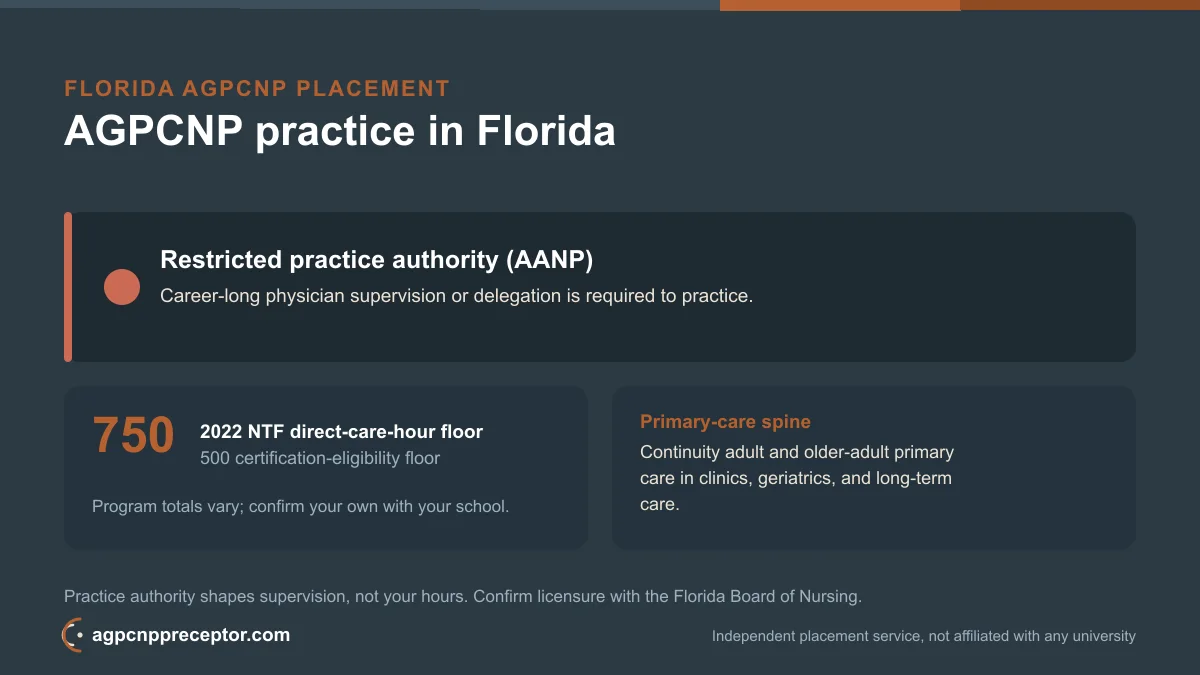
Florida is classified by the American Association of Nurse Practitioners as a restricted-practice state, but the detail matters for AGPCNP students, and it cuts the opposite way from acute care. Florida law lets qualifying nurse practitioners register for autonomous practice, and that autonomy is limited specifically to primary care, meaning family medicine, general pediatrics, and general internal medicine. Adult-gerontology primary care sits squarely inside that covered field.
In practice, a nurse practitioner who has completed the required clinical hours, commonly cited as several thousand, and meets the other conditions can register with the Florida Board of Nursing to practice primary care autonomously. Many AGPCNPs, though, especially earlier in their careers, still work within a supervisory or collaborative arrangement with a physician. So your preceptor may be an autonomously registered AGPCNP running an independent primary care panel, a board-certified AGPCNP-BC or A-GNP working under a physician-led group, or a physician in family medicine, internal medicine, or geriatrics. Licensure and registration specifics are set by the Florida Board of Nursing, so confirm the current rules there.
Hardest hours and the totals your program sets
Florida is one of the easier states for geriatric and long-term care exposure, given how many older adults live here, but some hours still take planning. Continuity with a single preceptor across a full block can be competitive at the busiest senior clinics, and the adolescent end of the range, which starts around age 13, shows up rarely in senior-focused practices, so it may need a deliberate rotation.
Hour totals come from your program, not one national rule. The 2022 National Task Force standards recommend a minimum of 750 direct patient care hours for a nurse practitioner track, while AANP or ANCC certification requires at least 500 faculty-supervised hours. Accredited AGPCNP programs commonly publish totals from roughly 500 to 750 or more, and many sit below 750, so confirm your own figure. Simulation generally does not count.
How we match Florida AGPCNP students
We are independent, unaffiliated with any school, and we help students from any program. Share your region, the settings you still owe, whether adult primary care, geriatrics, long-term care, or a chronic-disease continuity block, along with your hour target and timeline, and we look for a board-certified primary care preceptor and a site that fit, whether within a physician-led group or an autonomously registered AGPCNP practice. We advocate for you but do not guarantee a placement or your program's approval of any preceptor or site.
If you have a geriatrics or long-term care requirement and no lead, start with how it works, review typical preceptor requirements, and tell us what you need through the match form or the contact page.
Good to know
Is Florida a good state for AGPCNP clinical hours?
Yes, among the best for volume. Florida has the country's largest older-adult population, so geriatrics, chronic-disease, and long-term care hours are comparatively plentiful across its retirement metros. The main challenges are competition at the busiest senior clinics and thinner supply in the rural interior.
Florida is restricted, so does that hurt AGPCNP students?
Less than it does acute care students. Florida's autonomous-practice pathway is limited to primary care, which is exactly where AGPCNPs work, so an experienced AGPCNP may practice independently after registering with the Board of Nursing. Newer nurse practitioners often still work under a physician arrangement, and either can precept you.
Where are the oldest parts of Florida for geriatric training?
Sumter County and The Villages north of Orlando have the oldest median age in the country, and Southwest Florida around Cape Coral, Fort Myers, and Naples has a very high senior share. Tampa Bay and Southeast Florida also carry dense senior care. These areas are where geriatric and long-term care hours are easiest to find.
Do AGPCNP students train in hospitals in Florida?
No. Adult-gerontology primary care is longitudinal and outpatient, so your hours come from primary care and geriatrics clinics, long-term care and assisted living, home-based care, and chronic-disease continuity sites. Inpatient and intensive care hours belong to the acute care track, and we place primary care students in ambulatory and residential settings.
Can you guarantee a placement in Florida?
No. We search for and help arrange primary care preceptors and sites and advocate for you, but we cannot guarantee a placement or your school's approval of any preceptor or site. Those approvals belong to your program.
Secure both ends of the arc, not just one
Tell us your school, your city, and the hours you still need across the continuum. We will come back with a plan that reaches from continuity primary care to genuine frail-elder exposure, and a realistic path to placed.