Primary-care preceptors for AGPCNP students in an aging Connecticut
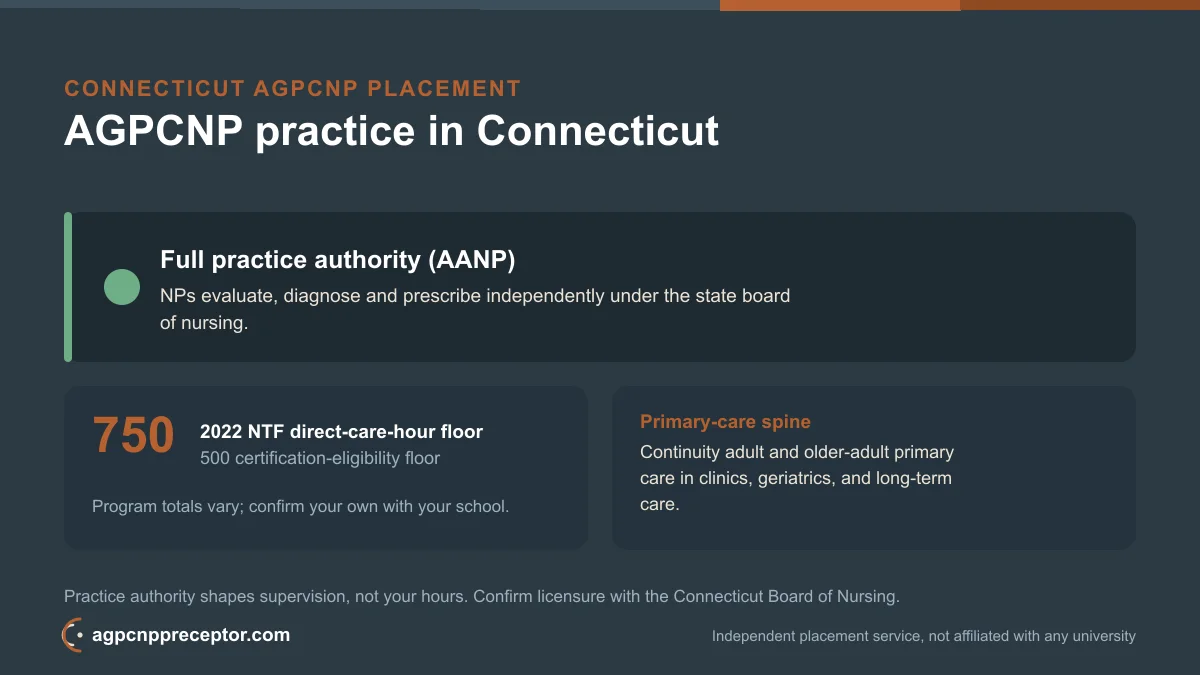
Connecticut is one of the oldest states in the country, which makes it fertile ground for adult-gerontology primary care training, from busy shoreline and Hartford-corridor clinics to the quiet rural corners where older residents cluster. If you are an AGPCNP student here, your hours belong in longitudinal outpatient and residential care, not the hospital, and we help students at any program find board-certified primary care preceptors close to home. Connecticut grants full practice authority, though newly licensed nurse practitioners first work through a defined collaboration period.
Tell us your school and city. It is free to ask, with no obligation.
Why Connecticut suits adult-gerontology primary care
Connecticut ranks among the oldest states in the nation, and its senior share keeps climbing. The largest concentrations of residents past 65 sit in Litchfield County in the northwest, Middlesex County along the lower Connecticut River, and New London County in the southeast, while the population aged 65 and older is projected to grow far faster than the working-age population over the coming decades.
For an AGPCNP student that demographic tilt is an advantage. Adult-gerontology primary care follows patients from adolescence, around age 13, through the frail elderly, and a state with this many older adults generates steady demand for the chronic-disease management, preventive care, and geriatric coordination the track is built around. The work is longitudinal and non-emergent, delivered in clinics, homes, and residential care, not in an emergency room or intensive care unit.
Settings that host AGPCNP students in Connecticut
Your rotations should sit where adults and elders are cared for over time. Across Connecticut that includes:
- Internal medicine and adult primary care practices for the core panel
- Family medicine offices with a strong adult and older-adult mix
- Dedicated geriatrics clinics and memory care
- Skilled nursing, assisted living, and long-term care facilities
- Home-based primary care for the homebound elderly
- Community health centers with adult panels and chronic-disease specialty clinics used for continuity
We do not place AGPCNP students in emergency departments, intensive care, or inpatient hospitalist services, because those hours build acute care competency, a different population focus. Primary care skill is built in the ongoing relationship with a patient, not in a single hospital encounter.
The primary-care map, corridor versus countryside
Connecticut's clinic density follows its two main corridors. The Interstate 95 shoreline from Greenwich through New Haven to New London, and the Interstate 91 spine through New Haven, Hartford, and up toward the Massachusetts line, hold most of the state's internal medicine, family medicine, and specialty practices. Students in those areas usually find an adult primary care preceptor without long travel.
The rural edges are a different story. The Northwest Hills of Litchfield County and the northeastern Quiet Corner have far thinner provider supply, and parts of both fall within federally designated primary care shortage areas. Connecticut's roughly ten federally qualified health center organizations help fill that gap, with one large network based in Middletown reaching communities from Greenwich to Putnam. These centers carry heavy adult panels and often precept.
That geography matters most for geriatric hours. The rural counties with the highest senior share are also the ones with the fewest clinicians, so a student in Litchfield or the Quiet Corner may keep general hours local and travel to a larger town for a dedicated geriatrics or long-term care block.
No statewide PACE, so continuity runs elsewhere
Unlike many states, Connecticut does not operate a Program of All-Inclusive Care for the Elderly as of early 2026, so you cannot lean on PACE centers here for concentrated geriatric hours. That places more weight on the settings that do carry frail elders: skilled nursing facilities, assisted living, memory care, and home-based primary care run by the state's health systems and visiting-nurse organizations.
We treat those residential and in-home settings as central to a Connecticut AGPCNP plan rather than as extras, because they are where the state's fast-growing elderly population actually receives day-to-day care.
Full practice with a collaboration runway
The American Association of Nurse Practitioners lists Connecticut as a full practice authority state, and the Connecticut Board of Examiners for Nursing oversees APRN licensure. The nuance worth knowing is that Connecticut phases in that independence. A newly licensed nurse practitioner practices in collaboration with a physician for a defined early period, commonly described as three years and a set number of practice hours, after which they may practice on their own.
For your preceptor search this rarely changes much. An experienced AGPCNP who is past that early period, certified as an A-GNP or AGPCNP-BC, can precept you on their own authority, and a family primary care NP or a physician in internal medicine, family medicine, or geriatrics can as well. A newer nurse practitioner may still be working alongside a collaborating physician, which simply means the physician is already part of that practice.
Hours that are hard to line up, and the totals your program sets
In Connecticut the scarce piece is usually dedicated geriatrics and long-term care rather than general adult primary care, and the absence of PACE narrows the options further, so we prioritize those blocks early. The adolescent end of the range, which begins around age 13, can also need a deliberate rotation, since many adult practices see few teenagers.
Hour totals come from your program, not one national rule. The 2022 National Task Force standards recommend a minimum of 750 direct patient care hours for a nurse practitioner track, while AANP or ANCC certification requires at least 500 faculty-supervised hours. Accredited AGPCNP programs commonly publish totals from roughly 500 to 750 or more, and many sit below 750, so confirm your own figure. Simulation generally does not count. Our clinical hours guide walks through this in more detail.
How we match Connecticut AGPCNP students
We are independent, unaffiliated with any school, and we help students from any program. Share your region, the settings you still owe, whether adult primary care, geriatrics, long-term care, or a chronic-disease continuity block, plus your hour target and timeline, and we look for a board-certified primary care preceptor and a site that fit. We advocate for you but do not guarantee a placement or your school's approval of any preceptor or site.
If you have a geriatrics or long-term care requirement and no lead, start with how it works, review typical preceptor requirements, and tell us what you need through the match form or the contact page.
Good to know
Is Connecticut a good state for AGPCNP clinical hours?
Yes. It is one of the oldest states in the country, so demand for adult and geriatric primary care is high, and the shoreline and Hartford corridor hold a dense supply of clinics. The main challenges are thinner provider coverage in the rural northwest and northeast, and the absence of PACE centers for concentrated geriatric hours.
Connecticut has full practice authority, so will my preceptor be independent?
Usually. Connecticut phases in independence, so a newly licensed nurse practitioner collaborates with a physician for an early period, commonly around three years, before practicing on their own. An experienced AGPCNP past that point can precept you independently, and a physician can also serve as your preceptor.
Does Connecticut have PACE programs for geriatric hours?
Not as of early 2026. Connecticut does not operate a Program of All-Inclusive Care for the Elderly, so dedicated geriatric hours come instead from skilled nursing and assisted living facilities, memory care, and home-based primary care. We factor that into your plan from the start.
Can you guarantee a preceptor placement in Connecticut?
No. We search for and help arrange primary care preceptors and sites and advocate for you, but we cannot guarantee a placement or your school's approval of any preceptor or site. Those approvals belong to your program.
Secure both ends of the arc, not just one
Tell us your school, your city, and the hours you still need across the continuum. We will come back with a plan that reaches from continuity primary care to genuine frail-elder exposure, and a realistic path to placed.