Adult-gerontology primary care preceptors across Colorado
If you are an adult-gerontology primary care nurse practitioner student in Colorado, your clinical hours belong in longitudinal outpatient and residential settings, primary care offices, geriatrics practices, long-term care, and home-based visits, not the hospital. We help students at any program line up board-certified AGPCNP or family primary care preceptors along the Front Range and in the mountain and plains communities where older adults increasingly live. Colorado grants full practice authority, which widens who can take you on once they have met the state's mentorship requirement.
Tell us your school and city. It is free to ask, with no obligation.
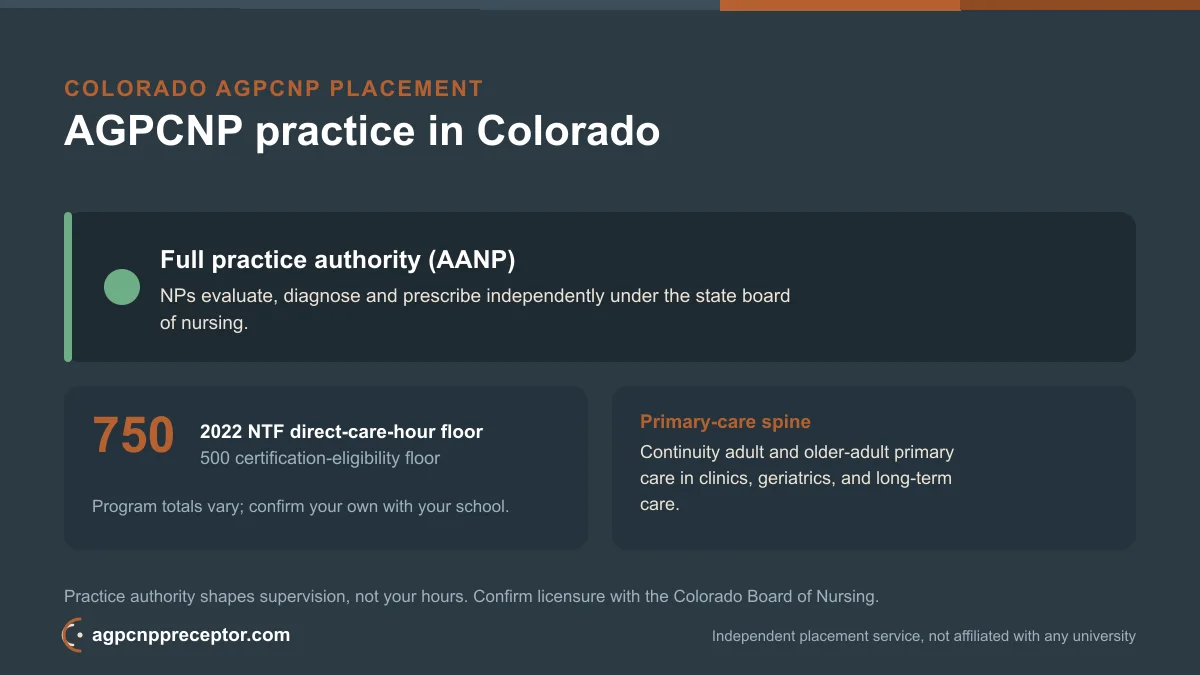
Where AGPCNP hours actually happen in Colorado
The adult-gerontology primary care role is built for continuity, not emergencies. Your rotations should follow patients from adolescence, roughly age 13, through the frail elderly across ambulatory and residential care. In Colorado that means internal medicine and adult primary care practices, family medicine offices that carry a strong adult and older-adult panel, dedicated geriatrics, and the long-term care and home-based programs that serve people who can no longer come to a clinic easily.
- Internal medicine and adult primary care clinics for the core longitudinal panel
- Dedicated geriatrics practices and PACE centers for frail elders
- Skilled nursing, assisted living, and long-term care facilities
- Home-based primary care and house-call programs for the homebound
- Community health centers and FQHCs with adult panels, plus chronic-disease clinics in endocrinology, cardiology, and nephrology for continuity hours
Emergency departments, intensive care, and inpatient hospitalist services belong to the acute care track, so we do not place AGPCNP students there. If a rotation cannot show how chronic conditions are managed over months in the same patient, it does not match the intent of this population focus.
Colorado's primary-care map, from the Front Range outward
Most of Colorado's outpatient clinic capacity sits along the Front Range, the urban band that runs from Fort Collins and Greeley through the Denver metro to Colorado Springs and Pueblo. This corridor holds the deepest supply of internal medicine, family medicine, and specialty clinics, so it is where most AGPCNP students find a primary care preceptor without long travel.
West and east of that corridor the picture thins quickly. The Western Slope leans on Grand Junction, while the San Luis Valley, the mountain resort counties, and the eastern plains include federally designated primary care Health Professional Shortage Areas where one clinic may cover a wide rural area. Students there often build in travel time or split hours between a home clinic and a metro geriatrics site.
Older adults are not spread evenly either. Several mountain and rural counties carry an above-average share of residents past 65, and the metro suburbs are aging fast, which drives geriatric and long-term care demand that does not always line up with where clinics are thickest.
A real PACE and long-term-care bench
Colorado is stronger than most states on programs that concentrate older-adult care, which helps when you need dedicated geriatric hours. The Program of All-Inclusive Care for the Elderly, or PACE, operates through several organizations statewide, from the Denver metro and Northern Colorado to the Colorado Springs area, Mesa County on the Western Slope, Boulder, and the Delta and Montrose region. Each center manages a panel of frail, nursing-home-eligible elders in one interdisciplinary setting, close to ideal for an AGPCNP learning to coordinate complex geriatric care.
Beyond PACE, skilled nursing facilities, assisted living communities, and home-based primary care give you the residential and house-call exposure that pure clinic rotations miss. We treat these as a priority, not an afterthought, because dedicated geriatric and long-term care hours are usually the scarce piece of an AGPCNP plan.
Full practice authority and who can precept you
Colorado is a full practice authority state under the Colorado State Board of Nursing, which places it in the American Association of Nurse Practitioners full-practice category. An experienced nurse practitioner can assess, diagnose, order, and prescribe under the board's sole authority, and gains full prescriptive authority after completing a defined mentorship period.
For your search this is helpful. A seasoned AGPCNP, certified as an A-GNP through the AANP or an AGPCNP-BC through the ANCC, can be your primary preceptor on their own signature, and so can a family primary care NP or a physician in internal medicine, family medicine, or geriatrics. Full practice authority mainly widens the pool of NPs who can precept you independently; it does not change what your preceptor must be qualified to do.
The hours that are hardest to line up
In Colorado, general adult primary care hours are the easier part, since internal medicine and family medicine clinics are plentiful along the Front Range. The tighter pieces are dedicated geriatrics and long-term care, because the frail-elderly panels concentrate in PACE, nursing facilities, and house-call programs that take a limited number of students.
The younger end of the range can also need planning. AGPCNP scope begins around age 13, yet many adult practices see few adolescents, so that experience may need a deliberate rotation. We map these gaps early rather than leaving them to your final term.
Clinical hours your program will set
Hour totals come from your program, not one national rule. The 2022 National Task Force standards recommend a minimum of 750 direct patient care hours for a nurse practitioner track, while AANP or ANCC certification requires at least 500 faculty-supervised hours. Accredited AGPCNP programs commonly publish totals from roughly 500 to 750 or more, and many sit below 750, so confirm your own figure. Simulation generally does not count.
Once you know your target and which settings you still owe, matching gets far more precise. You can review our clinical hours guidance and typical preceptor requirements before you reach out.
How we match Colorado AGPCNP students
We are an independent placement service, not a school, and we work with students at any program. Tell us your location, the settings you still need, and your program's hour target and timeline, and we look for a board-certified primary care preceptor and a site that fit. We assist and advocate; we never guarantee a placement or your school's approval of any preceptor or site, because those approvals belong to your program.
If you are staring at a geriatrics or long-term care requirement with no lead, start with how it works, or tell us what you need through the match form or the contact page.
Good to know
Do AGPCNP students in Colorado train in hospitals?
No. The adult-gerontology primary care role is longitudinal and outpatient, so your hours come from primary care clinics, geriatrics practices, long-term care and assisted living, home-based care, and chronic-disease continuity sites. Inpatient and intensive care hours belong to the acute care track, and we do not place primary care students there.
Does Colorado full practice authority mean my preceptor does not need a physician?
In most cases, yes. Once a nurse practitioner has completed Colorado's mentorship requirement, they hold full practice and prescriptive authority and can precept you on their own signature. A physician in family medicine, internal medicine, or geriatrics can also serve as your preceptor. Full practice authority simply widens your options.
What if I live on the Western Slope, the plains, or the San Luis Valley?
Those regions include federally designated primary care shortage areas where clinics are spread thin. Many students there keep their general adult hours close to home and travel to a hub like Grand Junction or a Front Range metro for a dedicated geriatrics or long-term care block. We try to find the nearest workable site and help you plan around it.
Can you guarantee an AGPCNP placement in Colorado?
No. We search for and help arrange primary care preceptors and sites and advocate hard for you, but we cannot guarantee a placement or your program's approval of any preceptor or site. Those decisions are made by your school.
Secure both ends of the arc, not just one
Tell us your school, your city, and the hours you still need across the continuum. We will come back with a plan that reaches from continuity primary care to genuine frail-elder exposure, and a realistic path to placed.