Where South Carolina AGPCNP students find primary care preceptors
South Carolina's coast is filling with retirees, and that is reshaping where adult-gerontology primary care nurse practitioners are needed most. We help AGPCNP students across the state, from the Grand Strand to the Upstate, find preceptors for the longitudinal primary care, geriatrics, and long-term care hours their programs require.
Tell us your school and city. It is free to ask, with no obligation.
Retirement growth is reshaping demand
South Carolina is projected to have more than 1.5 million residents aged 65 and older by 2030, and that growth is heaviest along the coast. The Grand Strand around Myrtle Beach in Horry County and the Lowcountry around Hilton Head in Beaufort County have drawn large retiree populations, and local health systems have openly reported shortages of primary care and specialty clinicians to keep up. Inland retirement growth around Aiken, the lakes of the Midlands, and the greater Charleston area adds to the same trend, so older-adult demand is rising well beyond the beach towns.
For AGPCNP students that concentration is useful: coastal practices carry heavy older-adult panels, which is exactly the longitudinal, chronic-disease work the track is built around. The same growth also means demand for preceptors runs ahead of supply in those counties.
AGPCNP settings from the coast to the Upstate
Adult-gerontology primary care is delivered in clinics, facilities, and homes, not on the hospital floor. Clinic density is strongest in Charleston, the Midlands around Columbia, and the Upstate around Greenville and Spartanburg, with the coastal Pee Dee and Lowcountry adding older-adult volume. These four hubs hold most of the state's internal medicine and multispecialty groups, which makes them the usual base for an adult primary care term even when a student lives elsewhere.
- Internal medicine and adult primary care practices
- Federally qualified health centers with adult panels
- Skilled nursing, long-term care, and assisted living
- Home-based primary care and house-call programs for homebound seniors
- Chronic-disease specialty clinics such as cardiology, endocrinology, and nephrology used for continuity
Most students combine two or three of these into a term of adult primary care hours.
Geriatrics, PACE, and long-term care
South Carolina runs a Program of All-Inclusive Care for the Elderly through the state Medicaid agency, with sites active in counties including Anderson, Berkeley, Charleston, Dorchester, Greenville, Lexington, Orangeburg, Pickens, and Richland. These interdisciplinary elder-care programs are strong adult-gerontology environments where they operate.
Home-based primary care and house-call programs also serve homebound older adults across the state. Even so, dedicated geriatrics and long-term care preceptors are the hardest single piece to secure, because the bulk of adult care sits inside general primary care rather than a geriatrics specialty. Where a PACE site or a busy skilled nursing facility will take a student, it is often the single best source of concentrated older-adult hours in the region.
Restricted practice and the practice agreement
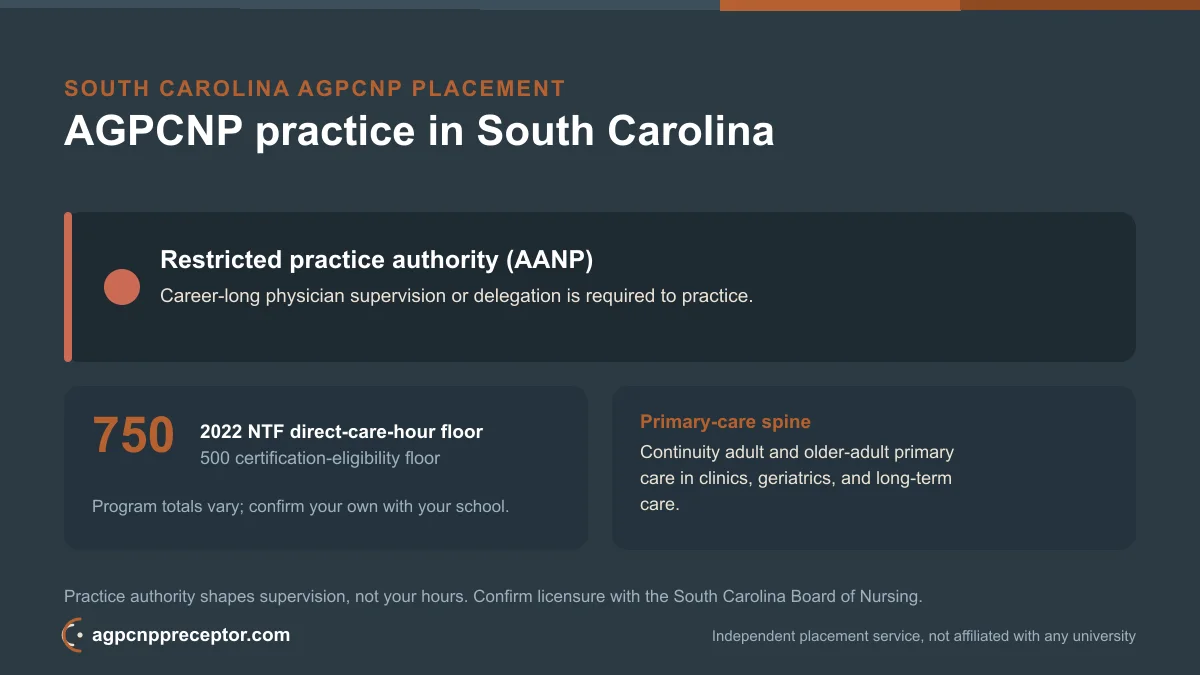
The AANP classifies South Carolina as a restricted-practice state. Nurse practitioners who perform medical acts do so under a written practice agreement with a physician, and a single physician may hold agreements with no more than the equivalent of six full-time NPs or physician assistants. The South Carolina Board of Nursing oversees these arrangements.
For a student, this affects the supervision structure rather than the preceptor's core qualifications. Your preceptor, whether an AGPCNP or a physician, practices within that agreement, and that is the backdrop your school paperwork sits in. Confirm the current rules with the Board of Nursing before you finalize a site.
Rural shortage areas and preceptor travel
Away from the metros and the coast, much of South Carolina is rural, and rural seniors are less likely to have community-based care nearby. The state's rural federally qualified health centers are a core safety net and often the most realistic placement for a student in the inland Pee Dee, the Lowcountry interior, or the rural Upstate. The rural counties along the Interstate 95 corridor carry some of the state's most persistent primary-care shortages, which shapes both where patients travel for care and where a student can realistically find a preceptor.
Because preceptor supply concentrates in Charleston, Columbia, Greenville, and the coastal retiree belt, rural students should plan for some travel. Tell us your county early and we will build the search around a commute you can actually sustain.
Matching your AGPCNP hours in South Carolina
Hour totals are set by your program. The 2022 National Task Force standards recommend a minimum of 750 direct patient-care hours, certification through the AANP A-GNP or the ANCC AGPCNP-BC requires at least 500 faculty-supervised hours, and accredited AGPCNP programs commonly publish totals from roughly 500 to 750 or more, with many below 750. Simulation is excluded, so confirm your program's real number.
When you are ready, send your county, target settings, and hour goal at #match or through contact, and see AGPCNP clinical hours for more detail. We are independent and serve students at any university; we assist with the search and the practice-agreement paperwork and never guarantee a placement or your school's approval of a preceptor or site.
Good to know
Why is the South Carolina coast good for adult-gerontology hours?
The Grand Strand and the Lowcountry have large retiree populations, so coastal practices carry heavy older-adult panels. That is the longitudinal, chronic-disease work AGPCNP training is built around.
Does South Carolina require a physician for my preceptor?
Yes. It is a restricted-practice state, so nurse practitioners work under a written practice agreement with a physician. This shapes the supervision structure, not a preceptor's core qualifications.
Where can I find geriatrics and long-term care hours?
The state's PACE sites, long-term care facilities, and home-based primary care programs are the best sources. Dedicated geriatrics is still scarce, since most adult care runs through general primary care.
How many clinical hours will my program require?
It is program-specific. National standards recommend at least 750 direct patient-care hours and certification requires at least 500 supervised hours, but many programs publish totals below 750. Confirm your own program's number.
Do you guarantee a placement in South Carolina?
No. We help you search and coordinate the practice-agreement paperwork, but your school approves the preceptor and site, and we never promise a specific placement.
Secure both ends of the arc, not just one
Tell us your school, your city, and the hours you still need across the continuum. We will come back with a plan that reaches from continuity primary care to genuine frail-elder exposure, and a realistic path to placed.