Home / AGPCNP by School / Maryville University
Maryville University AGPCNP supportAGPCNP preceptor support for Maryville University students
AGPCNP students connected with Maryville University can ask us to search for adult-gerontology primary-care preceptors and practicum settings. The program decides what is eligible; our independent work is to source and document a possible match against the current requirements supplied by the student.
Tell us your school and city. It is free to ask, with no obligation.
Maryville University AGPCNP pathway snapshot
- Program: Adult-Gerontology Primary Care Nurse Practitioner
- School: Maryville University
- Directory location: St. Louis, Missouri
- Verified pathways: MSN, DNP, and post-graduate certificate
- Official evidence checked: July 21, 2026
- Clinical population: adults and older adults with stable or chronic conditions that benefit from ongoing care
- Setting landscape: internal medicine, adult primary care, geriatrics, community health, long-term care, chronic disease management, and approved specialty primary-care settings
- Approval authority: the student's current program
This snapshot reports only what the linked official program evidence supports. It does not assign a delivery format, clinical sequence, hour total, placement responsibility, preceptor rule, or approval timeline to Maryville University. Confirm each of those details with the current program.
What the official Maryville University evidence confirms
The directory uses the official AGPCNP pages available on July 21, 2026. They support MSN, DNP, and post-graduate certificate as the pathway set for this record. Any detail that is not explicit in those pages remains unclaimed and must be confirmed with the program.
- Official AGPCNP source 1, MSN: Current official page identifies the AGPCNP MSN.
- Official AGPCNP source 2, DNP: Current official page identifies the AGPCNP DNP.
- Official AGPCNP source 3, post-graduate certificate: Current official page identifies the AGPCNP post-master's certificate.
These citations are included for verification, not as an endorsement of our service. Read the current official page and ask the program to confirm any requirement that affects the proposed preceptor or site.
Build the adult-gerontology primary-care spine
Longitudinal reasoning is the thread that connects adult primary care and geriatrics. The student should be able to assess risk, manage stable or chronic problems, revisit treatment plans, coordinate care, and respond to changes within primary-care scope. The program retains the final decision on fit.
No single site category is automatically suitable. A community health center may offer broad continuity, a geriatric practice may strengthen aging-focused care, and an approved specialty primary-care setting may fill a defined gap. The student's program must evaluate the complete proposal.
Turn the Maryville University pathway label into a clinical brief
For this record, the official evidence names MSN, DNP, and post-graduate certificate. We use that verified label only to orient the request. The student's own course documents must supply the setting, population, competencies, dates, geography, and preceptor criteria.
Use a one-page clinical brief to explain the remaining need: course, dates, adult-gerontology population, continuity, setting, required experiences, and credential criteria. A specific brief respects the preceptor's time and gives the program a clearer proposal to evaluate.
Confirm hours and preceptor eligibility
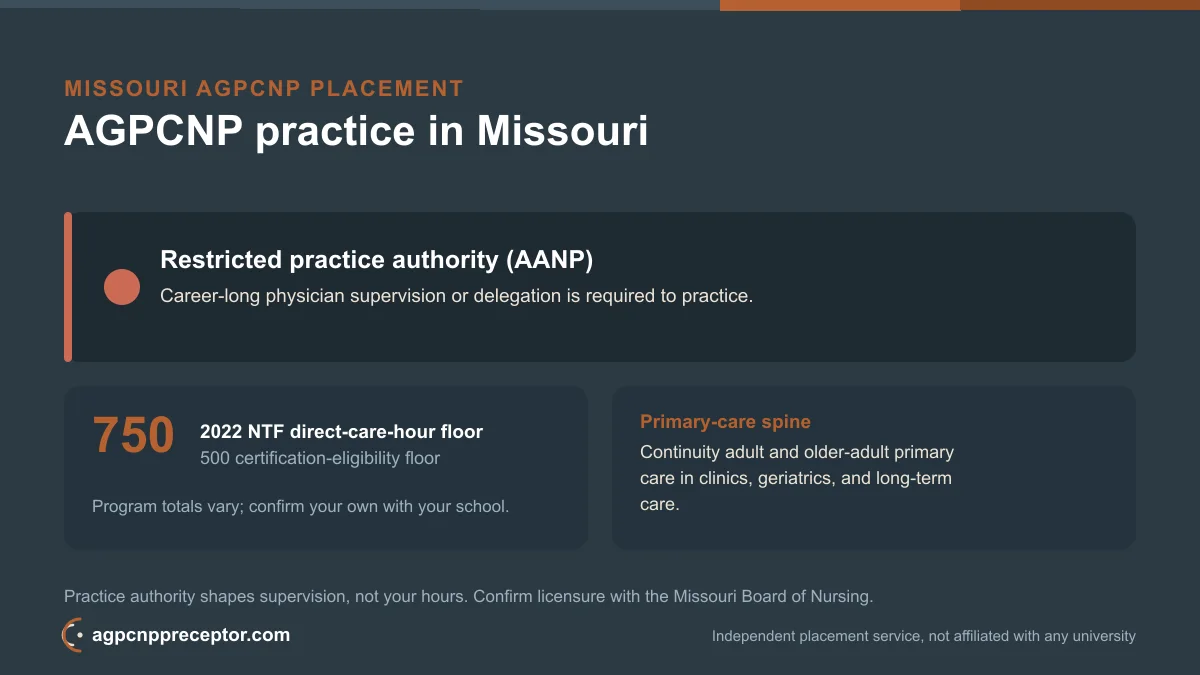
The hour plan must come from the student's program record. Nationally, NTF recommends a 750-hour direct patient care minimum for an NP population track, and the certification bodies publish a 500-hour faculty-supervised eligibility floor. Neither figure is presented here as Maryville University's rule. Confirm the exact current requirement before sourcing.
Use the AGPCNP clinical hours guide for national context and the preceptor requirements guide for screening questions. Neither guide replaces the program's current instructions.
Credentials start the review, but they do not finish it. We gather the prospective preceptor's license, certification, current primary-care role, experience, patient population, site, and availability. The student's program applies its own current criteria and makes the approval decision.
Plan the primary-care search from St. Louis
Longitudinal primary-care opportunities are distributed unevenly across communities. Confirm approved states and travel limits first, then compare the remaining objectives with internal medicine, geriatrics, community health, long-term care, and chronic disease settings in that area.
For wider geographic context, read the AGPCNP placement guide for Missouri. It describes the state's adult primary-care and aging landscape without assigning a policy to Maryville University or claiming that a named practice accepts students.
Prepare a complete proposal for Maryville University review
- The exact course, clinical objectives, term dates, and remaining approved hours
- The approved geography, adult-gerontology population, continuity objectives, and setting
- The proposed clinician's license, certification, specialty, primary-care role and availability
- The site's practice setting, patient mix, and opportunities tied to the objectives
- Every current preceptor, site, compliance, and submission form supplied by the program
Document the match in the program's own terms. The file should show candidate qualifications, adult-gerontology primary-care role, site context, objective alignment, dates, and availability. The school can require additional review or documents that we cannot approve.
Independent AGPCNP placement support
Bring the current syllabus or checklist, the student's schedule and geography, the adult-gerontology primary-care objectives, the remaining approved hours, and the candidate forms. That evidence keeps the search aligned and gives the program a clear proposal to consider.
We do not represent Maryville University and have no authority to approve a clinician, site, schedule, or clinical plan. Our independent role is limited to searching and documenting a possible match. Availability, review time, and the final program decision cannot be guaranteed.
Good to know
Which AGPCNP pathways are verified for Maryville University?
The official source set checked July 21, 2026 identifies MSN, DNP, and post-graduate certificate. Those labels do not establish clinical hours, delivery format, placement policy, or approval steps. Confirm the active pathway and course requirements directly with the program.
How many AGPCNP clinical hours does Maryville University require?
This page does not assign an exact school total. NTF recommends at least 750 direct patient care hours for an NP track, while certification eligibility sources use a minimum of 500 faculty-supervised clinical hours. Programs vary, so confirm the student's exact current requirement with Maryville University.
Who can precept an AGPCNP student from Maryville University?
A board-certified primary-care NP or an appropriately licensed physician in a matching longitudinal primary-care role is a reasonable search target. The program decides whether a particular candidate, credential, role, and site meet the course rules.
Which clinical settings can support AGPCNP objectives?
Potential settings range from adult health clinics and internal medicine to geriatric, community, long-term care, and chronic disease practices. A category alone is not approval; patient mix, supervised work, continuity, and objectives all need program review.
Is AGPCNP Preceptor affiliated with Maryville University?
No. AGPCNP Preceptor is an independent service and does not represent or receive endorsement from Maryville University. We cannot guarantee placement, a timeline, paperwork completion, or program approval.
Related
Secure both ends of the arc, not just one
Tell us your school, your city, and the hours you still need across the continuum. We will come back with a plan that reaches from continuity primary care to genuine frail-elder exposure, and a realistic path to placed.