Where Missouri AGPCNP students find continuity and geriatric hours
Missouri has one feature that shapes Adult-Gerontology Primary Care NP placement more than most: a restricted practice model that ties a nurse practitioner to a collaborating physician within a set driving distance. That geographic rule, layered over a state split between two big metros and a wide aging countryside, decides where your continuity and geriatric hours can realistically sit. We help students at any university source and verify a qualified primary-care preceptor and settle the site paperwork, without ever guaranteeing a placement.
Tell us your school and city. It is free to ask, with no obligation.
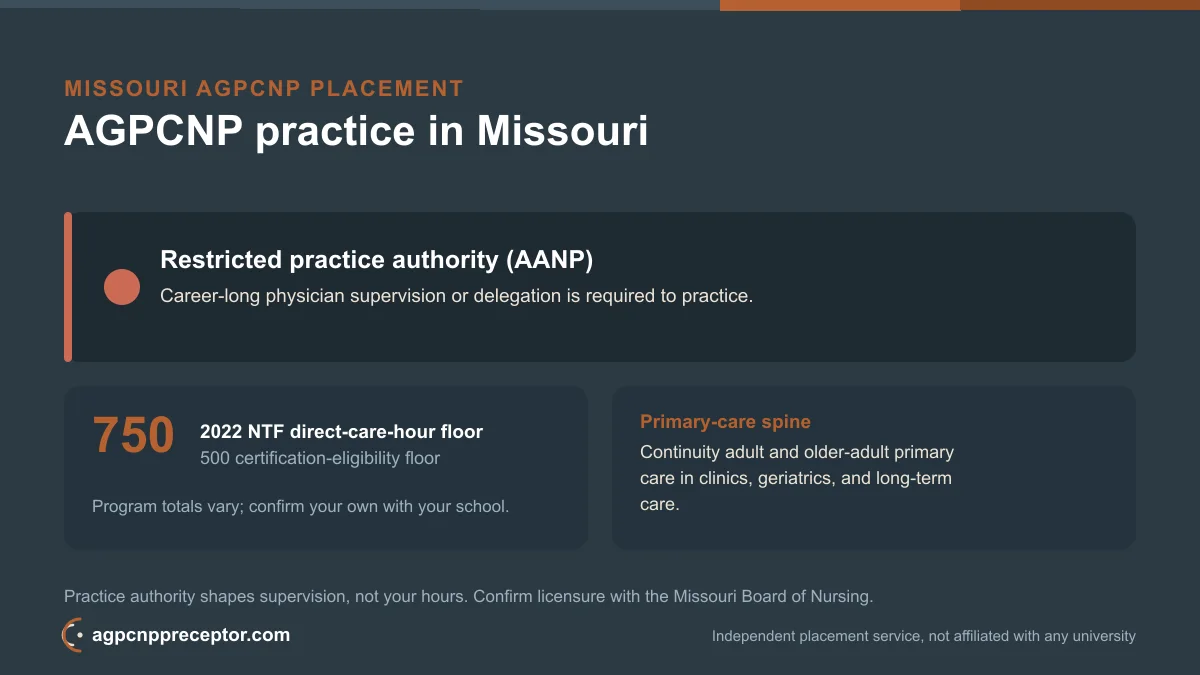
Restricted practice, and Missouri's proximity rule
The American Association of Nurse Practitioners classifies Missouri as a restricted practice state, and the detail that matters for placement is geographic. Missouri requires a nurse practitioner to work under a collaborative practice arrangement with a physician, and historically the collaborating physician had to practice within a set number of road miles, with a wider allowance in federally designated shortage areas and a waiver process for others. New arrangements also expect an initial stretch of practice at the same site as the collaborating physician.
A recent change lets an APRN who has logged a large number of documented collaborative hours, on the order of two thousand, step out of the arrangement, so the rule is loosening for experienced NPs. For a student, though, the practical effect is that your preceptor and the supervising physician are usually a linked pair, and that pairing has to make geographic sense. Confirm current requirements with the Missouri State Board of Nursing.
The primary-care map: metros, Ozarks, and the Bootheel
Clinic supply concentrates in Missouri's metros. St. Louis and Kansas City anchor the two largest pools of adult primary care and specialty clinics, with Springfield anchoring the southwest and Columbia adding an academic hub in the center of the state. Those are where continuity primary-care hours are easiest to reach.
The aging population sits elsewhere. The Ozarks across southern Missouri skew older and more rural, and the Bootheel in the southeast corner is a persistent primary-care shortage region with high need and few clinicians. That is the familiar AGPCNP tension: the geriatric and long-term-care demand is concentrated in the rural counties, while the preceptor supply is concentrated in the cities, so a rural student often plans a wider radius for part of the rotation.
The settings that host adult-gerontology hours
Your adult primary-care and gerontology hours can sit across several Missouri settings, and a full plan usually spans more than one to cover the whole arc.
- Internal-medicine and family practices with adult panels across the metros
- Federally qualified health centers and rural primary-care clinics, including sizable systems in the Springfield area and south-central Missouri
- PACE programs that keep nursing-home-eligible elders at home, including a senior-care program run by a Springfield community health center
- Skilled nursing and long-term-care facilities and assisted living
- Home-based primary care and adult chronic-disease specialty clinics for continuity
Reaching from a metro adult panel to authentic frail-elder care is what finishes the plan, and few single sites carry both the continuity and the geriatric ends.
The hours that are hardest to secure
Because most adult care in Missouri runs through general internal medicine and family practice, the ambulatory continuity hours are the more available piece. Dedicated geriatrics and hands-on long-term-care hours are the bottleneck, and the proximity rule can tighten it further, since a rural nursing home needs not only an NP preceptor but a collaborating physician within reach.
The practical read: reserve the geriatric and long-term-care block first, especially in the Ozarks and the Bootheel, and plan for a wider search radius. Continuity hours can usually be filled closer to home.
Your program sets the hours
Missouri does not set your clinical-hour total; your program and its accreditor do. The 2022 National Task Force standards recommend a minimum of 750 direct patient care hours, and AANP and ANCC certification eligibility requires at least 500 supervised hours. Accredited AGPCNP programs publish totals across a range, commonly from roughly 500 to 750 or more, and many sit below 750. Simulation is excluded from direct patient care.
Pin your number down early so we can plan how many settings you need. Our clinical hours page has the detail; your school confirms the final figure.
Setting up your Missouri placement
Tell us your program, the part of the state you can reach, and the continuity and geriatric hours you still owe. We source and vet a qualified primary-care preceptor, check them and the collaborating physician against your school's requirements and the state's arrangement rules, and work the affiliation paperwork so you are not doing it between shifts. See how it works and preceptor requirements.
Start with the match form below or reach out. We are independent, we serve students at any university, and we help you place without guaranteeing a site or your school's approval of a preceptor.
Good to know
How does Missouri's collaboration rule affect finding a preceptor?
It links your preceptor to a collaborating physician who has to be within a set driving distance, so the pair must make geographic sense. In the metros that is straightforward; in the rural Ozarks and Bootheel it narrows the options, which is where our sourcing helps most.
Can I complete my hours in rural Missouri?
Often the continuity primary-care hours, through a rural clinic or federally qualified health center. Dedicated geriatrics and long-term-care hours are harder to place locally, partly because of the proximity rule, so plan them early and expect a wider radius. We help build that route.
Who can serve as my preceptor in Missouri?
Generally a board-certified adult-gerontology or family primary-care NP (A-GNP or AGPCNP-BC), or a physician in internal medicine, family medicine, or geriatrics, in a setting that matches your rotation. Your program sets the exact rule, so check its preceptor form.
How many clinical hours will I need?
The state does not set it; your program does. The 2022 NTF standards recommend at least 750 direct-care hours and certification eligibility requires at least 500, and accredited programs vary, with many under 750. Confirm your total with your school.
Do you place students from any school?
Yes. We are independent of every university. We work with Adult-Gerontology Primary Care NP students from any accredited program and match preceptors to your program's requirements.
Secure both ends of the arc, not just one
Tell us your school, your city, and the hours you still need across the continuum. We will come back with a plan that reaches from continuity primary care to genuine frail-elder exposure, and a realistic path to placed.