Home / AGPCNP by School / Emory University
Emory University AGPCNP supportAGPCNP preceptor support for Emory University students
Students in the Emory University AGPCNP program can use our independent service to source potential preceptors and longitudinal primary-care clinical sites. We build the request around the requirements confirmed by the student, while the program keeps every approval decision for the preceptor, setting, and paperwork.
Tell us your school and city. It is free to ask, with no obligation.
Emory University AGPCNP pathway snapshot
- Program: Adult-Gerontology Primary Care Nurse Practitioner
- School: Emory University
- Directory location: Atlanta, Georgia
- Verified pathways: MSN and post-graduate certificate
- Official evidence checked: July 21, 2026
- Clinical population: adults and older adults with stable or chronic conditions that benefit from ongoing care
- Setting landscape: internal medicine, adult primary care, geriatrics, community health, long-term care, chronic disease management, and approved specialty primary-care settings
- Approval authority: the student's current program
Treat the pathway list as an evidence boundary, not a summary of school policy. The official pages establish the AGPCNP credential routes shown here, while the current handbook and program contact remain the authorities for hours, sites, preceptors, forms, and deadlines.
What the official Emory University evidence confirms
We verified the listed MSN and post-graduate certificate evidence on July 21, 2026. Each link belongs to the institution or its official catalog and names the AGPCNP specialty. The student's present course materials still control the clinical request.
- Official AGPCNP source 1, post-graduate certificate: Official page explicitly identifies the AGPCNP specialty (Home | Nell Hodgson Woodruff School of Nursing).
- Official AGPCNP source 2, MSN: Official page explicitly identifies the AGPCNP specialty (Adult Gerontology Primary Care Nurse Practitioner | Nell Hodgson Woodruff School of Nursing).
These citations are included for verification, not as an endorsement of our service. Read the current official page and ask the program to confirm any requirement that affects the proposed preceptor or site.
Build the adult-gerontology primary-care spine
The placement should reflect the primary-care needs of adults across aging, from routine prevention through multimorbidity and frailty. That does not make every adult-facing clinic eligible. The proposed patient mix and activities must support the student's approved competencies.
A practical search often considers several parts of the care landscape: internal medicine, adult primary care, geriatrics, community health, long-term care, chronic disease programs, and approved specialty primary-care clinics. We do not promise that a named practice will be accepted before program review.
Turn the Emory University pathway label into a clinical brief
The published pathway set is MSN and post-graduate certificate. Before sourcing, separate that public fact from the student's individual clinical need. Confirm the active course, required outcomes, remaining approved hours, site boundaries, and candidate credentials with the program.
Break the practicum into the competencies that remain unmet. The search can then prioritize the right service and clinician instead of asking broadly for any AGPCNP preceptor. The program still reviews the combined picture and can request a different arrangement.
Confirm hours and preceptor eligibility
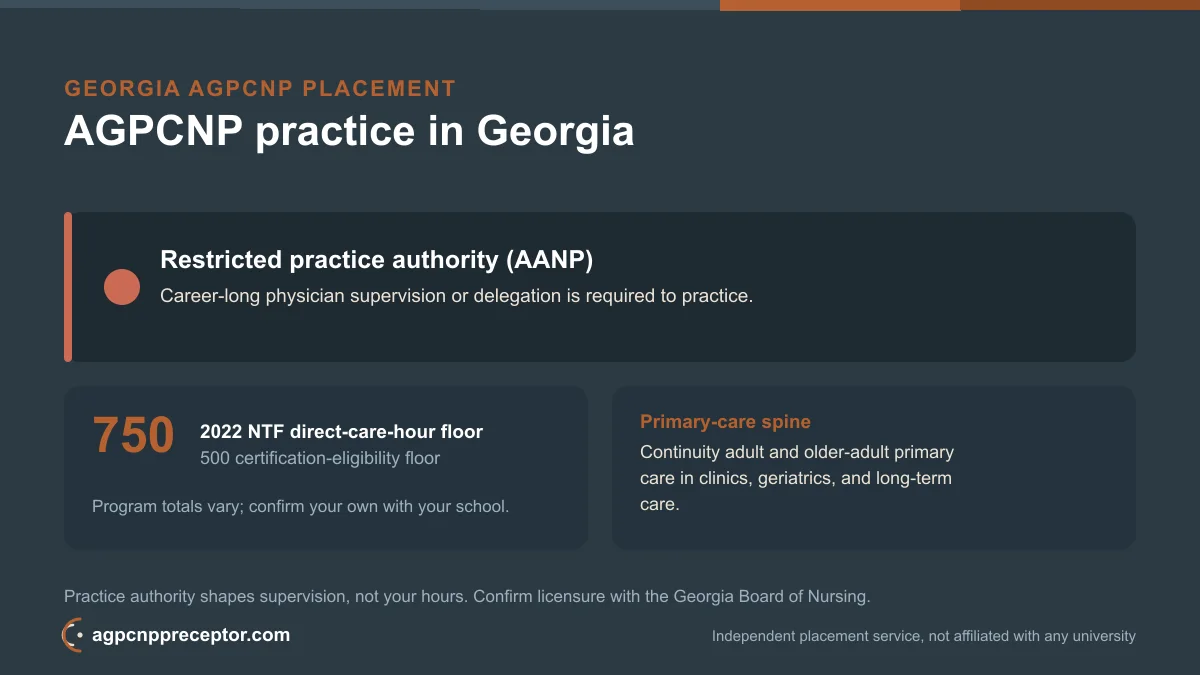
Two national benchmarks are often confused: the NTF recommendation of at least 750 direct patient care hours per NP population track and the 500 faculty-supervised clinical hour floor used in certification eligibility. A student's program can require or distribute hours differently. Ask Emory University to confirm the actual AGPCNP total and approved balance.
Use the AGPCNP clinical hours guide for national context and the preceptor requirements guide for screening questions. Neither guide replaces the program's current instructions.
The clinician should actively provide longitudinal primary care to the adult or older-adult population the student needs. A title without matching practice is not enough. We document the candidate and setting for Emory University to consider rather than declaring either one approved.
Plan the primary-care search from Atlanta
Longitudinal primary-care opportunities are distributed unevenly across communities. Confirm approved states and travel limits first, then compare the remaining objectives with internal medicine, geriatrics, community health, long-term care, and chronic disease settings in that area.
Pair this record with the AGPCNP placement guide for Georgia when considering travel and setting supply. The guide is not a list of guaranteed sites, and the program remains the approval authority.
Prepare a complete proposal for Emory University review
- The exact course, clinical objectives, term dates, and remaining approved hours
- The approved geography, adult-gerontology population, continuity objectives, and setting
- The proposed clinician's license, certification, specialty, primary-care role and availability
- The site's practice setting, patient mix, and opportunities tied to the objectives
- Every current preceptor, site, compliance, and submission form supplied by the program
Before submission, assemble the candidate's license and certification details, role, site, population, continuity opportunities, schedule, and fit with each objective. The program may request more information or decline the proposal. A complete file is never presented as a guarantee.
Independent AGPCNP placement support
Bring the current syllabus or checklist, the student's schedule and geography, the adult-gerontology primary-care objectives, the remaining approved hours, and the candidate forms. That evidence keeps the search aligned and gives the program a clear proposal to consider.
AGPCNP Preceptor has no affiliation with Emory University. We help students search for potential primary-care preceptors and sites, subject to the program's current rules and final approval. No page, conversation, or submitted form creates a guarantee.
Good to know
Which AGPCNP pathways are verified for Emory University?
The official source set checked July 21, 2026 identifies MSN and post-graduate certificate. Those labels do not establish clinical hours, delivery format, placement policy, or approval steps. Confirm the active pathway and course requirements directly with the program.
How many AGPCNP clinical hours does Emory University require?
This page does not assign an exact school total. NTF recommends at least 750 direct patient care hours for an NP track, while certification eligibility sources use a minimum of 500 faculty-supervised clinical hours. Programs vary, so confirm the student's exact current requirement with Emory University.
Who can precept an AGPCNP student from Emory University?
A board-certified primary-care NP or an appropriately licensed physician in a matching longitudinal primary-care role is a reasonable search target. The program decides whether a particular candidate, credential, role, and site meet the course rules.
Which clinical settings can support AGPCNP objectives?
The right setting supports prevention and ongoing management for adults and older adults with stable or chronic conditions. Its name does not make it eligible, so the program must evaluate the actual clinician, population, and proposed experiences.
Is AGPCNP Preceptor affiliated with Emory University?
No. AGPCNP Preceptor is an independent service and does not represent or receive endorsement from Emory University. We cannot guarantee placement, a timeline, paperwork completion, or program approval.
Related
Secure both ends of the arc, not just one
Tell us your school, your city, and the hours you still need across the continuum. We will come back with a plan that reaches from continuity primary care to genuine frail-elder exposure, and a realistic path to placed.