Adult-gerontology primary care placements in Rhode Island
Rhode Island is compact enough that a student in Providence can reach most of the state's adult-gerontology primary care sites within an hour, and it is a full practice authority state, so an experienced AGPCNP can precept independently. We help AGPCNP students here line up primary care, geriatrics, and long-term care hours close to home.
Tell us your school and city. It is free to ask, with no obligation.
A small state with short clinical commutes
Rhode Island's size is a genuine advantage for clinical placement. From the Providence core you can reach Woonsocket to the north, the East Bay and Newport to the south, and the Washington County towns of South County without the multi-hour drives that define rural placement in larger states. Kent and Warwick fill in the center. The whole state effectively functions as one connected metro along the Interstate 95 spine, so a preceptor forty minutes away is still an easy weekly commitment. Only western Washington County and Block Island sit far enough out to feel genuinely rural.
The trade-off is scale: any single specialty has a naturally small pool of clinicians, so a geriatrics or nephrology continuity slot can fill quickly. Short distances make it easier to combine two nearby sites into one term of hours, which we plan around from the start. It also pays to start early, because a strong site that takes only one or two students each term is booked well ahead in a state this size.
Where AGPCNP students place in Rhode Island
Adult-gerontology primary care here runs through clinics, community health centers, and residential settings rather than the hospital. Providence and its inner suburbs hold the densest supply, with additional sites across Kent and Washington counties. Providence anchors the state's largest concentration of internal medicine and adult primary care, and its teaching-affiliated practices see a broad, older, and medically complex panel that fits the track well.
- Internal medicine and adult primary care practices
- Community health centers and FQHCs with adult panels
- Skilled nursing, long-term care, and assisted living
- Home-based primary care and house-call programs
- Chronic-disease specialty clinics such as endocrinology, cardiology, and nephrology used for continuity
Any of these can anchor an adult primary care rotation, and the short geography makes blending them practical.
PACE-RI and the geriatrics advantage
Rhode Island punches above its size in organized elder care. The PACE Organization of Rhode Island has operated since 2005, with a base in Providence and a growing site in Woonsocket, and its clinical teams are built around geriatricians and other specialists in complex older-adult care. It delivers services in homes, clinics, and day centers and is designed to keep participants out of nursing homes.
That matters because dedicated geriatrics and long-term care hours are the scarce piece almost everywhere, since most adult care sits in general primary care. A concentrated PACE presence gives Rhode Island students a real shot at true geriatric continuity within a short drive. Training inside an interdisciplinary team, alongside social work, therapy, and pharmacy, also mirrors how good older-adult care actually works, which is hard to reproduce in a single-clinician office.
Full practice authority and preceptor independence
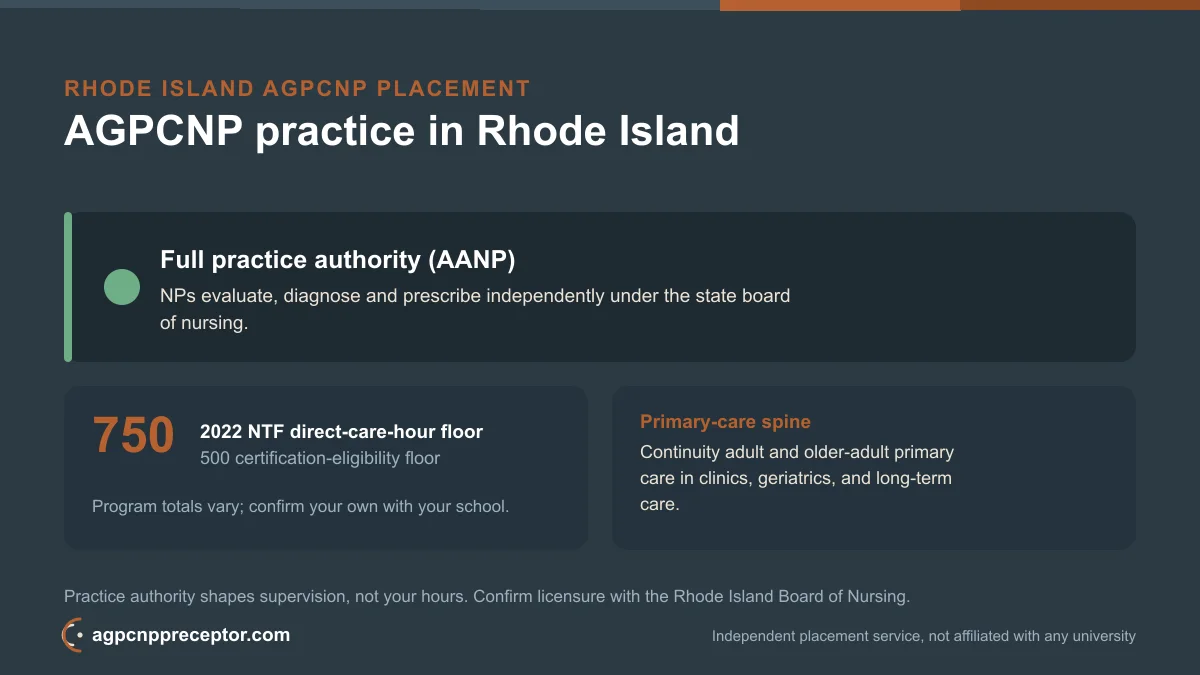
The Rhode Island Board of Nurse Registration and Nursing Education, housed within the Department of Health, licenses nurse practitioners to practice and prescribe independently, and the AANP classifies the state as full practice. For students that means an experienced AGPCNP can precept on their own authority, widening the pool beyond physician-led practices.
The core qualifications hold regardless: a preceptor is generally a board-certified adult-gerontology or family primary-care NP, or a licensed MD or DO in internal medicine, family medicine, or geriatrics. Many Rhode Island practices already rely on nurse practitioners as primary providers, which makes an experienced AGPCNP a realistic and common choice of preceptor. Confirm any licensure detail with the board.
Hours, certification, and getting matched
Your program sets the hour total. The 2022 National Task Force standards recommend a minimum of 750 direct patient-care hours, certification through the AANP A-GNP or the ANCC AGPCNP-BC requires at least 500 faculty-supervised hours, and accredited AGPCNP programs commonly publish totals from about 500 to 750 or more, with many below 750. Simulation does not count, so confirm your program's figure early, since that single number drives how many weeks and how many sites your term needs.
When you are set, send your target settings and hour goal through the form at #match or via contact. We are independent and serve students at any university; we help with the search and coordination and never guarantee a placement or your school's approval of a preceptor or site.
Good to know
Is Rhode Island easy to place in because it is small?
Short commutes are a real advantage, and full practice authority widens the preceptor pool. The main limit is scale, since any single specialty has a small number of clinicians and popular slots fill fast.
Where can I find geriatrics hours in Rhode Island?
The PACE Organization of Rhode Island, with sites in Providence and Woonsocket, is a strong source of true geriatric continuity. Long-term care facilities and internal medicine practices with older-adult panels add more.
Does Rhode Island require a collaborating physician for my preceptor?
No. It is a full practice authority state, so an experienced AGPCNP can precept independently. Confirm current licensure details with the Rhode Island Board of Nurse Registration and Nursing Education.
How many clinical hours will I need?
It depends on your program. National standards recommend at least 750 direct patient-care hours and certification requires at least 500 supervised hours, but many programs publish totals below 750. Confirm your own program's requirement.
Do you guarantee a placement in Rhode Island?
No. We help you search and coordinate, but your school approves the preceptor and site, and we never promise a specific placement.
Secure both ends of the arc, not just one
Tell us your school, your city, and the hours you still need across the continuum. We will come back with a plan that reaches from continuity primary care to genuine frail-elder exposure, and a realistic path to placed.