Precepting adult and older-adult primary care in Pennsylvania
Pennsylvania has one of the oldest populations in the country, and that single fact shapes almost every adult-gerontology primary care rotation here. We help AGPCNP students across the commonwealth find preceptors in the internal medicine practices, community health centers, and geriatrics and long-term care settings where older adults get their day-to-day care.
Tell us your school and city. It is free to ask, with no obligation.
One of the country's oldest states
Pennsylvania ranks among the five oldest states by median age, with roughly 2.5 million residents aged 65 and older, close to a fifth of the population. It also has one of the largest rural populations in the nation. That combination means older-adult demand is spread across the whole map, not just the cities, and it is exactly why adult-gerontology primary care preceptors, especially those with heavy older-adult panels, are sought after here. Seniors are not spread evenly: the northern tier, much of the southwest around Pittsburgh, and many small central counties skew markedly older than the state as a whole.
For a student, the upside is that longitudinal older-adult care is genuinely everywhere. The challenge is that demand outpaces the number of clinicians available to teach, which is where a focused search helps. Because older-adult panels are common even in general practice, a well-chosen internal medicine or family-medicine site can supply strong adult-gerontology continuity without a geriatrics label on the door.
AGPCNP placement settings across Pennsylvania
Adult-gerontology primary care is ambulatory and residential, so the productive sites are clinics, facilities, and homes rather than the hospital. Clinic density is highest in Philadelphia, Pittsburgh, and the Lehigh Valley around Allentown, with strong secondary hubs in Harrisburg, Lancaster, Erie, and Scranton.
- Internal medicine and adult primary care practices
- Federally qualified health centers with adult panels
- Skilled nursing, long-term care, and assisted living
- Home-based primary care and house-call programs
- Chronic-disease specialty clinics such as cardiology, endocrinology, and nephrology used for continuity
Any of these can anchor an adult primary care rotation, and most students blend two or three across a term.
LIFE, the state's PACE program and a geriatrics classroom
Pennsylvania runs one of the largest Program of All-Inclusive Care for the Elderly systems in the country under the name Living Independence for the Elderly, or LIFE. Enrollment is among the highest of any state, and the day centers deliver on-site provider visits, nursing, therapy, and home support to frail older adults who want to stay in their communities.
These interdisciplinary elder-care sites are excellent adult-gerontology primary care environments, and the state is actively expanding LIFE into rural counties. Where a LIFE program operates, it can be one of the best available sources of true geriatrics and long-term care hours. Because a LIFE participant is medically complex by definition, the caseload leans into polypharmacy, cognitive change, and multiple chronic conditions, which is the heart of older-adult primary care.
Reduced practice and the collaborating physician
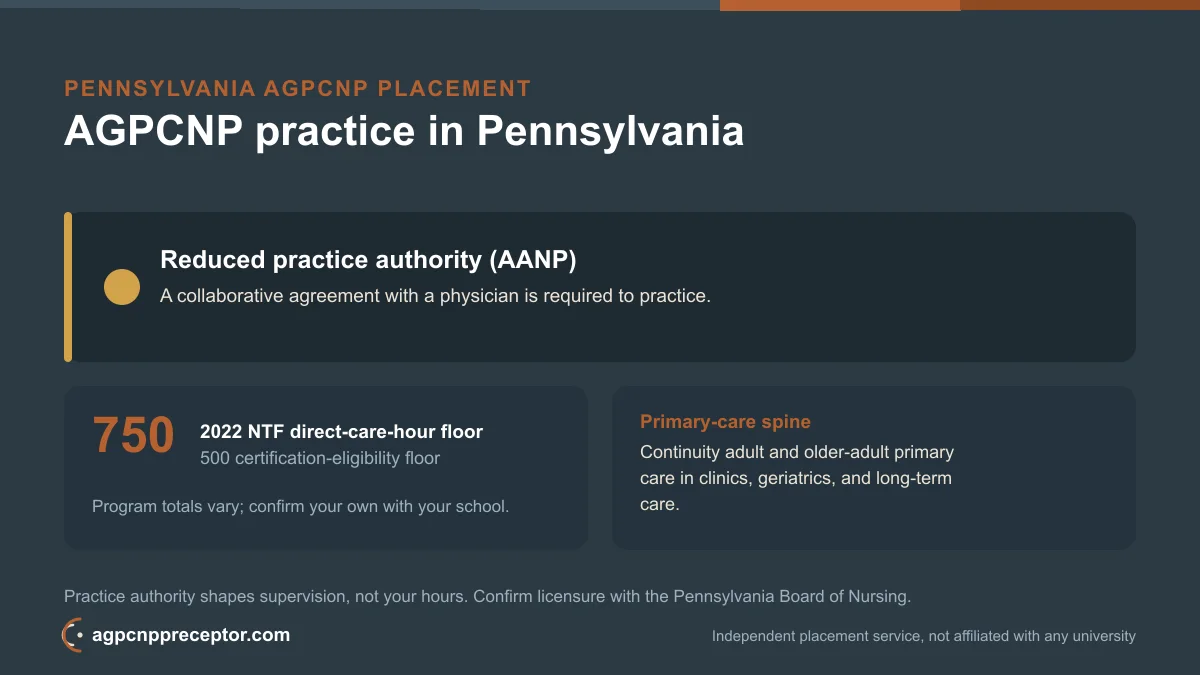
The AANP classifies Pennsylvania as a reduced-practice state. Certified registered nurse practitioners maintain a collaborative agreement with a physician throughout their career, filed through the Pennsylvania Licensing System and overseen by the Pennsylvania State Board of Nursing. Prescriptive authority is written into that agreement.
For students this shapes the supervision structure rather than the preceptor's qualifications. Your preceptor, whether an AGPCNP or a physician, practices within a collaborative arrangement, and that is simply the backdrop your paperwork sits in. Confirm the current rules with the State Board of Nursing before you finalize anything.
Rural Pennsylvania and the hardest hours
With one of the largest rural populations in the country, Pennsylvania has wide stretches, across the northern tier and much of central and western counties, where preceptor supply is thin. Older residents are often overrepresented in exactly these areas.
As almost everywhere, dedicated geriatrics is the single scarcest piece, because most adult care runs through general primary care rather than a geriatrics specialty. Rural students frequently lean on federally qualified health centers and LIFE sites and should expect some travel for continuity hours. In the Appalachian counties of the north and west especially, the nearest suitable practice may be a county or more away, so we plan the search around a commute you can hold for an entire term.
Your hours, your program, and our role
Hour totals come from your program. The 2022 National Task Force standards recommend a minimum of 750 direct patient-care hours, certification through the AANP A-GNP or the ANCC AGPCNP-BC requires at least 500 faculty-supervised hours, and accredited AGPCNP programs commonly publish totals from roughly 500 to 750 or more, with many below 750. Simulation is excluded, so confirm your program's real number early.
Tell us your region, target settings, and hour goal at #match or through contact, and we will search adult primary care, geriatrics, and long-term care sites and help coordinate the agreement. See find a preceptor for the steps. We are independent and serve students at any university; we assist and never guarantee a placement or your school's approval of a preceptor or site.
Good to know
Why is Pennsylvania strong for adult-gerontology primary care hours?
Its population is among the oldest in the country, so older-adult primary care, long-term care, and geriatrics demand is high statewide. The LIFE program adds a large network of interdisciplinary elder-care sites.
Does Pennsylvania require a collaborating physician?
Yes. It is a reduced-practice state, so nurse practitioners keep a collaborative agreement with a physician throughout their career. For students this affects supervision structure, not a preceptor's core qualifications.
What is the LIFE program?
LIFE is Pennsylvania's Program of All-Inclusive Care for the Elderly. Its day centers provide on-site medical care and home support to frail older adults, which makes them strong geriatrics and long-term care rotation sites where they operate.
How many clinical hours will my program require?
That is program-specific. National standards recommend at least 750 direct patient-care hours and certification requires at least 500 supervised hours, but many programs publish totals below 750. Confirm your own program's requirement.
Do you guarantee a placement in Pennsylvania?
No. We help you search and coordinate the collaborative paperwork, but your school approves the preceptor and site and we never promise a specific placement.
Secure both ends of the arc, not just one
Tell us your school, your city, and the hours you still need across the continuum. We will come back with a plan that reaches from continuity primary care to genuine frail-elder exposure, and a realistic path to placed.