Adult-gerontology primary care rotations across Oregon
Oregon is a full practice authority state, so an experienced adult-gerontology primary care nurse practitioner can serve as your preceptor without a supervising physician. We help AGPCNP students throughout Oregon secure those preceptors and the ambulatory, longitudinal hours the track is built on, from Portland clinics to the frontier counties east of the Cascades.
Tell us your school and city. It is free to ask, with no obligation.
Full practice authority and who can precept
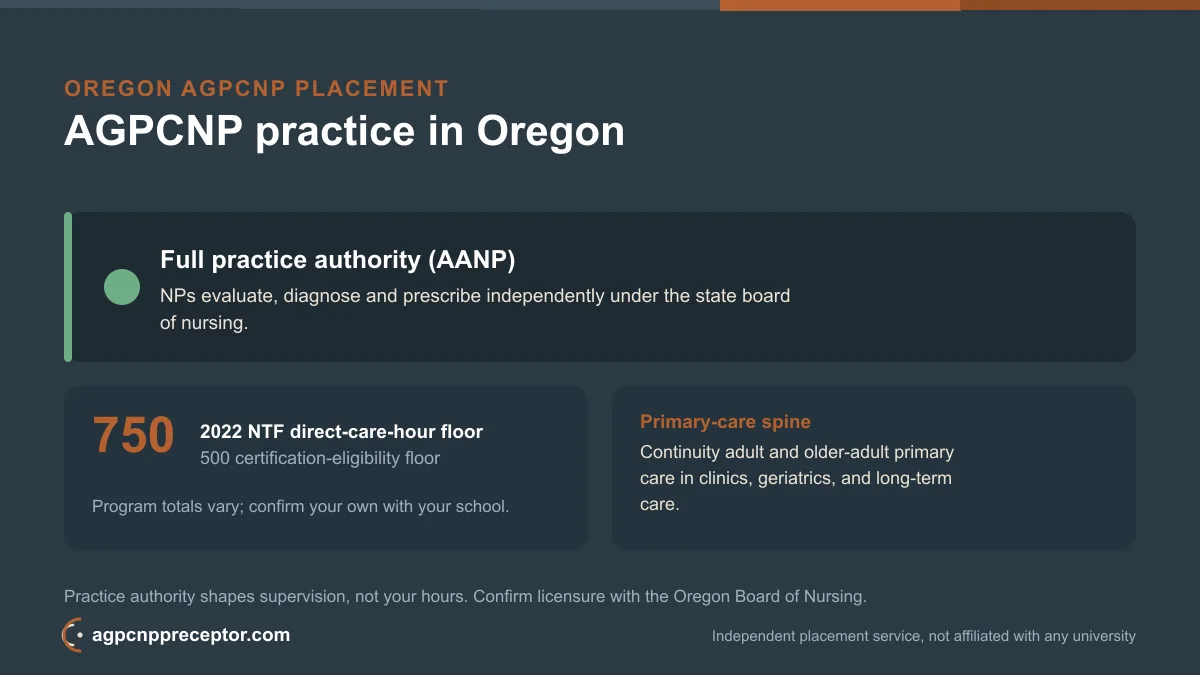
The Oregon State Board of Nursing licenses nurse practitioners to evaluate, diagnose, and prescribe on their own authority, and the AANP classifies Oregon as a full practice state. For a student that widens the pool in a real way: a seasoned AGPCNP can precept independently, and you are not waiting on a physician willing to co-sign a collaborative agreement. In a state with real distances between towns, that flexibility often decides whether a rotation sits near your home or at the end of a long drive to the nearest physician-led group.
The core qualifications do not change with the setting. A preceptor is generally a board-certified adult-gerontology or family primary-care NP, or a licensed MD or DO in internal medicine, family medicine, or geriatrics. You can read our preceptor requirements for the full picture, and confirm any licensure detail with the board.
Primary-care settings that host AGPCNP students
Adult-gerontology primary care is longitudinal and non-emergent, so the useful sites are clinics and residential settings rather than the hospital floor. Portland carries the densest supply, with Salem, Eugene, Medford, and Bend adding regional depth. Internal medicine and multispecialty groups in those hubs are the most common starting point, while employee and retail health clinics add lower-acuity adult continuity that can round out a schedule.
- Adult and internal-medicine primary care practices
- Federally qualified health centers and community health centers with adult panels
- Retail and employee health clinics
- Dedicated geriatrics and Program of All-Inclusive Care for the Elderly sites
- Skilled nursing, long-term care, and assisted living
- Chronic-disease specialty clinics such as endocrinology, nephrology, and cardiology used for continuity hours
Frontier and rural Oregon: distance and scarcity
Much of Oregon east and south of the Cascades is rural or frontier, and large parts carry federal primary-care shortage designations. The Oregon Office of Rural Health at OHSU maintains those health-care-need designations, and they line up with where preceptors thin out: Klamath, Malheur, Harney, Lake, and the eastern counties have far fewer clinics than the Willamette Valley.
Students in those areas usually place at the nearest federally qualified health center, a tribal health clinic, or a rural practice affiliated with a critical-access hospital, and they plan travel around a preceptor's schedule. Winter conditions across the mountain passes can complicate a long weekly commute, so timing matters. We factor that distance into every search so the drive stays realistic across a full term of hours.
Geriatrics, PACE, and home-based care
Aging is concentrating quickly in Oregon: roughly one in four residents will be over 65 by the mid-2030s, and several rural counties already exceed that share. Central Oregon around Bend and much of the coast have drawn retirees, which pushes older-adult demand well beyond the Portland area. As elsewhere, dedicated geriatrics and long-term care hours are the scarce piece, since most adult care runs through general primary care, so assisted living and skilled nursing facilities become important sources of older-adult continuity.
Oregon's Program of All-Inclusive Care for the Elderly footprint is geographically limited but strong where it exists: Providence ElderPlace serves the Portland area and PacificSource PACE serves Lane County. Both are interdisciplinary, older-adult environments that suit adult-gerontology training. Home-based primary care and house-call programs are also expanding to reach rural elders who cannot easily travel to a clinic.
Clinical hours, certification, and getting matched
Your program sets the hour total. The 2022 National Task Force standards recommend a minimum of 750 direct patient-care hours, certification through the AANP A-GNP or the ANCC AGPCNP-BC requires at least 500 faculty-supervised hours, and accredited AGPCNP programs commonly publish totals from about 500 to 750 or more, with many below 750. Simulation is excluded. Verify your program's requirement before planning.
When you are ready, share your region, the settings you need, and your hour target at #match or through contact, and see our cost page for what our help involves. Where it helps, we sequence two or three sites across a term so your primary care, geriatrics, and continuity hours fit together instead of competing for the same weeks. We are independent and serve students at any university; we assist with the search and paperwork and never guarantee a placement or your school's approval of a preceptor or site.
Good to know
What does full practice authority mean for finding a preceptor in Oregon?
It means an experienced AGPCNP can precept you without a supervising physician, which enlarges the pool of possible preceptors. It does not change the core qualifications a preceptor must hold.
Where are geriatrics hours easiest to find in Oregon?
In the Portland area and Lane County, where PACE programs and larger health systems operate. Elsewhere, geriatrics often runs through general primary care and long-term care facilities, which we search directly.
How should rural Oregon students plan their rotations?
Expect to place at the nearest federally qualified health center or rural clinic and to travel. Tell us your county early so we can build a schedule around a realistic commute.
How many clinical hours does an AGPCNP program require?
It varies by program. National standards recommend at least 750 direct patient-care hours and certification requires at least 500 supervised hours, but many programs publish totals below 750. Confirm your own program's number.
Do you guarantee placement in Oregon?
No. We help you search and coordinate the agreement, but your school approves the preceptor and site and we never promise a specific outcome.
Secure both ends of the arc, not just one
Tell us your school, your city, and the hours you still need across the continuum. We will come back with a plan that reaches from continuity primary care to genuine frail-elder exposure, and a realistic path to placed.