Adult-gerontology primary care preceptors in North Carolina's retiree country
North Carolina is a restricted practice state, so a nurse practitioner here works under a collaborative practice agreement with a supervising physician, which mostly shapes who signs on as your preceptor rather than the care you deliver. On placement, the state is a strong one for adult-gerontology primary care, because retirees have been moving to the coast, the mountains, and the Sandhills for years, and that older population pulls geriatric and long-term-care capacity along with it. This page maps where those AGPCNP hours actually sit.
Tell us your school and city. It is free to ask, with no obligation.
Follow the retirees: where North Carolina's older population clusters
North Carolina is one of the country's steadier retirement destinations, and three regions concentrate the older adults who fill an AGPCNP panel. The southeastern coast around Wilmington, with Brunswick County among the faster-growing retiree counties anywhere, draws a large in-migration of people sixty-five and up. The western mountains around Asheville and Hendersonville have long pulled retirees for the climate. And the Sandhills, centered on Pinehurst and Southern Pines in Moore County, are a classic golf-and-retirement belt.
Those three pockets, plus aging-in-place across the rural coastal plain, are where geriatric and long-term-care demand runs highest. The big metros still matter, since Charlotte, the Raleigh, Durham, and Chapel Hill Triangle, and the Greensboro and Winston-Salem Triad hold the deepest supply of clinics and specialists, but the oldest panels are often outside them.
The settings that carry AGPCNP hours here
AGPCNP hours come from longitudinal adult and elder care in clinics and residential settings, not acute hospital work. North Carolina offers a full spread.
- Internal-medicine and family practices with adult panels, and federally qualified health centers coordinated through the North Carolina Community Health Center Association, which represents dozens of health-center organizations serving close to half a million patients
- Programs of All-Inclusive Care for the Elderly: the state runs roughly a dozen, from the coastal program in the Wilmington area to the rural-focused SeniorCare program around Burlington and Pittsboro
- Skilled nursing and long-term care facilities and assisted living, heavily represented in the retiree regions
- Home-based primary care and house calls for home-bound elders
- Adult chronic-disease clinics in endocrinology, cardiology, and nephrology used for continuity hours
For a mixed panel, a community health center or a general adult primary care practice is usually the first stop, while the PACE programs and nursing facilities are where the frail, complex elder hours concentrate.
Restricted practice and the supervising physician
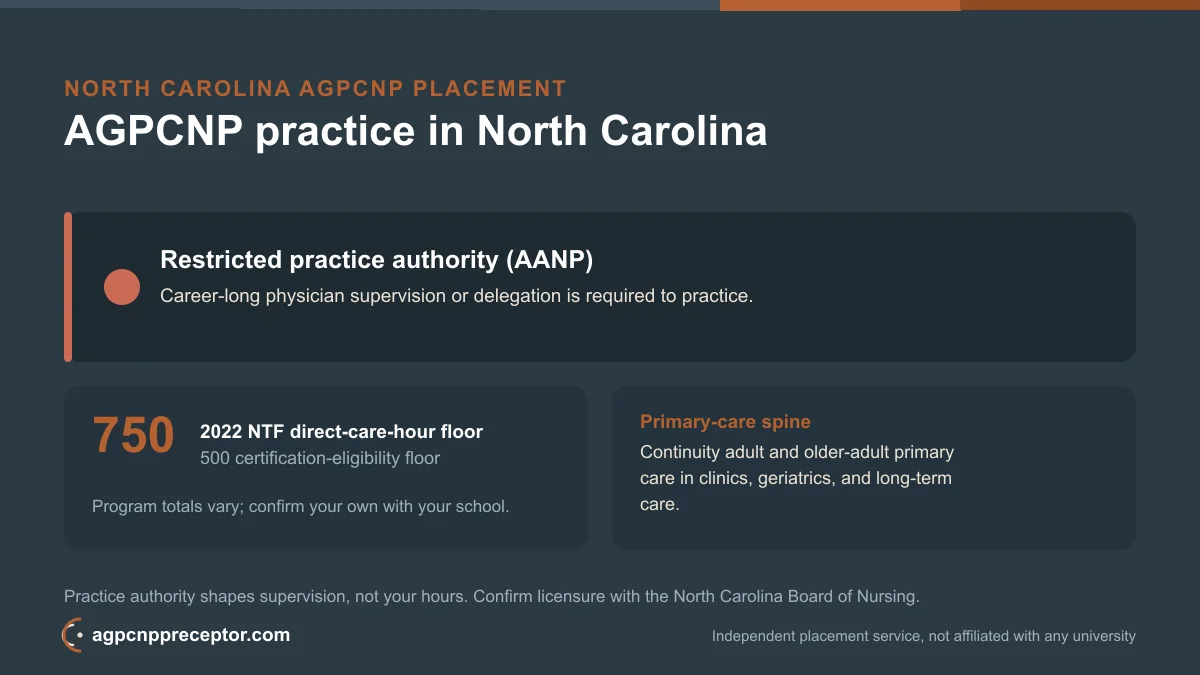
North Carolina remains a restricted practice state. The American Association of Nurse Practitioners places it there because a nurse practitioner must maintain a collaborative practice agreement with a supervising physician, jointly overseen by the North Carolina Board of Nursing and the North Carolina Medical Board. Proposals to grant full practice authority, including the SAVE Act, have been introduced repeatedly but had not become law as of 2026, so the collaborative-agreement requirement still stands.
For your placement, this usually means the preceptor is either a physician in internal medicine, family medicine, or geriatrics, or an adult-gerontology or family primary care NP practicing under a supervising physician of their own. It changes the supervision arrangement, not the core qualifications: your preceptor still needs an unencumbered North Carolina license, adult and older-adult practice, and whatever your program requires. See preceptor requirements.
The hours that are hardest to line up
As in most states, general adult primary care is the straightforward part, and a family or internal-medicine practice can supply it almost anywhere in North Carolina. The scarce piece is a dedicated geriatrics or long-term-care preceptor. Even with strong retiree demand, much elder care runs through general primary care, and purpose-built geriatric rotations concentrate in the PACE programs, larger nursing facilities, and academic-affiliated practices in the metros and retiree hubs.
Rural North Carolina adds a supply problem. The eastern coastal plain and the far western mountains carry federally designated primary-care shortage areas, so a student there may find adult primary care locally but travel to Wilmington, Asheville, the Triangle, or the Triad for a concentrated geriatrics block. Line that block up early.
Hours: check your program's number first
Totals are set by your program, not one national rule, so start with the handbook. The 2022 National Task Force standards published through AACN recommend a minimum of 750 direct patient care hours for a nurse practitioner population focus, while certification eligibility through AANP or ANCC requires at least 500 faculty-supervised hours. Accredited AGPCNP programs commonly publish totals from roughly 500 to 750 or more, and plenty sit below 750, so confirm your own figure. Simulation does not count. Our clinical hours page has the detail.
Whatever your total, the hours must spread across the adult-gerontology range, from about age thirteen through the frail elderly. North Carolina makes the older end easier to reach than most states, provided you place near one of the retiree regions.
How we help you place in North Carolina
We are an independent placement service for AGPCNP students at any university. We work independently of a school, and we never guarantee a placement or your program's approval of a preceptor or site; that decision is your school's. We run the outreach, confirm the license, the supervising-physician arrangement, and the adult-gerontology match, and handle the paperwork practices and facilities ask for.
Send your city, the hours still open, and your start window through the form at #match or our contact page. How it works and cost cover the mechanics.
Good to know
What does restricted practice mean for an AGPCNP student in North Carolina?
It means a nurse practitioner works under a collaborative practice agreement with a supervising physician, overseen jointly by the Board of Nursing and the Medical Board. In practice it mainly shapes who can serve as your preceptor and how supervision is documented, rather than changing what you do on a clinic day.
Where in North Carolina are geriatric hours easiest to find?
In the retiree regions: the Wilmington coast and Brunswick County, the Asheville and Hendersonville mountains, and the Pinehurst and Southern Pines Sandhills. The state's PACE programs, nursing facilities, and home-based practices in those areas are the strongest sources of frail-elder time.
Did North Carolina pass the SAVE Act?
Not as of 2026. The SAVE Act, which would grant nurse practitioners full practice authority, has been introduced multiple times but had not become law, so the collaborative practice agreement with a supervising physician is still required. Confirm the current status with the North Carolina Board of Nursing.
Can one site cover the whole adult-gerontology range?
Sometimes. A community health center or busy family practice comes closest, since its adult panel runs from adolescents near thirteen through the frail elderly. Verify rather than assume: ask what share of visits are older adults and whether the practice does nursing-home or home visits. Two sites is common here.
Does the Board of Nursing approve my preceptor?
No. The North Carolina Board of Nursing licenses nurse practitioners and, with the Medical Board, oversees collaborative agreements; it does not approve anyone as your clinical preceptor. That approval is your school's. Use the board to confirm a license is current and unencumbered.
Related
Secure both ends of the arc, not just one
Tell us your school, your city, and the hours you still need across the continuum. We will come back with a plan that reaches from continuity primary care to genuine frail-elder exposure, and a realistic path to placed.