Adult-gerontology primary care preceptors across New Mexico
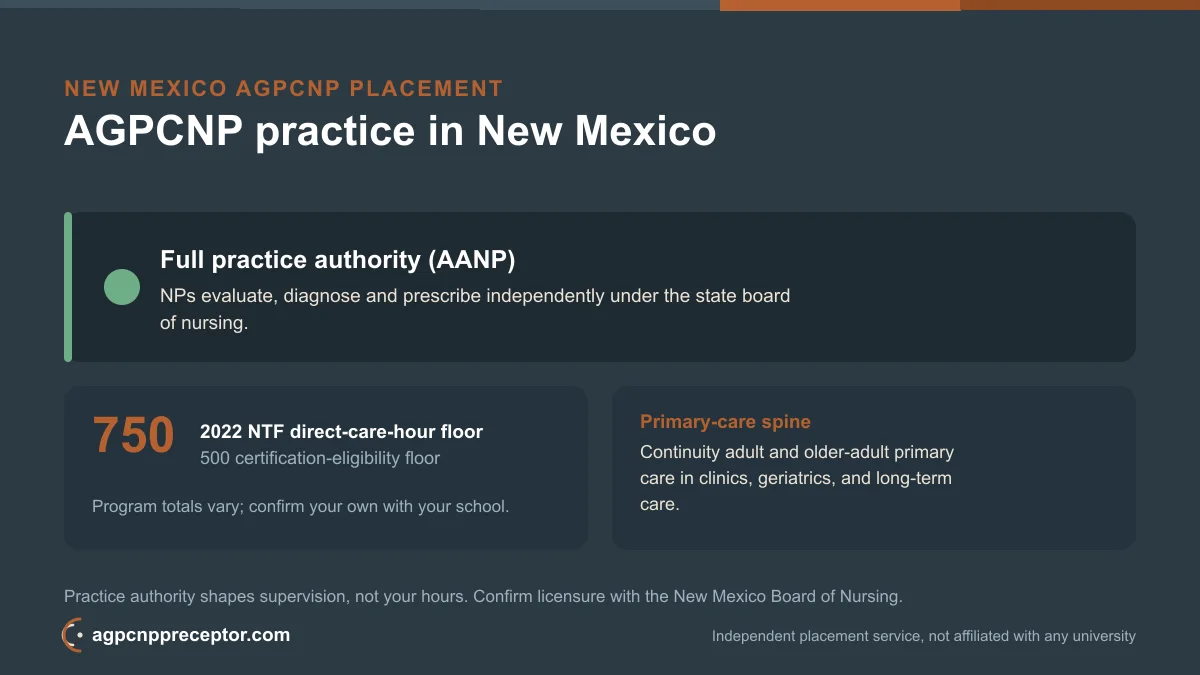
New Mexico grants full practice authority, so an experienced adult-gerontology primary care nurse practitioner here can precept your hours on their own license, with no collaborating physician folded into the arrangement. The placement question is a different one: this is among the fastest-aging states in the country, yet its older residents and its clinics are spread thinly across a very large map. This page walks through where AGPCNP primary care, geriatrics, and long-term care hours actually sit in New Mexico.
Tell us your school and city. It is free to ask, with no obligation.
The settings that carry AGPCNP hours here
AGPCNP training is longitudinal, non-emergent, adult and elder care, so your hours come from clinics and residential settings, not a hospital floor. In New Mexico that means a short list of dependable settings. Small internal-medicine and family practices with a mostly adult panel handle the bread and butter of adult primary care, and the state's community health centers reach patients that private offices miss.
- Federally qualified and community health centers with adult and elder panels, coordinated through the New Mexico Primary Care Association, which reports roughly 200 clinic sites statewide, most of them rural
- Dedicated geriatrics and long-term care inside nursing facilities and assisted living
- The state's Program of All-Inclusive Care for the Elderly in Albuquerque, a strong site for frail, complex elders
- Home-based primary care and house-call visits for home-bound adults
- Adult chronic-disease clinics in endocrinology, cardiology, and nephrology used for continuity hours
Community health centers are usually our first call, because one adult panel can move a newly diagnosed diabetic, a hypertensive fifty-year-old, and a frail elder on nine medications through a single day. That is the closest one site comes to the full adult-gerontology range.
Where New Mexico's older population actually sits
The demand side of your placement follows the state's older residents, and New Mexico is aging quickly. The oldest counties are rural: Catron and Sierra in the southwest and Harding in the northeast each report more than a third of residents aged sixty-five and up, and small rural counties as a group run above a quarter. Sierra County, around Truth or Consequences and Elephant Butte, draws retirees and seasonal snowbirds, and Santa Fe attracts a steady retiree inflow of its own.
Albuquerque and Rio Rancho hold the largest concentration of clinics and specialists, with Las Cruces, Santa Fe, Farmington, and Roswell next. That split matters. The metros carry the clinic density, but a large share of the frail elderly live in rural counties where one primary-care office may cover an entire region. Geriatrics demand is real out there; the preceptor supply is the thin part.
The hours that are hardest to secure locally
Across most of New Mexico, general adult primary care is the easy part. A family or internal-medicine practice can supply it, and rural panels skew older, so geriatric complexity tends to find you. The scarce piece is a dedicated geriatrics or long-term-care preceptor. Much of the state's elder care runs through general primary care rather than a specialist, and New Mexico operates a single PACE program, based in Albuquerque, so a purpose-built frail-elder rotation is not something every student can reach close to home.
If your program wants concentrated geriatric or long-term care time, plan for it early. A workable pattern is a home-region block for your adult primary-care hours and one travel block, often to Albuquerque, for a PACE, nursing-facility, or geriatrics rotation that your own town cannot provide.
Practice authority and who signs on as your preceptor
The American Association of Nurse Practitioners lists New Mexico as a full practice state, and the New Mexico Board of Nursing licenses nurse practitioners to evaluate, diagnose, order and interpret tests, and prescribe under their own authority. For placement, the practical effect is narrow but useful: an experienced adult-gerontology primary care NP can serve as your preceptor without a collaborating physician written into the arrangement.
It does not lower the bar on qualifications. Your preceptor still needs a current, unencumbered New Mexico license, still needs to practice in adult and older-adult care, and still has to satisfy whatever your program adds, often board certification as an A-GNP or AGPCNP-BC and a set number of years in practice. Physicians in internal medicine, family medicine, or geriatrics precept as well. See preceptor requirements.
Reading the map before you commit
New Mexico is the fifth largest state with a modest population, so travel time decides more here than in most places. Most of the state outside the metros is a federally designated primary-care shortage area, which cuts two ways: rural clinics are stretched, but a practice in Silver City, Clovis, or Gallup that has not been asked in a while may say yes faster than a busy Albuquerque office already hosting students.
Ask the drive-time question up front. A quick yes ninety minutes away can cost you most of a day per shift once you add the round trip. Weigh a nearby site that covers your adult primary care against one distant block for the geriatric or long-term-care hours you cannot log at home.
Hours, and confirming your own number
Totals vary by program, so start with your own handbook. The 2022 National Task Force standards published through AACN recommend a minimum of 750 direct patient care hours for a nurse practitioner population focus, while certification eligibility through AANP or ANCC requires at least 500 faculty-supervised hours. Accredited AGPCNP programs commonly publish totals from roughly 500 to 750 or more, and many sit below 750, so confirm the figure your school uses. Simulation does not count toward it. Our clinical hours page explains how the pieces fit.
Whatever the total, AGPCNP hours have to spread across the adult-gerontology range, from about age thirteen through the frail elderly. In New Mexico the harder part is usually not the raw count but reaching the older, more complex end of that range.
How we help you place in New Mexico
We are an independent service that works with AGPCNP students at any university. We are not tied to a school, and we do not guarantee a placement or your program's approval of a preceptor or site; that decision always belongs to your school. What we do is run the outreach, confirm the license and adult-gerontology match, and handle the paperwork clinics and facilities ask for.
Send your city, the hours still open, and your start window through the form at #match or our contact page. How it works and cost cover the mechanics.
Good to know
Does my New Mexico preceptor have to be a nurse practitioner?
Not necessarily. An adult-gerontology or family primary care NP is the most common choice, and full practice authority means an experienced one can precept on their own license. Physicians in internal medicine, family medicine, or geriatrics precept AGPCNP students too. The binding requirements are your program's, not the state's.
Which New Mexico settings are best for geriatric and long-term-care hours?
Nursing facilities and assisted living, the Albuquerque PACE program, and home-based primary care are the strongest sources of frail-elder time. Because dedicated geriatrics preceptors are scarce statewide, many students pair local adult primary care with one travel block for these hours.
I live in Albuquerque. Should I still expect to travel?
Maybe for one block. Albuquerque has the deepest clinic supply and the most students competing for it. Concentrated geriatrics or long-term-care rotations sometimes come from Rio Rancho, Belen, Los Lunas, or Santa Fe, so ask about drive time before you commit.
Can one site cover the whole adult-gerontology range?
Sometimes. A community health center is the best candidate, because its adult panel runs from adolescents near thirteen through the frail elderly. Verify rather than assume: ask what share of visits are older adults and whether the practice does nursing-home or home visits. Two sites is a normal outcome here.
Does the Board of Nursing approve my preceptor?
No. The New Mexico Board of Nursing licenses nurse practitioners; it does not approve anyone as your clinical preceptor. That approval is your school's, on its own criteria. Use the board to confirm a license is current and unencumbered.
Secure both ends of the arc, not just one
Tell us your school, your city, and the hours you still need across the continuum. We will come back with a plan that reaches from continuity primary care to genuine frail-elder exposure, and a realistic path to placed.