Building your adult-gerontology primary-care rotation in Michigan
Adult-Gerontology Primary Care NP hours in Michigan belong in longitudinal, non-emergent care, in the internal-medicine and family clinics, PACE programs, and nursing homes that carry adults from young adulthood through the frail elderly. Michigan pairs dense clinic supply in a few metros with wide rural stretches where preceptors are scarce, so where you live changes your search as much as the rules do. We help students at any university source and verify a qualified primary-care preceptor and get the site approved, without ever promising a placement.
Tell us your school and city. It is free to ask, with no obligation.
Where adult-gerontology primary care happens in Michigan
Your continuity hours sit in ambulatory and residential settings, not the hospital floor. The densest supply is in the metros: internal-medicine and family practices carrying adult panels across metro Detroit, Grand Rapids, Ann Arbor, Lansing, Flint, and Kalamazoo, plus the community health centers and federally qualified health centers that anchor primary care in underserved neighborhoods and rural towns.
The gerontology end of the arc runs through a different set of doors, and Michigan has real capacity in each: PACE programs that keep nursing-home-eligible elders in their homes, skilled nursing and long-term-care facilities, assisted-living communities, and home-based primary care. For continuity on a single condition, adult chronic-disease clinics in endocrinology, cardiology, and nephrology round out a plan. A recent expansion added a PACE program serving five rural counties in northeast Michigan, a sign of where the aging demand is heading.
Michigan's aging map, from the metros to the Upper Peninsula
Federal shortage designations tell the story plainly: a large majority of Michigan's eighty-three counties are designated primary-care Health Professional Shortage Areas, and the gaps are widest away from the southern metros. That is also where the population is oldest. In the Upper Peninsula close to twenty-three percent of residents are sixty-five or older, well above the statewide share near eighteen percent, and the northern Lower Peninsula skews old as well.
For an AGPCNP student that geography is the whole ballgame. The continuity primary-care hours are reachable in and around the metros, but the frail-elder and long-term-care hours are in highest demand exactly where preceptor supply is thinnest. Upper Peninsula and up-north students often face a wider search radius and real winter travel, which is worth building into any schedule that spans two regions.
Restricted practice, and the collaborating physician
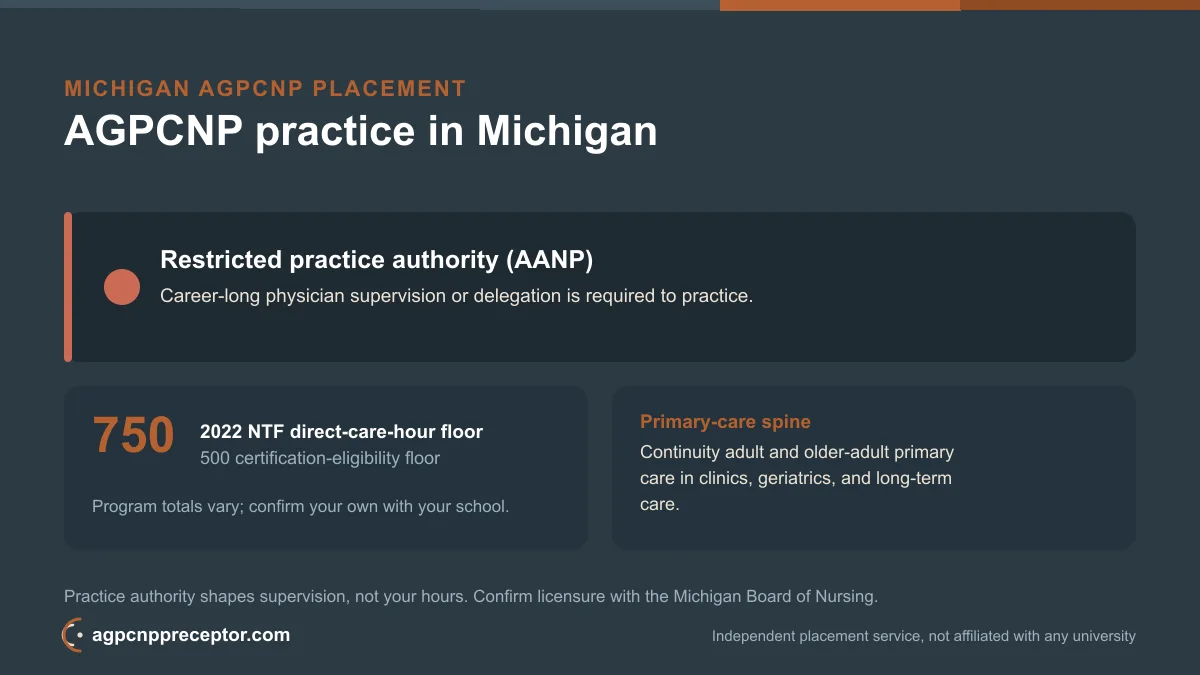
The American Association of Nurse Practitioners classifies Michigan as a restricted practice state. Michigan does not grant nurse practitioners an independent scope; NPs carry an RN license plus a specialty certification, physician delegation is required to prescribe controlled substances, and NPs cannot own an independent practice. Most work under a written collaborative arrangement with a physician.
In primary care that shapes the supervision arrangement more than the preceptor's core qualifications. A collaborating or delegating physician is usually part of the practice already, so your preceptor may be that physician or an adult-gerontology or family NP practicing under such an arrangement. Either way your preceptor is generally a board-certified A-GNP or AGPCNP-BC, a family NP, or a physician in internal medicine, family medicine, or geriatrics, subject to your program's rules. Legislation to grant full practice authority has been introduced but not enacted, so confirm current rules with the Michigan Board of Nursing.
The scarce piece: geriatrics and long-term care
Because so much adult care sits in general internal medicine and family practice, the ambulatory continuity hours are the more available part of a Michigan plan. The dedicated geriatrics and long-term-care hours are the bottleneck. Fellowship-trained geriatricians and geriatric NPs are few, and they concentrate in the larger systems and PACE organizations, while rural nursing homes may have no NP preceptor on site at all.
The practical read: reserve the frail-elder hours first. If you are in the Upper Peninsula or the northern Lower Peninsula, plan early and expect a broader radius for the geriatric block, which is precisely where a sourcing service earns its keep.
Your program sets the hours
Michigan does not set your clinical-hour total; your program and its accreditor do. The 2022 National Task Force standards recommend a minimum of 750 direct patient care hours, and AANP and ANCC certification eligibility requires at least 500 supervised hours. Accredited AGPCNP programs publish totals across a range, commonly from roughly 500 to 750 or more, and many sit below 750. Simulation is excluded from direct patient care.
Pin your number down early so we can plan how many settings you need to reach it. Our clinical hours page has the detail; your school confirms the final figure.
Lining up your Michigan rotation
Tell us your program, the part of the state you can reach, and the continuity and geriatric hours you still need. We source and vet a qualified primary-care preceptor, check them against your school's requirements, and work the site and affiliation-agreement piece so you are not chasing clinic and nursing-home offices yourself. See how it works and preceptor requirements.
Start with the match form below or reach out. We are independent, we serve students at any university, and we assist with placement without guaranteeing a site or your school's approval of a preceptor.
Good to know
Does Michigan's restricted status make it harder to find an AGPCNP preceptor?
Not dramatically for primary care. A collaborating or delegating physician is usually already part of the practice, so the arrangement a restricted state expects tends to be in place. The bigger factor is geography, since geriatric and long-term-care preceptors thin out away from the southern metros.
I am in the Upper Peninsula. Can I do all my hours locally?
Some, yes, especially continuity primary care through a clinic or community health center near a hub like Marquette. Dedicated geriatrics is harder, so up-north students often plan a wider radius or a block nearer a larger senior-care program. We help map the route.
Who can serve as my preceptor in Michigan?
Generally a board-certified adult-gerontology or family primary-care NP (A-GNP or AGPCNP-BC), or a physician in internal medicine, family medicine, or geriatrics, practicing in a setting that matches your rotation. Your program sets the exact rule, so check its preceptor form.
How many clinical hours does Michigan require?
The state does not set your hours; your program and its accreditor do. The 2022 NTF standards recommend at least 750 direct-care hours and certification eligibility requires at least 500. Totals vary by program, with many under 750, so confirm yours.
Do you place students from any school?
Yes. We are independent of every university. We work with Adult-Gerontology Primary Care NP students from any accredited program and vet each preceptor against your program's requirements.
Secure both ends of the arc, not just one
Tell us your school, your city, and the hours you still need across the continuum. We will come back with a plan that reaches from continuity primary care to genuine frail-elder exposure, and a realistic path to placed.