AGPCNP preceptor placement throughout Maryland
Maryland grants full practice authority, so an experienced adult-gerontology primary care nurse practitioner can precept without a collaboration agreement, which broadens who can take you on. The state runs from the dense clinics of Baltimore and the Washington suburbs to Eastern Shore counties with some of the lowest provider ratios anywhere in the state. We help students at any Maryland program line up continuity primary care and the geriatric hours that are harder to find.
Tell us your school and city. It is free to ask, with no obligation.
Two Marylands: metro density and rural scarcity
Maryland packs most of its primary care into the Baltimore area and the Washington suburbs of Montgomery and Prince George's counties, along with Howard, Anne Arundel, and Frederick. Preceptor supply is deepest there. The picture flips on the Eastern Shore and in western Maryland, where clinicians are stretched thin.
The gap is stark. The five counties with the fewest primary care physicians per capita are all on the Eastern Shore, where a rural county can have roughly one provider for every 2,500 residents against about one for every 1,000 in the Baltimore suburbs. Garrett and Allegany counties in the western panhandle face similar strain. Those regions also skew older, so geriatric demand runs highest where preceptors are thinnest.
Settings that host AGPCNP students
Adult-gerontology primary care is longitudinal, non-emergent care for patients from adolescence through the frail elderly, so it happens in clinics and residential care, not on a hospital floor. In Maryland the working settings are adult and internal medicine primary care, family practices with an adult panel, and the federally qualified health centers that carry safety-net care in both cities and rural counties.
- Adult and internal medicine primary care for continuity panels
- Family medicine practices with older-adult patients
- Federally qualified health centers for community health hours
- Geriatrics practices, skilled nursing, long-term care, and assisted living
- Endocrinology, cardiology, and nephrology clinics for chronic-disease continuity
Community health and home-based primary care
Two settings do a lot of work in Maryland. Federally qualified health centers and other community health centers carry safety-net adult panels in Baltimore, the Washington suburbs, and the rural counties, and they are a dependable source of continuity and community health hours. Home-based primary care and house-call programs, meanwhile, reach older adults who cannot easily travel, which is common on the Eastern Shore and in the western counties.
Both settings give you longitudinal relationships with medically complex adults, and both tend to book preceptors well ahead, so we open those conversations early. If your program treats community health as its own requirement, the community health rotation guide shows what qualifies.
Geriatric and long-term-care hours
Maryland's aging population is a major driver of its primary care need; state projections tie a large part of the added demand for physicians over this decade to older patients. For students, that underscores how valuable dedicated geriatric time is, and how scarce it can be, since most adult care flows through general primary care.
Skilled nursing facilities, assisted living, and home-based primary care are where you build frail-elder experience. Maryland has also been expanding its Program of All-Inclusive Care for the Elderly from a single long-running site in Baltimore to additional locations in the Baltimore area, Montgomery County, and Prince George's County. PACE centers, nursing facilities, and geriatrics practices are the settings we pursue first. See the geriatrics and long-term care rotation guides.
Full practice under the Board of Nursing
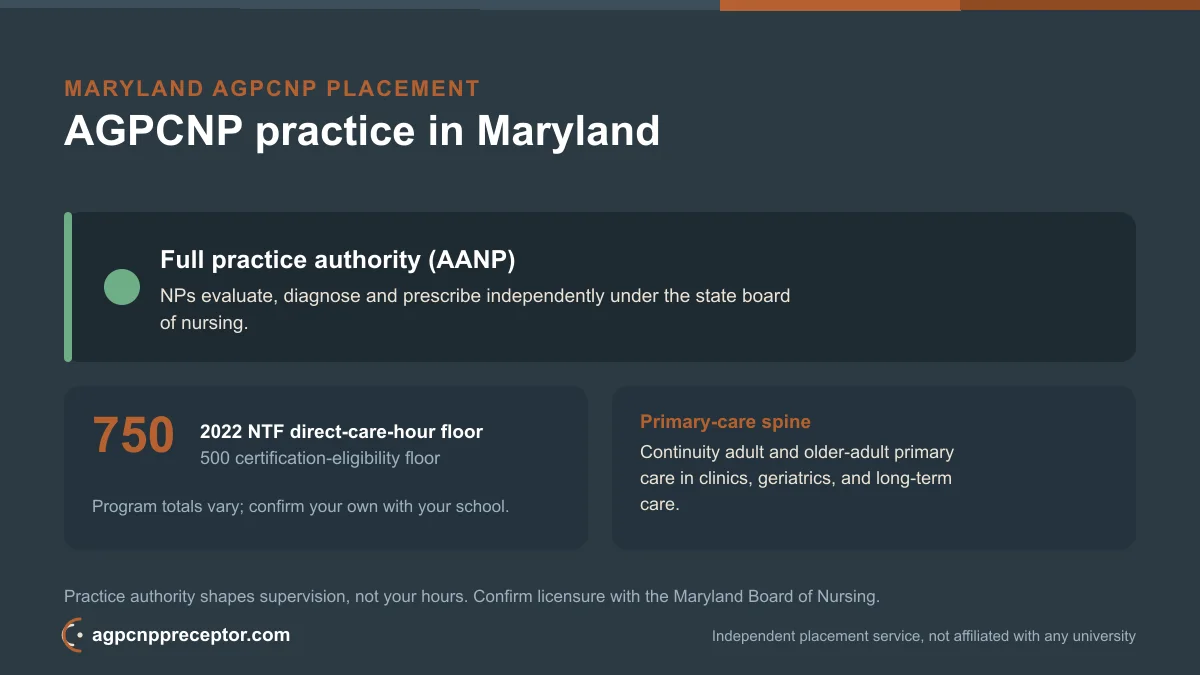
Maryland is a full practice authority state. Certified nurse practitioners evaluate, diagnose, and prescribe under the Maryland Board of Nursing without a required physician collaboration agreement. That is why an experienced adult-gerontology or family primary care NP can precept independently here.
The practical effect is a wider preceptor pool. Your preceptor can be a board-certified adult-gerontology or family primary care NP, or a physician in internal medicine, family medicine, or geriatrics, subject to your program's rules. Requirements shift over time, so confirm current details with the board and your school.
How we place you in Maryland
We match on where you live, the hours you still need, and your program's requirements, then source and vet preceptors, check them against your school's rules, and handle the affiliation agreements so a continuity clinic and a geriatric setting arrive together rather than as two separate hunts. Matching comes before payment; the pricing page explains it.
Send your Maryland city and program through the matching form or contact, and we will come back with a realistic view of the preceptors we can pursue, on either side of the Bay.
Good to know
Is Maryland a full practice authority state?
Yes. Certified nurse practitioners evaluate, diagnose, and prescribe under the Maryland Board of Nursing without a required physician collaboration agreement, so an experienced adult-gerontology primary care NP can precept independently. Confirm current requirements with the board, since your program still sets its own preceptor rules.
Where are Maryland's primary care shortages?
The five counties with the fewest primary care physicians per capita are all on the Eastern Shore, and Garrett and Allegany counties in western Maryland are also stretched. Those rural regions skew older, so we plan around a regional hub and realistic travel when you live outside the Baltimore or Washington suburbs.
How do I get geriatric hours in Maryland?
Through skilled nursing facilities, assisted living, home-based primary care, dedicated geriatrics practices, and Maryland's expanding PACE program, which is growing from its long-running Baltimore site into the wider Baltimore area, Montgomery County, and Prince George's County. We prioritize these frail-elder settings early.
What hours will my Maryland program require?
Your program sets the total, not the state. The 2022 national standards recommend at least 750 direct patient care hours, certification eligibility requires at least 500 faculty-supervised hours, and many AGPCNP programs run between roughly 500 and 750 or more. Simulation is excluded. Confirm your own number, and see our clinical hours guide.
Do you only place students from one Maryland school?
No. We are independent of every university. We place adult-gerontology primary care students from any Maryland program, including online programs whose students complete their hours in Maryland.
Secure both ends of the arc, not just one
Tell us your school, your city, and the hours you still need across the continuum. We will come back with a plan that reaches from continuity primary care to genuine frail-elder exposure, and a realistic path to placed.