AGPCNP placement in the nation's oldest state
Maine is the oldest state in the country by median age, so adult-gerontology primary care students train where the need is unusually concentrated, and where geriatric preceptors are genuinely scarce. Maine grants full practice authority once a nurse practitioner completes a supervised transition period, which shapes who can precept independently. We help students at any Maine program secure continuity primary care and the frail-elder hours the state needs most.
Tell us your school and city. It is free to ask, with no obligation.
Why aging defines AGPCNP training in Maine
Close to 22 percent of Maine residents are 65 or older, more than a quarter of a million people, and the median age is among the highest anywhere. That demographic reality is the spine of adult-gerontology primary care here: chronic-disease management, function and mobility, polypharmacy, and advance care planning are everyday work, not edge cases. It also means demand for geriatric and long-term-care hours is high.
The supply side is the catch. Maine has fewer than 40 practicing geriatricians statewide, and 15 of its 16 counties face primary care shortages. Dedicated geriatric preceptors are the scarce resource, so the students who plan early tend to be the ones who secure them.
Where students train, from Portland to the county
Primary care employers concentrate in and around Portland in Cumberland County, plus Lewiston-Auburn, Bangor, and Augusta. Those areas hold the deepest preceptor pool. Maine is also the most rural state in the country, and care thins quickly in Aroostook County to the north, the Down East counties, and the western mountains.
For adult-gerontology primary care, the working settings are adult and internal medicine primary care, family practices with a strong older-adult panel, and the community health centers and rural clinics that anchor care outside the cities. If you live in a rural county, part of your plan may route through a regional hub, and we build that travel in honestly from the start.
- Adult and internal medicine primary care for continuity panels
- Family medicine practices weighted toward older adults
- Community health centers and rural clinics for community health hours
- Endocrinology, cardiology, and nephrology clinics for chronic-disease continuity
Long-term care, assisted living, and house calls
Because Maine leans heavily on residential and home-based care for its older population, the frail-elder end of your hours often comes from skilled nursing facilities, assisted living communities, and home-based primary care rather than a single geriatrics clinic. House-call and home-based primary care programs are a real part of the Maine landscape, and they are strong settings for continuity with medically complex elders.
These are also the placements that take the most lead time to arrange, so we go after nursing facilities, assisted living, and home-based practices early. The long-term care rotation and geriatrics rotation guides cover what to expect from these preceptors.
Full practice, after a transition period
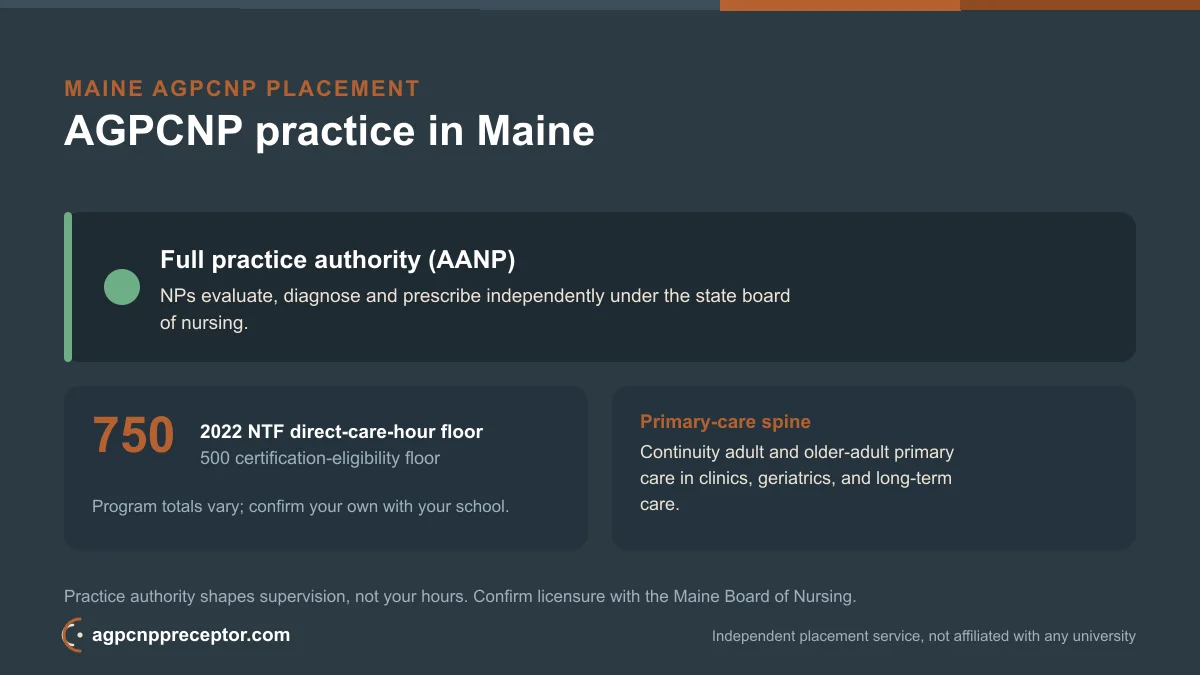
Maine is a full practice authority state, with one wrinkle that matters for new graduates. A nurse practitioner practices under the supervision of a physician or an experienced NP for an initial period, commonly described as about 24 months, before moving to fully independent practice and prescribing. The Maine State Board of Nursing administers the rules.
For placement, that means an experienced adult-gerontology or family primary care NP well past the transition can precept independently, which widens the pool, while a newer NP may still be working under supervision. A licensed physician in internal medicine, family medicine, or geriatrics can also precept. Your program sets the final criteria, so confirm current requirements with the board.
Building your Maine placement
We start with your town, the hours you still need, and your program's requirements, then source and vet preceptors, confirm they meet your school's rules, and handle the affiliation paperwork so continuity primary care and genuine geriatric hours come together in one plan. You are matched before you pay; see pricing and how it works.
Tell us your Maine city and program on the matching form, and we will give you an honest read on the preceptors we can pursue, including in the rural counties.
Good to know
Is Maine a full practice authority state?
Yes, with a transition period. A nurse practitioner works under the supervision of a physician or experienced NP for an initial stretch, commonly described as about 24 months, before practicing and prescribing independently. That is why an experienced adult-gerontology primary care NP can precept on their own, while a newer NP may still be supervised. Confirm current rules with the Maine State Board of Nursing.
Why is geriatric placement so important in Maine?
Maine is the oldest state by median age, with close to 22 percent of residents 65 or older and fewer than 40 practicing geriatricians. Demand for frail-elder care is high while dedicated geriatric preceptors are scarce, so planning your long-term-care and geriatrics hours early makes a real difference.
I live in rural Maine, such as Aroostook or Down East. Can you help?
Yes. Rural counties have fewer clinicians, so the search may reach a regional hub and involve some travel. We factor your location and driving range into the plan and are candid about what is realistic before you commit.
What counts as an AGPCNP setting versus acute care?
Adult-gerontology primary care hours come from longitudinal, non-emergent clinics and from residential and home-based care: primary care offices, geriatrics practices, skilled nursing, assisted living, and house-call programs. Hospital acute care belongs to the acute-care track, not the primary care AGPCNP track.
How many clinical hours does my Maine program require?
Your program sets the number, not the state. The 2022 national standards recommend at least 750 direct patient care hours, certification eligibility requires at least 500 faculty-supervised hours, and many AGPCNP programs land between roughly 500 and 750 or more. Simulation is excluded. See our clinical hours guide and confirm your own total.
Secure both ends of the arc, not just one
Tell us your school, your city, and the hours you still need across the continuum. We will come back with a plan that reaches from continuity primary care to genuine frail-elder exposure, and a realistic path to placed.