AGPCNP clinical placement across Kentucky
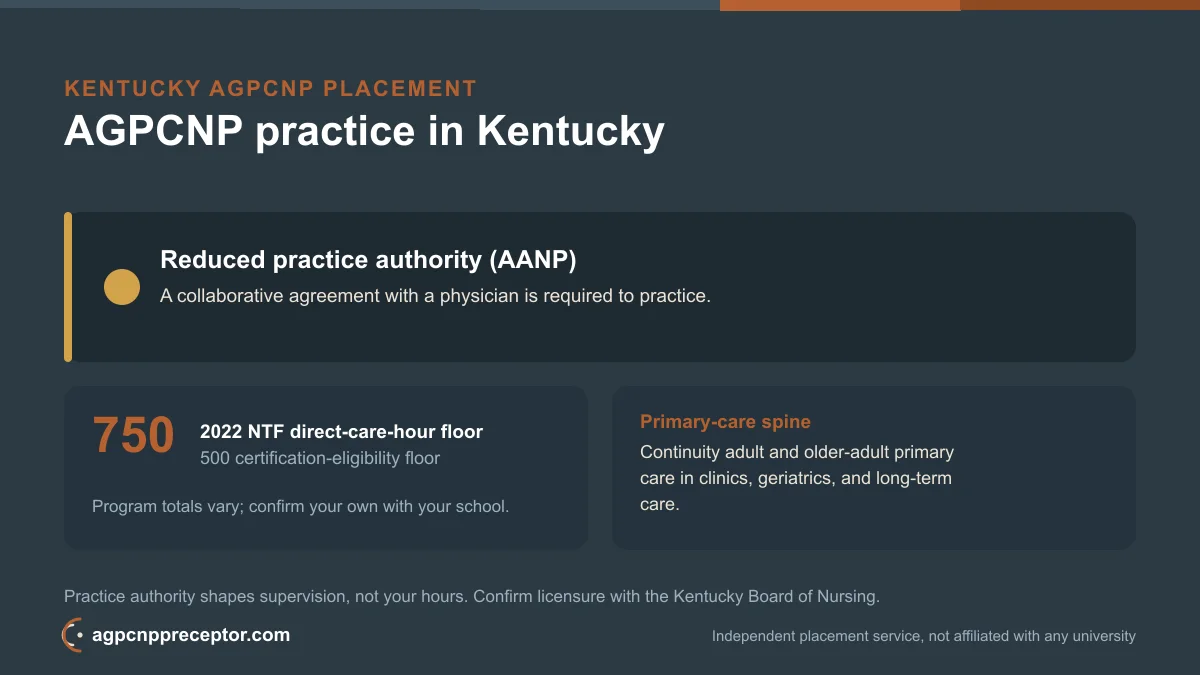
Kentucky is a reduced practice state, which means a collaborating physician is part of your preceptor's prescribing arrangement, though that shapes who signs the paperwork more than the qualifications you need in a preceptor. For adult-gerontology primary care students, the real work is finding continuity primary care plus authentic geriatric hours in a state split between a few busy metros and a wide rural map. We source both ends for students at any Kentucky program.
Tell us your school and city. It is free to ask, with no obligation.
Kentucky's primary-care geography
Kentucky's clinicians cluster in a handful of metros. Louisville in Jefferson County, Lexington in Fayette County, the northern Kentucky counties across the river from Cincinnati, and Bowling Green in the south-central region hold most of the state's primary care jobs. More than three quarters of physicians practice in urban counties, even though a large share of Kentuckians live rurally.
The rural gap is wide. Dozens of Kentucky's 120 counties meet the federal criteria for a primary care shortage area, and the strain is heaviest in the eastern Appalachian counties and parts of western Kentucky. Those same regions carry an older population, so the demand for geriatric and chronic-disease care is high where preceptors are thin. If you live outside a metro, expect to plan some travel, and let us build that into the search.
Settings that host AGPCNP students
Adult-gerontology primary care is longitudinal, non-emergent care for patients from adolescence through the frail elderly, so your hours belong in clinics and residential care, not on the hospital floor. In Kentucky the common settings are adult and internal medicine primary care, family practices with a large adult panel, and the federally qualified health centers that anchor care in underserved counties.
- Adult and internal medicine primary care for continuity panels
- Family medicine practices carrying older-adult patients
- Federally qualified health centers and rural clinics for community health hours
- Geriatrics practices, skilled nursing, long-term care, and assisted living
- Endocrinology, cardiology, and nephrology clinics for chronic-disease continuity
The frail-elder end: geriatrics and long-term care
As in most states, the scarce piece is dedicated geriatric and long-term-care time, because so much adult care runs through general primary care. Skilled nursing facilities, assisted living, and home-based primary care are where you get real frail-elder experience, and those preceptors are fewer and in higher demand.
Kentucky has been building out its Program of All-Inclusive Care for the Elderly since its first site opened in 2022, with providers now serving a set of counties around Lexington, Louisville, the Bowling Green area, northern Kentucky, and parts of southern and eastern Kentucky. PACE centers, nursing facilities, and geriatrics practices are the settings we go after first to close your geriatric hours. Our long-term care rotation guide covers what these preceptors look for.
Reduced practice and what CAPA means for you
Kentucky classifies nurse practitioners as reduced practice. Prescribing runs through a collaborative agreement: a CAPA-NS for non-scheduled medications during the first four years of practice, which an APRN in good standing can then discontinue, and a separate CAPA-CS for controlled substances that stays in place with a collaborating physician. The Kentucky Board of Nursing administers these rules.
For your placement, this mostly shapes who serves as preceptor. Many Kentucky AGPCNP students train with a board-certified adult-gerontology or family primary care NP who works alongside a collaborating physician, or directly with a physician in internal medicine, family medicine, or geriatrics. Your program sets the final preceptor criteria, so confirm both your school's rules and current board requirements before you commit.
Getting your Kentucky rotation placed
We match on your county, the hours you still need, and your program's requirements, then vet preceptors, check them against your school's rules, and handle the affiliation agreements so a continuity clinic and a geriatric setting arrive as one plan. You are matched before you pay; the pricing page explains how that works and how it works walks through the steps.
Tell us your Kentucky city and program on the matching form, and we will give you a straight read on the preceptors we can pursue near you.
Good to know
Does reduced practice in Kentucky change what preceptor I need?
It changes the arrangement more than the core qualifications. Because Kentucky requires a collaborative agreement for prescribing, your preceptor is often an adult-gerontology or family primary care NP working with a collaborating physician, or a physician in internal or family medicine or geriatrics. Your program still sets the final requirements, and your preceptor must be licensed in Kentucky.
Where do AGPCNP students find geriatric hours in Kentucky?
In skilled nursing facilities, assisted living, home-based primary care, dedicated geriatrics practices, and Kentucky's growing PACE program. These frail-elder settings are usually harder to secure than a general clinic, so we prioritize them early when we plan your placement.
I live in eastern Kentucky. Can you still place me?
Yes, though rural and Appalachian counties have fewer clinicians, so the search may reach a regional hub and involve some travel. We factor your location and driving range into the plan and stay honest about what is realistic before you commit.
How many clinical hours does an AGPCNP program require?
Your program sets the total, not the state. National standards from 2022 recommend at least 750 direct patient care hours, certification eligibility requires at least 500 faculty-supervised hours, and many AGPCNP programs land between roughly 500 and 750 or more. Simulation is excluded. Check your own program's figure, and see our clinical hours guide.
Do you place students from any Kentucky school?
Yes. We are independent and not tied to any university. We work with adult-gerontology primary care students at any Kentucky program, including online programs whose students complete hours in Kentucky.
Secure both ends of the arc, not just one
Tell us your school, your city, and the hours you still need across the continuum. We will come back with a plan that reaches from continuity primary care to genuine frail-elder exposure, and a realistic path to placed.