Placing AGPCNP students across Kansas primary care
Kansas is a full practice authority state, so an experienced adult-gerontology primary care nurse practitioner can precept on their own, without a supervising physician folded into the arrangement. That widens who can sign on for your continuity hours, from Wichita and Kansas City clinics to the family practices that carry most adult panels in small towns. We help AGPCNP students at any Kansas program line up both the ambulatory primary care and the genuine geriatric hours that are harder to find.
Tell us your school and city. It is free to ask, with no obligation.
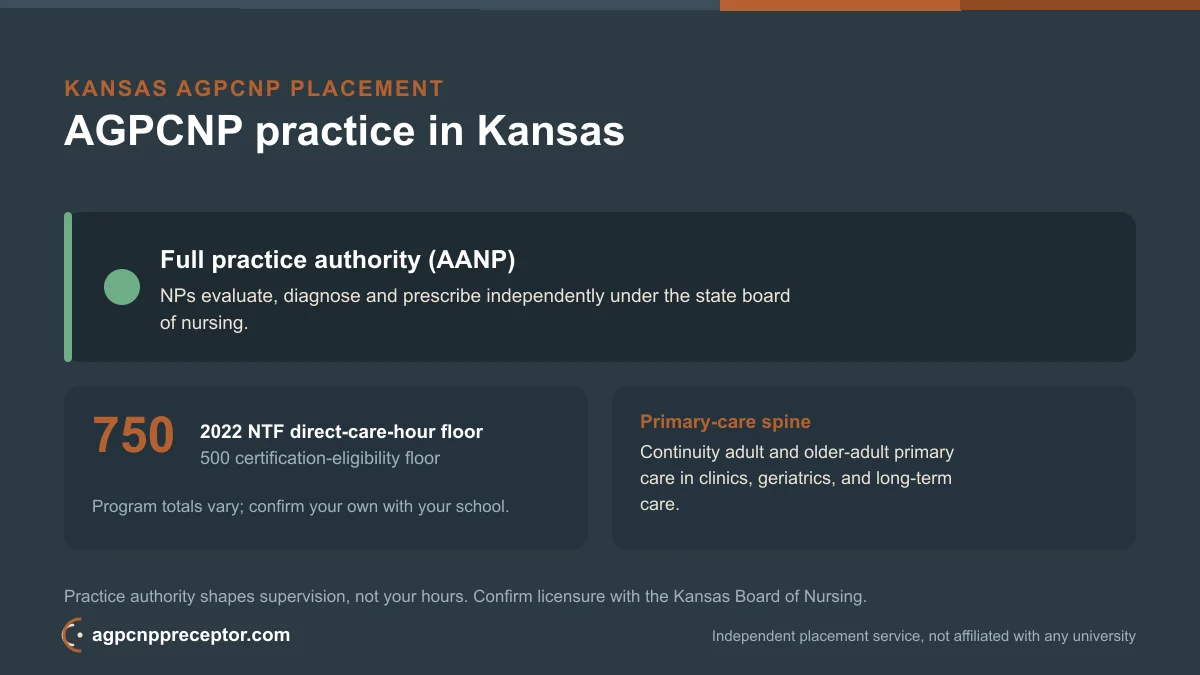
Where AGPCNP students train in Kansas
Your rotations sit in longitudinal, non-emergent care for patients from about age 13 through the frail elderly, not hospital acute care. In Kansas that means adult and internal medicine primary care, family practices that keep a broad adult panel, and the community health centers that carry a large share of the state's underserved patients. Kansas has roughly five dozen federally qualified health center organizations and well over a hundred rural health clinics, which is where a lot of chronic-disease continuity actually happens.
- Adult and internal medicine primary care for continuity panels
- Family medicine practices with a strong adult and older-adult mix
- Federally qualified health centers and rural health clinics for community health hours
- Dedicated geriatrics practices, skilled nursing, long-term care, and assisted living for frail-elder exposure
- Endocrinology, cardiology, and nephrology clinics used for chronic-disease continuity
If you want to see how these map to specific rotation types, the adult primary care rotation and chronic-disease management rotation guides break down what each setting counts toward.
The Kansas map: metros, rural, and frontier
Clinic density in Kansas concentrates in a handful of places. Wichita, the Kansas City suburbs in Johnson County, Topeka, Lawrence, and Manhattan hold most of the state's primary care employers, which is where preceptor supply is deepest. Move west and the picture changes fast: the western third of the state is sparsely populated frontier, and rural counties make up the large majority of the federally designated primary care shortage areas.
That geography matters for two reasons. First, aging is concentrated in the rural counties that already have the fewest clinicians, so the demand for geriatric care is highest exactly where preceptors are thinnest. Second, if you live in a small town you may need to plan travel to a larger regional hub for part of your hours. We factor your location and how far you can reasonably drive into the plan from the start.
Geriatric and long-term-care hours, the scarce piece
Most adult care in Kansas runs through general primary care, so the hardest hours to secure are usually the dedicated geriatric and long-term-care ones. Skilled nursing facilities, assisted living communities, and home-based primary care visits are where you build authentic frail-elder experience, and those preceptors are fewer and busier than a family clinic down the road.
Kansas also runs a small Program of All-Inclusive Care for the Elderly footprint, delivered by a few organizations across the central and northeastern counties, for example around Wichita, the Topeka area, and the south-central counties. PACE sites, nursing facilities, and geriatrics practices are exactly the settings we approach first, because they close the end of the arc that a general clinic cannot. The geriatrics rotation and long-term care rotation guides explain what to look for in these preceptors.
Kansas practice authority, in one section
Kansas grants full practice authority. Under the law that took effect on July 1, 2022, qualified advanced practice registered nurses evaluate, diagnose, and prescribe without a written collaborative agreement or physician protocol. The Kansas State Board of Nursing licenses APRNs and sets the current requirements.
For placement, the practical effect is about who can be your preceptor. In a full practice state, an experienced adult-gerontology or family primary care NP can precept independently, which broadens the pool beyond physician-led offices. Your preceptor still has to meet your own program's rules, and a licensed physician in internal medicine, family medicine, or geriatrics can precept as well. Confirm current licensure specifics with the board, since regulations change.
How we build your Kansas placement
We start from where you live, the hours you still need, and your program's preceptor and site requirements. Then we source and vet preceptors, confirm they fit your school's rules, and handle the affiliation-agreement paperwork so a continuity panel and a frail-elder setting come together into one plan rather than two separate searches. You are matched first and pay once a placement is secured; our pricing page lays that out.
If you are weighing your options, tell us your Kansas city and program on the matching form or through contact, and we will come back with a realistic read on what your search looks like across the state.
Good to know
Is Kansas a full practice authority state for AGPCNP students?
Yes. Since July 1, 2022 Kansas has granted advanced practice registered nurses full practice authority, so an experienced adult-gerontology primary care NP can precept without a supervising physician in the arrangement. Confirm current details with the Kansas State Board of Nursing, and remember your preceptor still has to meet your own program's requirements.
Which Kansas settings count for adult-gerontology primary care hours?
Longitudinal, non-emergent settings: adult and internal medicine primary care, family practices with adult panels, federally qualified health centers, dedicated geriatrics, skilled nursing and long-term care, assisted living, home-based primary care, and chronic-disease specialty clinics used for continuity. Acute hospital care belongs to the acute-care track, not AGPCNP.
Why are geriatric hours the hardest to find in Kansas?
Because most adult care sits in general primary care, dedicated geriatrics and long-term-care preceptors are fewer, and they are scarcest in the rural and frontier counties where the aging population is concentrated. We prioritize those settings, including skilled nursing facilities and PACE sites, when we build your plan.
How many clinical hours will I need in Kansas?
That is set by your program, not the state. The 2022 national standards recommend at least 750 direct patient care hours, while AANP and ANCC certification eligibility requires at least 500 faculty-supervised hours, and many AGPCNP programs publish totals between roughly 500 and 750 or more. Simulation does not count. Confirm your own program's number with your school, and see our clinical hours guide.
Do you only work with students from one Kansas university?
No. We are independent of every school. We place adult-gerontology primary care NP students from any Kansas program, or from an online program while you complete your hours in Kansas.
Secure both ends of the arc, not just one
Tell us your school, your city, and the hours you still need across the continuum. We will come back with a plan that reaches from continuity primary care to genuine frail-elder exposure, and a realistic path to placed.