Where Massachusetts AGPCNP students build their primary-care hours
Adult-Gerontology Primary Care NP training in Massachusetts happens inside a primary-care system that is stretched thin, from Boston community health centers with weeks-long waits to the geriatric and long-term-care sites that serve one of the oldest corners of New England. We help students at any university find and verify qualified primary-care preceptors, then handle the site and affiliation paperwork so your continuity hours are locked in. We are independent, and we assist without ever guaranteeing a placement or your school's approval of a site.
Tell us your school and city. It is free to ask, with no obligation.
A stretched primary-care system, and where the elders are
Massachusetts carries some of the deepest medical infrastructure in the country and, at the same time, one of its tightest primary-care bottlenecks. Community health centers across the state report waits of many weeks for a new primary-care appointment, and a large share keep a waitlist for primary care outright. For an AGPCNP student that pressure runs both ways: demand for adult primary care is high, but the clinicians carrying it have little slack in the day, which is what makes an outside sourcing effort worth its weight here.
The aging population is not spread evenly, and that shapes where your geriatric hours will come from. Cape Cod and the Islands sit among the oldest parts of the state by share of residents over sixty-five, and the western counties around the Berkshires and the Pioneer Valley skew older and more rural than Greater Boston. Those are the places where geriatric and long-term-care demand concentrates, and where local preceptor supply is thinnest.
The settings that host adult-gerontology hours
Your adult primary-care hours can sit in several kinds of Massachusetts settings, and the strongest plans reach across more than one so the whole adult and gerontology arc is covered.
- Internal-medicine and family practices that carry a mostly adult panel
- Community health centers and federally qualified health centers, a network that cares for more than a million residents statewide
- PACE programs for nursing-home-eligible elders who still live at home
- Skilled nursing and long-term-care facilities and assisted-living communities
- Home-based primary care and house-call programs
- Adult chronic-disease specialty clinics in endocrinology, cardiology, and nephrology used for continuity hours
Massachusetts leans on PACE more than most states, with programs such as Element Care across Greater Boston and Essex County, Summit ElderCare out of Worcester, and Mercy LIFE in the Springfield area. Settings like these, alongside the state's community health centers, are exactly where authentic geriatrics and frail-elder exposure lives, which is the half of the rotation students find hardest to arrange alone.
Full practice authority, and who precepts you
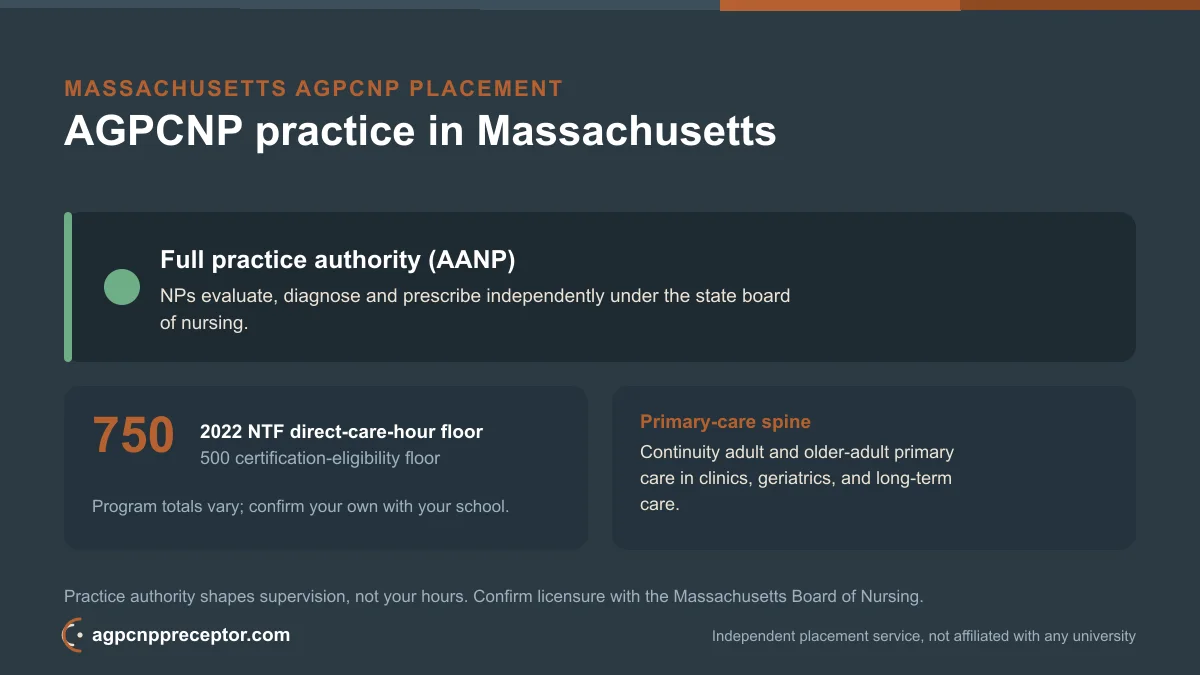
The American Association of Nurse Practitioners classifies Massachusetts as a full practice authority state. Since the start of 2021, nurse practitioners can evaluate, diagnose, treat, and prescribe within their certified scope without a standing collaborative agreement, once they have completed a supervised transition period. Newly licensed NPs practice under supervision from a qualified physician or an independent-practice NP for a defined early stretch before moving to full independence.
For placement, that matters in one practical way. An experienced adult-gerontology or family primary-care NP can serve as your preceptor and sign off on your hours on their own, with no physician co-signer folded into the arrangement. That widens the pool of possible preceptors compared with a reduced or restricted state. Your preceptor is generally a board-certified A-GNP or AGPCNP-BC, a family NP, or a physician in internal medicine, family medicine, or geriatrics, according to your program's rules. Confirm current licensure specifics with the Massachusetts Board of Registration in Nursing.
The hours that are hardest to line up
Most adult care in Massachusetts sits in general internal medicine and family practice, so ambulatory continuity time, while competitive, is the more available piece. The scarce piece is dedicated geriatrics and hands-on long-term-care hours. There are fewer fellowship-trained geriatricians and geriatric NPs than the aging population needs, and the ones in practice cluster in academic centers and the larger PACE and senior-care organizations.
That is why students who wait until late in the program to chase frail-elder hours tend to struggle. If your plan needs genuine nursing-home, assisted-living, or home-based long-term-care time, reserve it first, especially outside Greater Boston where the pool is smaller and a longer drive is often part of the answer.
Pinning down the hours your program expects
Massachusetts does not set your clinical-hour total; your program and its accreditor do. The 2022 National Task Force standards recommend a minimum of 750 direct patient care hours, while AANP and ANCC certification eligibility requires at least 500 supervised hours. Accredited AGPCNP programs publish totals across a range, commonly from about 500 to 750 or more, and many sit below 750. Simulation does not count toward direct patient care.
Confirm your own number early, because it decides how many settings you need to string together to finish. Our clinical hours guide walks through how the continuity and geriatric pieces add up.
Securing your Massachusetts placement
Tell us your program, the part of the state you can reach, and the mix of continuity and geriatric hours you still owe. We source and vet a qualified primary-care preceptor, confirm they meet your school's requirements, and work the affiliation-agreement paperwork so you are not cold-calling clinics and nursing homes between shifts. See how it works and our pricing for the full picture.
Start with the match form below or reach out. We are independent, we serve students at any university, and we help you place without ever guaranteeing a site or your school's approval of a preceptor.
Good to know
Does full practice authority make it easier to find an AGPCNP preceptor in Massachusetts?
It helps. Because an experienced adult-gerontology or family primary-care NP can precept and sign your hours without a physician co-signer, the pool of eligible preceptors is wider than in a reduced or restricted state. Geography and each preceptor's available time still shape your search more day to day.
I live on Cape Cod or in western Massachusetts. Can I do my hours locally?
Often the continuity primary-care hours, yes, since community health centers and family practices operate there. The harder part is dedicated geriatrics, since those preceptors are thinner outside Greater Boston, so some students plan a block nearer a larger senior-care or PACE program. We help map that.
Who can serve as my preceptor here?
Generally a board-certified adult-gerontology or family primary-care NP (A-GNP or AGPCNP-BC), or a physician in internal medicine, family medicine, or geriatrics, practicing in a setting that matches your rotation. Your program sets the exact rule, so check its preceptor form before you commit.
How many clinical hours will I need in Massachusetts?
The state does not set it; your program does. The 2022 NTF standards recommend at least 750 direct-care hours and certification eligibility requires at least 500, and accredited programs vary, with many under 750. Confirm your exact total with your school.
Do you only work with one university's students?
No. We are independent of every school. We place Adult-Gerontology Primary Care NP students from any accredited program and match preceptors to your program's requirements.
Secure both ends of the arc, not just one
Tell us your school, your city, and the hours you still need across the continuum. We will come back with a plan that reaches from continuity primary care to genuine frail-elder exposure, and a realistic path to placed.